Featured Cabins
Itinerary
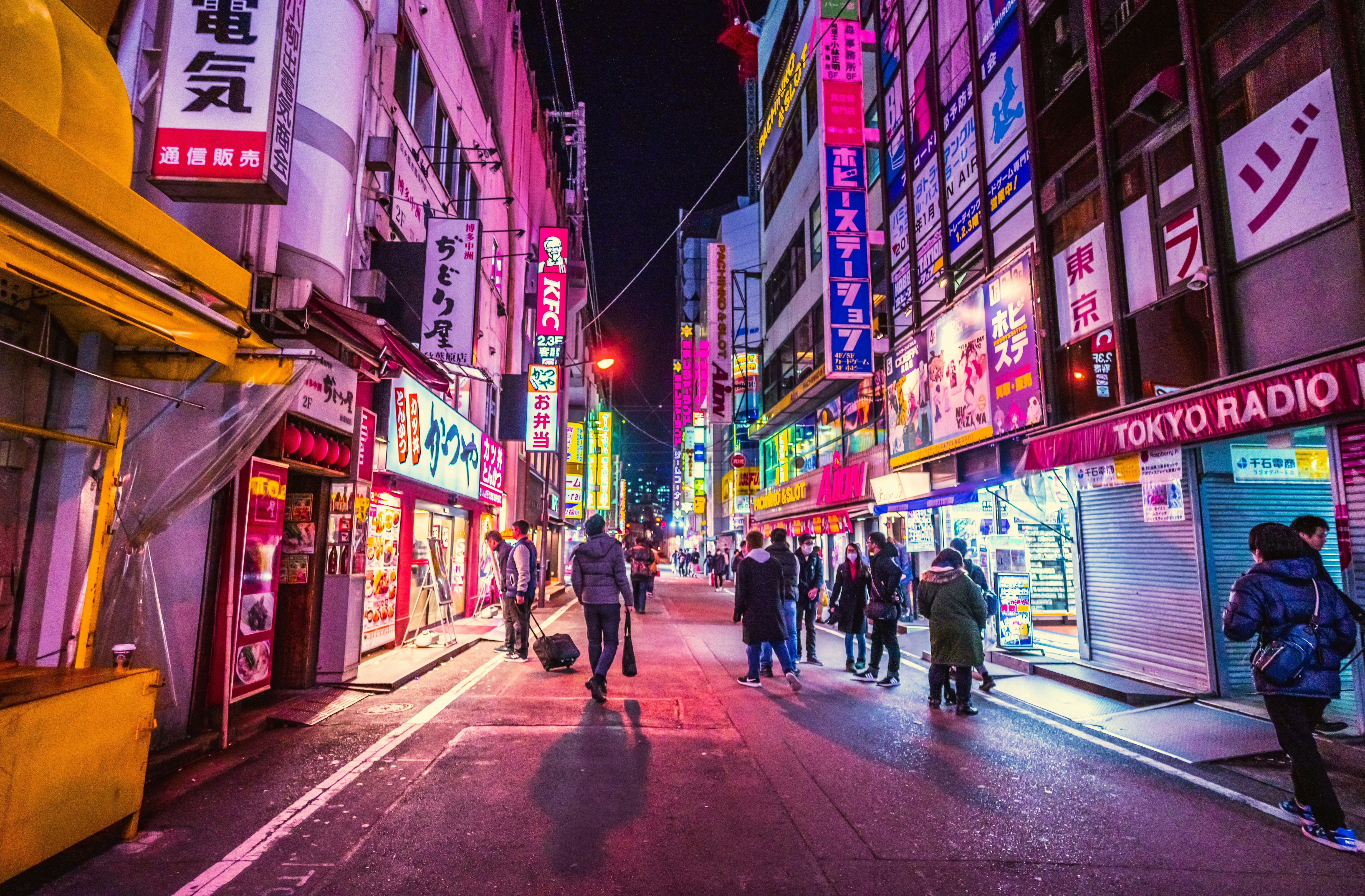
Tokyo, Japan
Lights, sushi, manga! Sprawling, frenetic, and endlessly fascinating, Japan’s capital is a city of contrasts. Shrines and gardens are pockets of calm between famously crowded streets and soaring office buildings. Mom-and-pop noodle houses share street space with Western-style chain restaurants and exquisite fine dining. Shopping yields lovely folk arts as well as the newest electronics. And nightlife kicks off with karaoke or sake and continues with techno clubs and more. Whether you seek the traditional or the cutting edge, Tokyo will provide it.
Shimizu, Japan
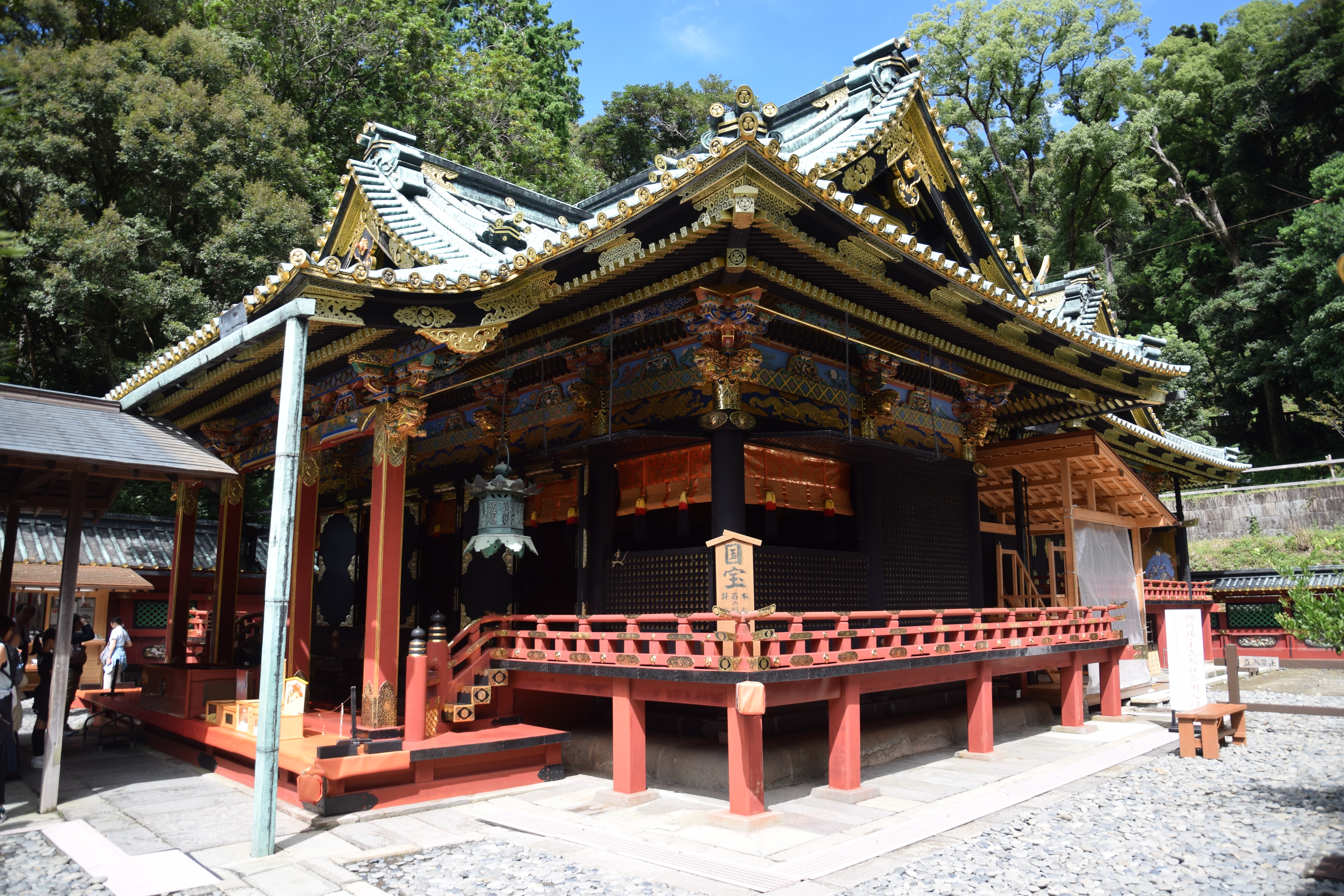
The salt and pepper cone of Japan’s most famous natural landmark won’t fail to take your breath away, as it soars into the sky in a vision of spectacular symmetry. Make sure your camera is fully prepared before you dock in Shimizu’s port, where unparalleled views of the extraordinary Mount Fuji’s dramatic peak await. Take your time to soak up one of Japan’s most iconic views, before dipping your toes into the rest of what this destination of tranquil temples has to offer. While there’s a bustling fish market, and a charming amusement park waiting close to the port, most new arrivals immediately set off in pursuit of the best views of Mount Fuji, or to see the stunning panorama on offer from the heights of the Kunozan Toshogu Shrine. Take the cable car up to the top, to experience the tranquillity around the forested shrine, and to enjoy its stunning architecture of deep scarlets and gleaming golds. You can also enjoy heart-stopping views out over the Bay of Suruga, and the tea plantations below.
Kobe, Japan
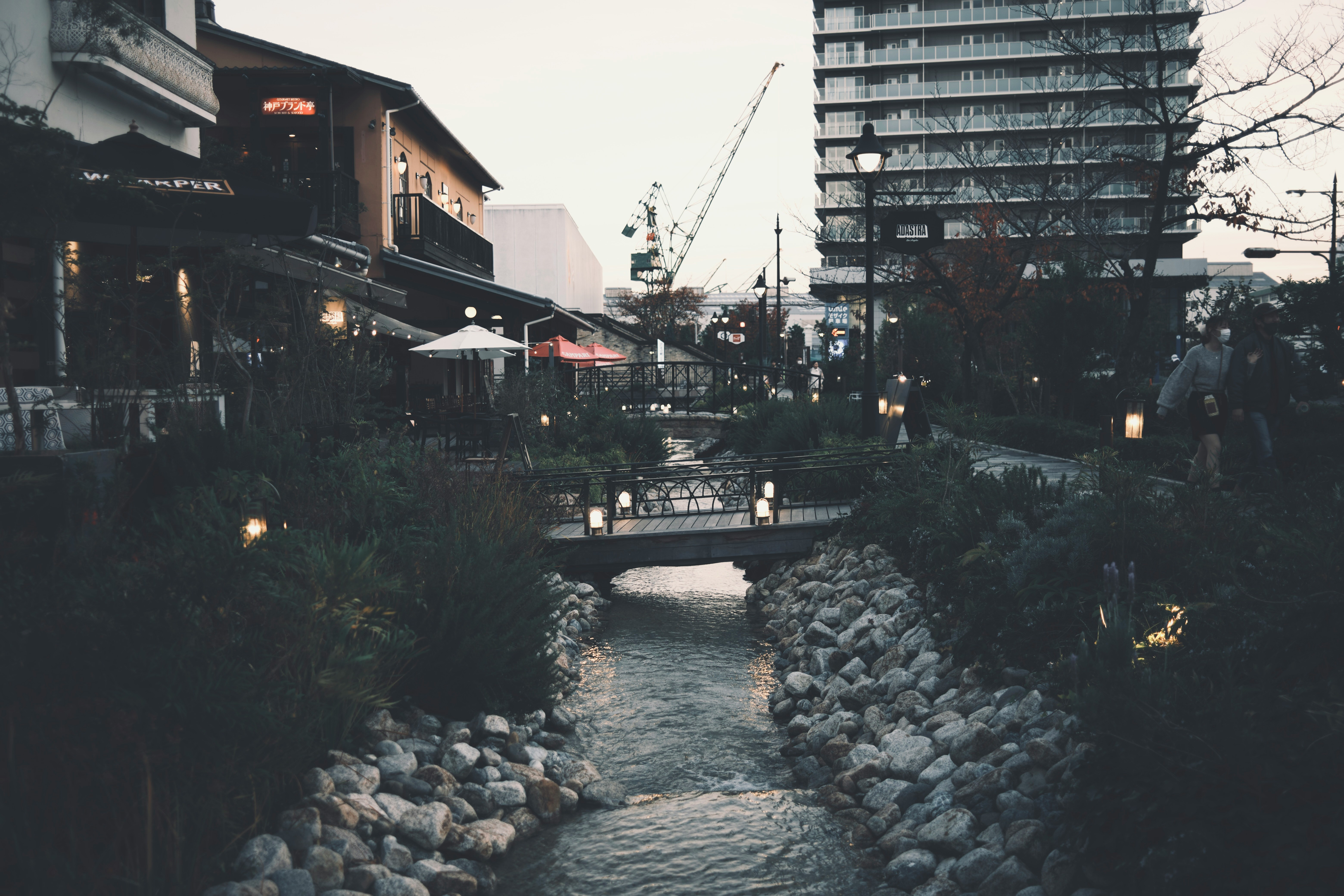
Located on the calm waters of the Inland Sea, Kobe has served as an important port town for hundreds of years. It was one of the first harbours to accept foreign traders in 1868 when Japan was just emerging from its centuries of isolation. What followed was a surge of Western trade and exports. Today, Kobe is quite multicultural, with expatriates from 98 different nations in residence, providing a cultural diversity most easily visible in restaurants serving every kind of cuisine, including the now world famous Kobe beef. The Great Hanshin Earthquake of 1995 set back Kobe’s development, but not for long. Kobe emerged more vibrant than before – with additional attractions, hotels and urban redevelopment, and only a few remnants of the extensive damage. It is a cosmopolitan place with lively shopping arcades, interesting museums, great restaurants, and a port that is still at the heart of things. Kobe is well known for its nightlife, in an intimate quarter of neon lights, cosy bars and sophisticated nightclubs. It also serves as the gateway to the ancient Japanese capitals of Kyoto and Nara.
Kobe, Japan
Located on the calm waters of the Inland Sea, Kobe has served as an important port town for hundreds of years. It was one of the first harbours to accept foreign traders in 1868 when Japan was just emerging from its centuries of isolation. What followed was a surge of Western trade and exports. Today, Kobe is quite multicultural, with expatriates from 98 different nations in residence, providing a cultural diversity most easily visible in restaurants serving every kind of cuisine, including the now world famous Kobe beef. The Great Hanshin Earthquake of 1995 set back Kobe’s development, but not for long. Kobe emerged more vibrant than before – with additional attractions, hotels and urban redevelopment, and only a few remnants of the extensive damage. It is a cosmopolitan place with lively shopping arcades, interesting museums, great restaurants, and a port that is still at the heart of things. Kobe is well known for its nightlife, in an intimate quarter of neon lights, cosy bars and sophisticated nightclubs. It also serves as the gateway to the ancient Japanese capitals of Kyoto and Nara.
Kochi, India
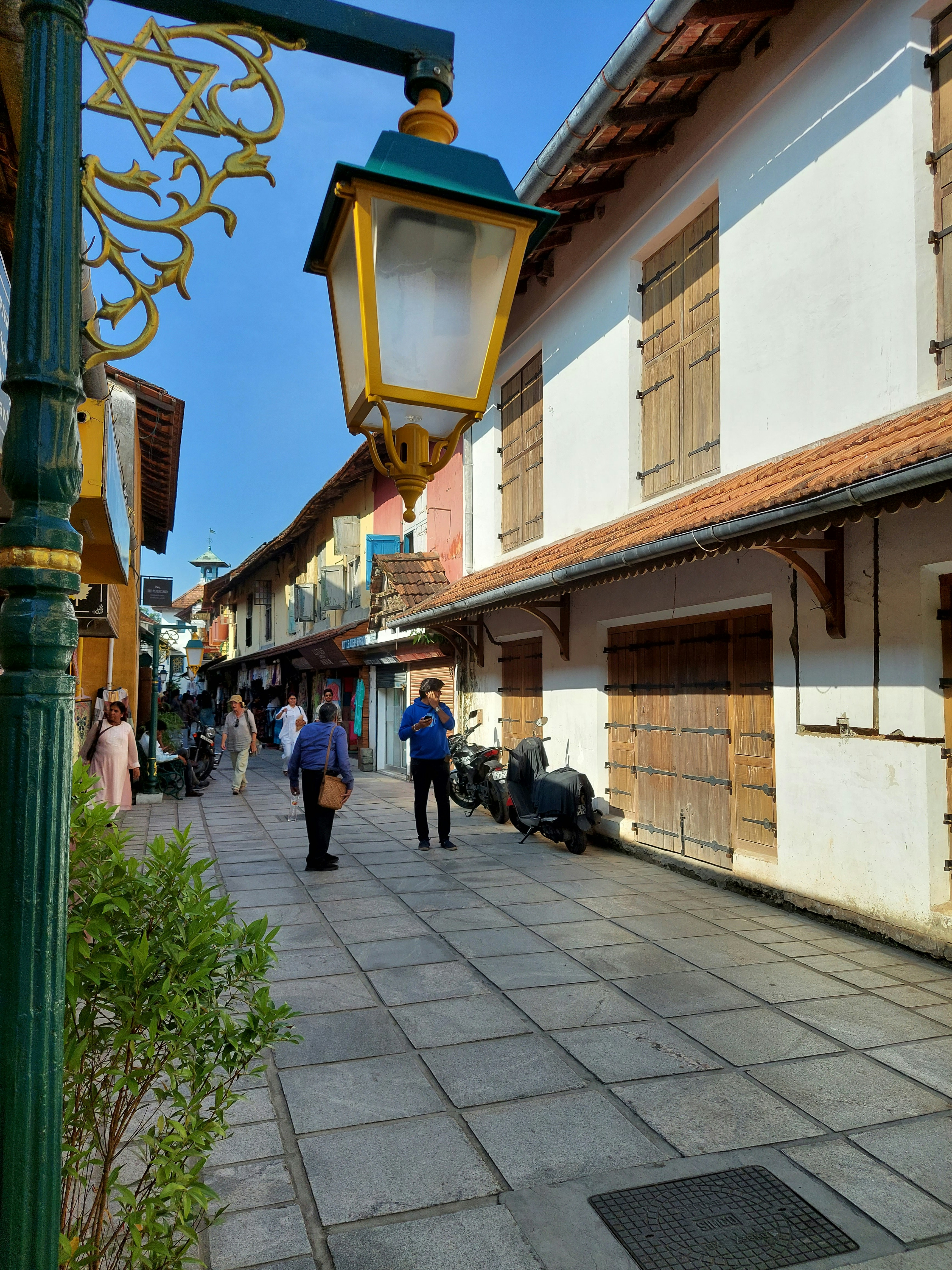
Hiroshima, Japan
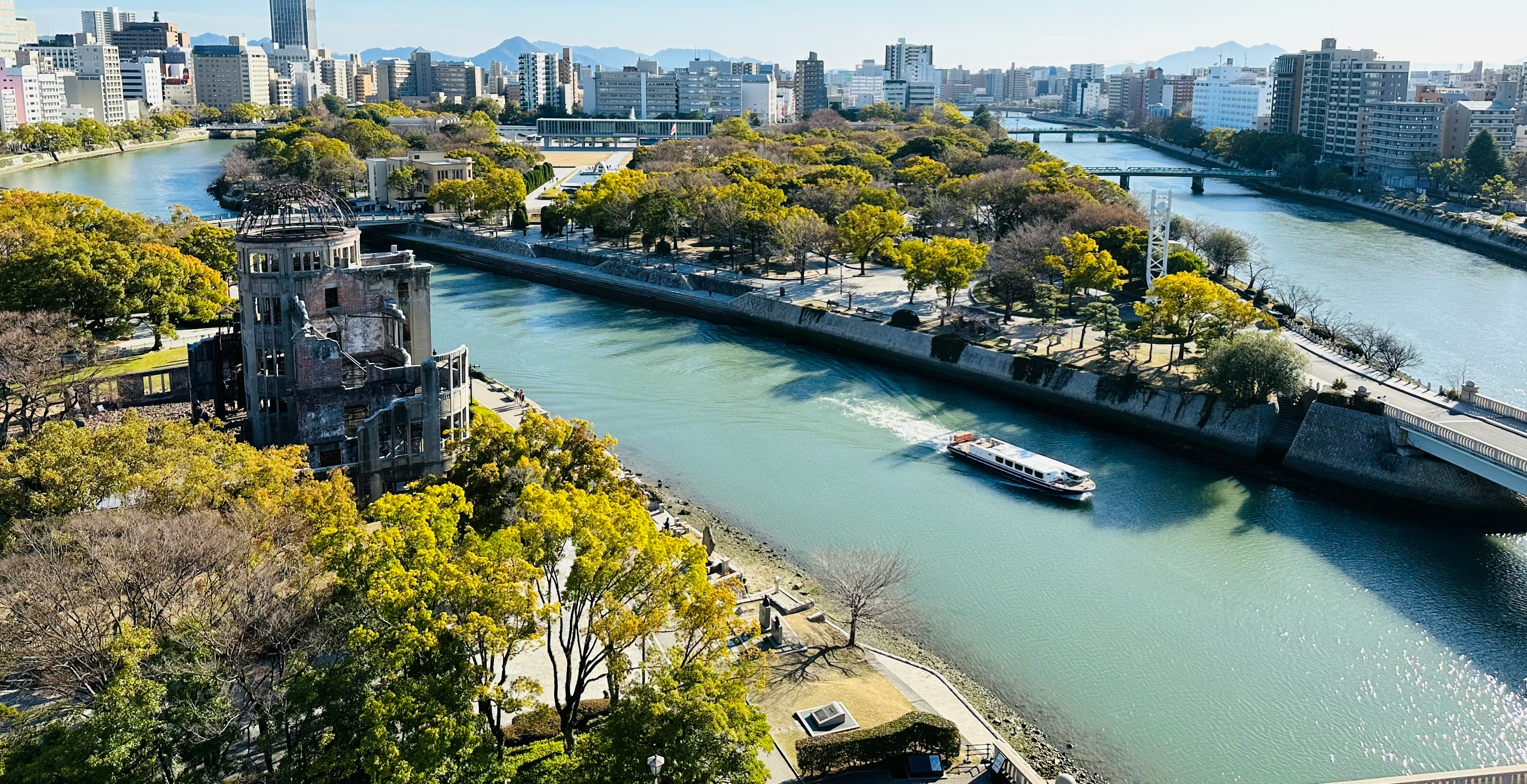
History buffs will want to write home Hiroshima. Despite being devastated in 1945, this Japanese city is known to all for its commitment peace – its ruin on the 6th August 1945 led to the end of the war and today, the Peace Memorial (a UNESCO World Heritage Site) , is a constant reminder of the destruction that war brings. A walk in the leafy boulevards of Peace Memorial Park brings quiet contemplation. The Flames of Peace – set in the park’s central feature pond – burn brightly and will continue to do so until all the nuclear bombs I the world have been destroyed. There are many other inspiring messages of hope around the city too; the Children’s’ Peace Monument just north of the park is a homage to little Sadako Sasaki, who was just two in 1945. When she developed leukemia in 1956, she believed that if she folded 1,000 paper cranes – a symbol of longevity and happiness in Japan – she would recover. Sadly she died before she finished her task but her classmates finished the rest. It is impossible to ignore the events of 1945 in Hiroshima, but this is far from a depressing place. The great efforts that have been made in rebuilding of the city over the years have given Hiroshima a vibrant, eclectic edge, with the downtown shopping area and street food stalls being well worth a visit. The proximity to Miyajima and its iconic, impressive, Torii gate should not be overlooked either. If you are lucky enough to visit during the unpredictable and short-lived Sakura (cherry blossom) season, then the extraordinary sight of the delicate pink blossom floating across the water to the red gate, means you can consider yourself one of the luckiest people on the planet.
Cruise Kanmon Strait
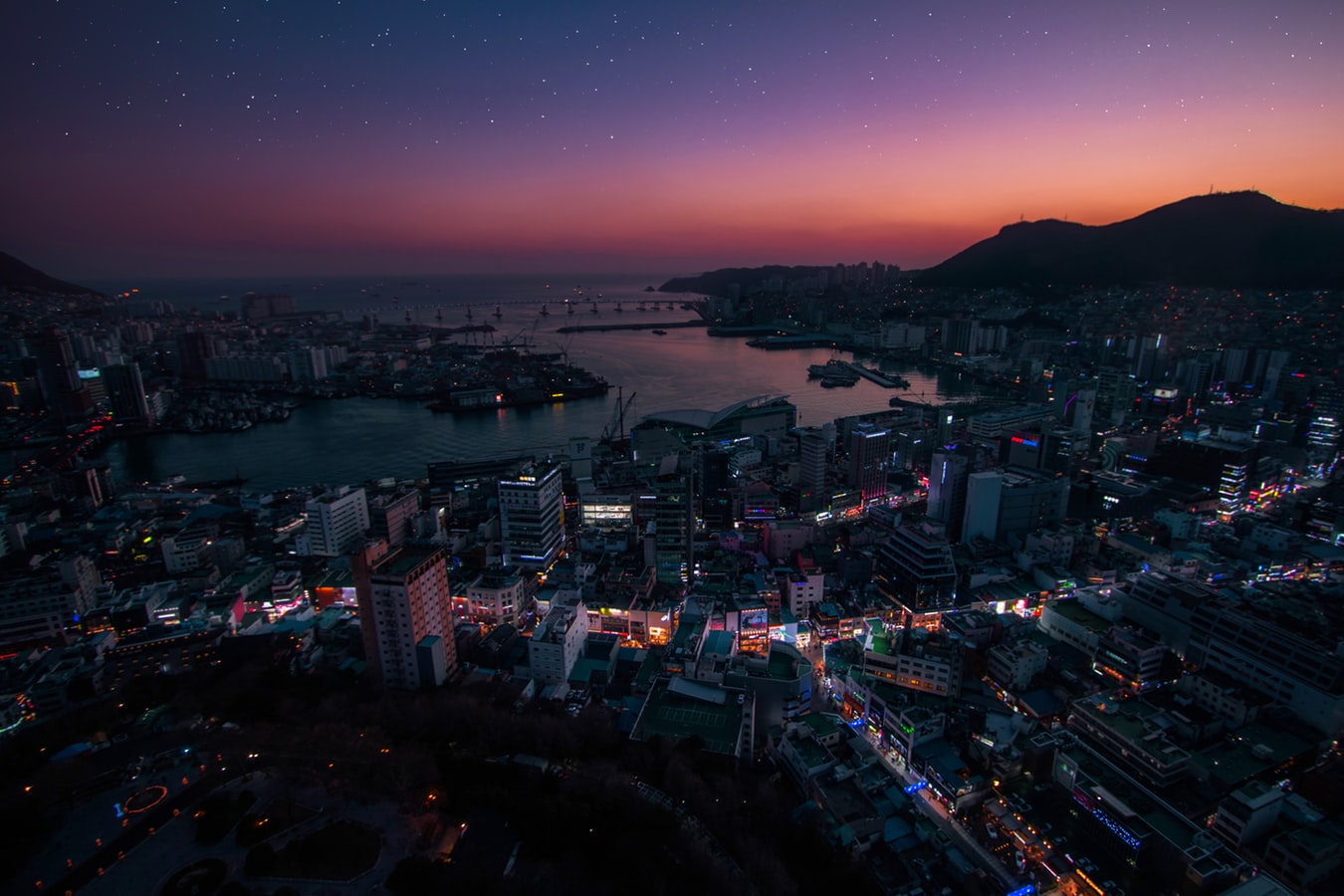
Busan, South Korea
White-sand city beaches and hot-spring resorts may not be everyone’s first image of Korea, but these are what Koreans flock to Busan for all year. And there are plenty of opportunities for rest, relaxation, retail therapy, and even a touch of glamour every October with the Busan International Film Festival. Busan’s beaches are the big summertime draw but there is plenty to be seen year round. Quintessential experiences include taking some rest and relaxation at a local spa and exploring the Beomeosa temple complex.
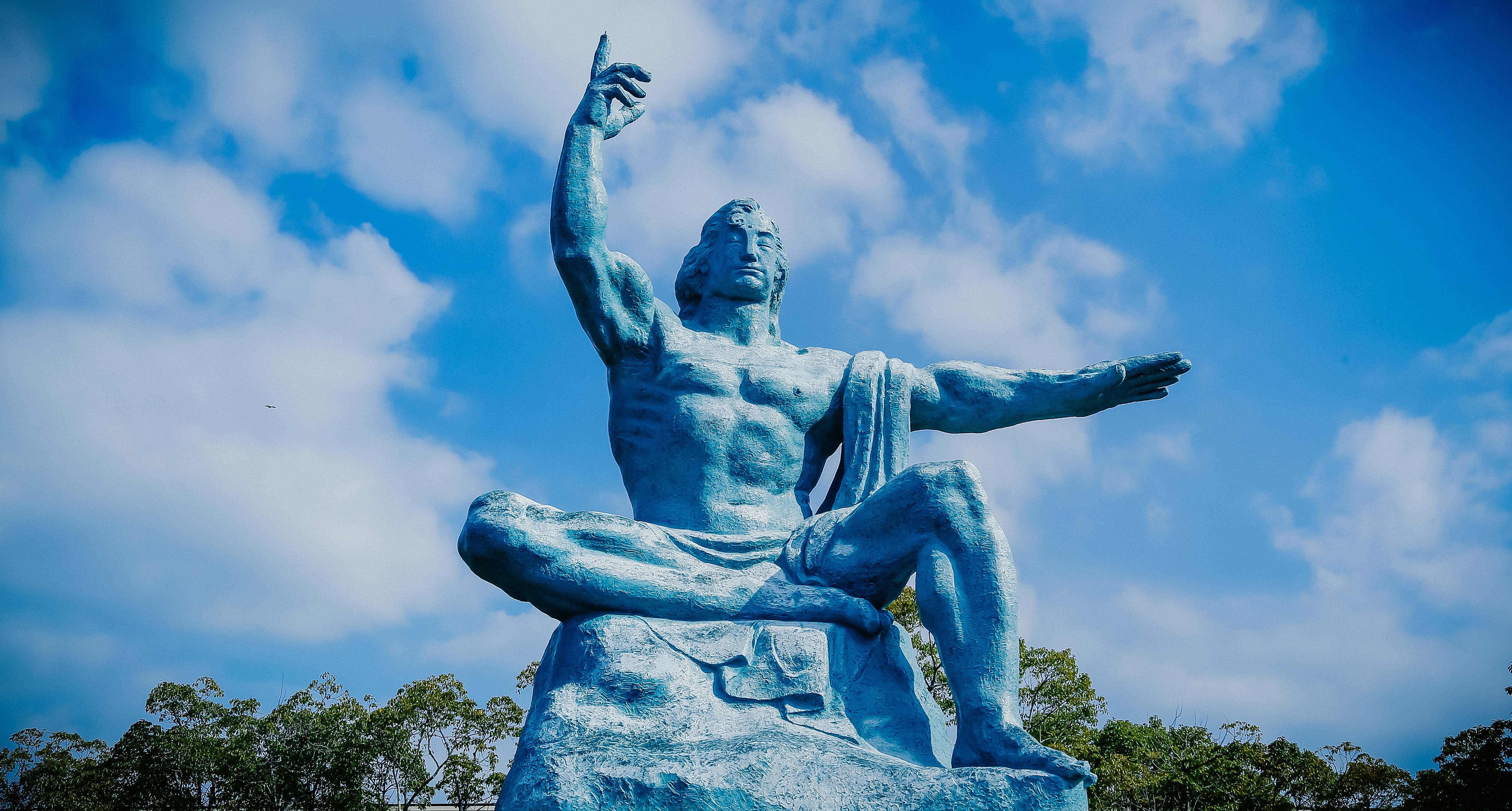
Nagasaki, Japan
Nagasaki city has developed into one of the most important port cities in Japan. During Japan’s period of isolation in the 17th century, Nagasaki played a prominent role in foreign trade relation and only a very few ports were open to restricted numbers of foreign traders. Even though Holland was a major country who conducted trading during this period, Dutch people were only allowed to stay in Dejima Island and were not allowed to have contact with the Japanese people. Today, you will still find the strong influence of Dutch and Chinese culture in the city which is very different from all other cities in Japan. In the more recent history, Nagasaki became the second city after Hiroshima to be destroyed by an atomic bomb towards the end of World War II. From the visit to Atomic bomb museum and peace memorial park, people could understand how chaotic the situation was and the agony that the people in the days have experienced from the damage inflicted by the atomic bomb. It continues to appeal to the world with their wish for world peace.
Kagoshima, Japan
Kagoshima city is the capital of Kagoshima prefecture and also Kyushu’s southernmost major city. This city is often compared to its Italian sister city Naples, due to its’s similarities such as mild climate and active volcano, Sakurajima. Sakurajima is one of the most renowned active volcanos not only in Japan but also in the whole entire world. This smoking Sakurajima is centred in Kinko Bay and is one of the main symbols of this prefecture. We cannot talk about Sakurajima without the history of continuous eruption. Sakurajima used to be an isolated island; however, the land has banded together with Osumi peninsula from the eruption in 1914. You may have a chance to see the smoke coming from the top of Sakurajima depending on the weather condition. Not only does the scenery of Sakurajima represent the beauty of Kagoshima City but Senganen garden is also symbolic to elegance in the Kagoshima region. This Japanese garden was constructed by a feudal lord, Mitsuhisa Shimazu, as a guest house of the Kagoshima castle which attracts many visitors for its splendid view.

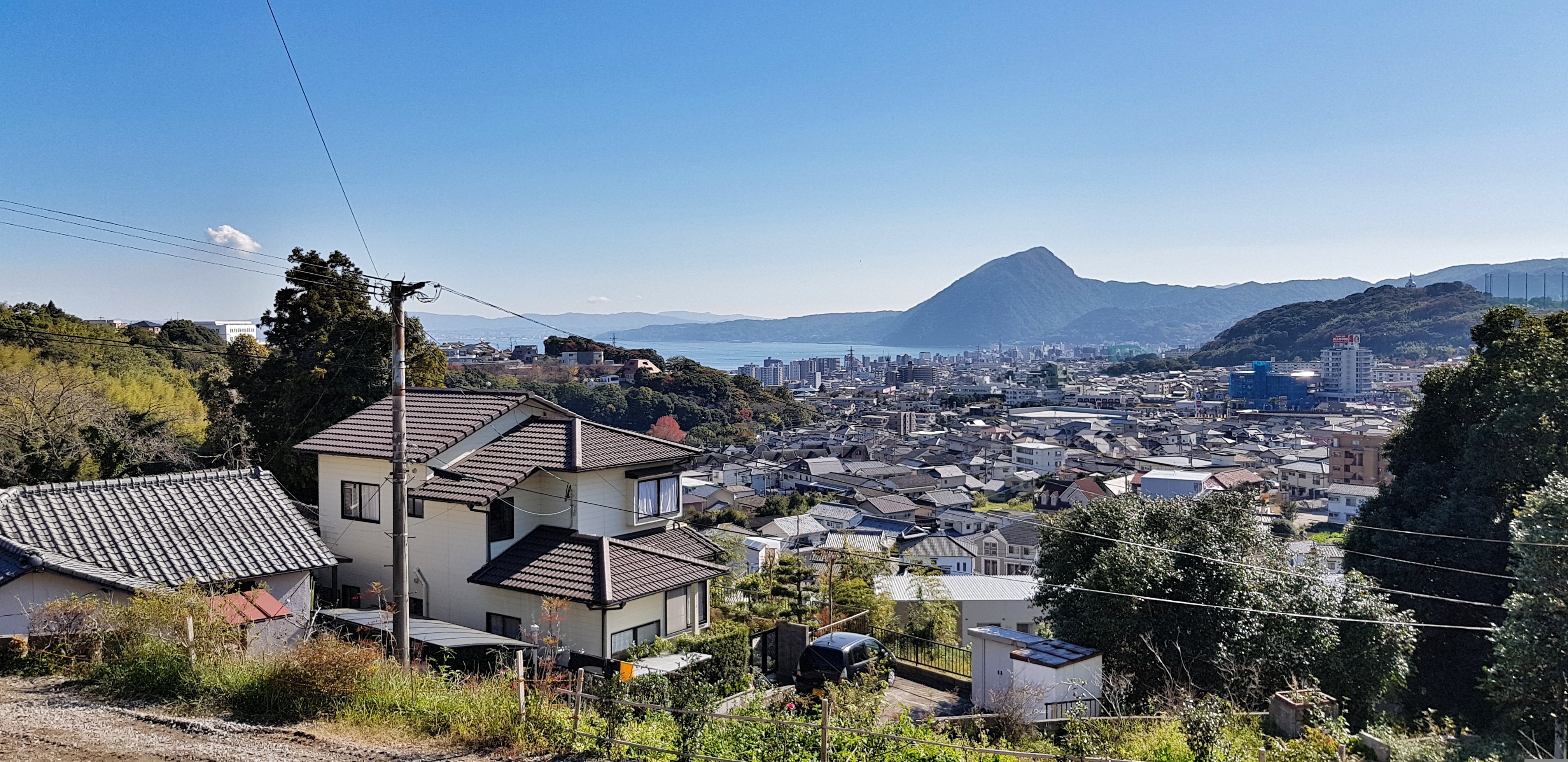
Beppu, Kyushu Island, Oita, Japan
Cruising the Pacific Ocean
Tokyo, Japan
Lights, sushi, manga! Sprawling, frenetic, and endlessly fascinating, Japan’s capital is a city of contrasts. Shrines and gardens are pockets of calm between famously crowded streets and soaring office buildings. Mom-and-pop noodle houses share street space with Western-style chain restaurants and exquisite fine dining. Shopping yields lovely folk arts as well as the newest electronics. And nightlife kicks off with karaoke or sake and continues with techno clubs and more. Whether you seek the traditional or the cutting edge, Tokyo will provide it.
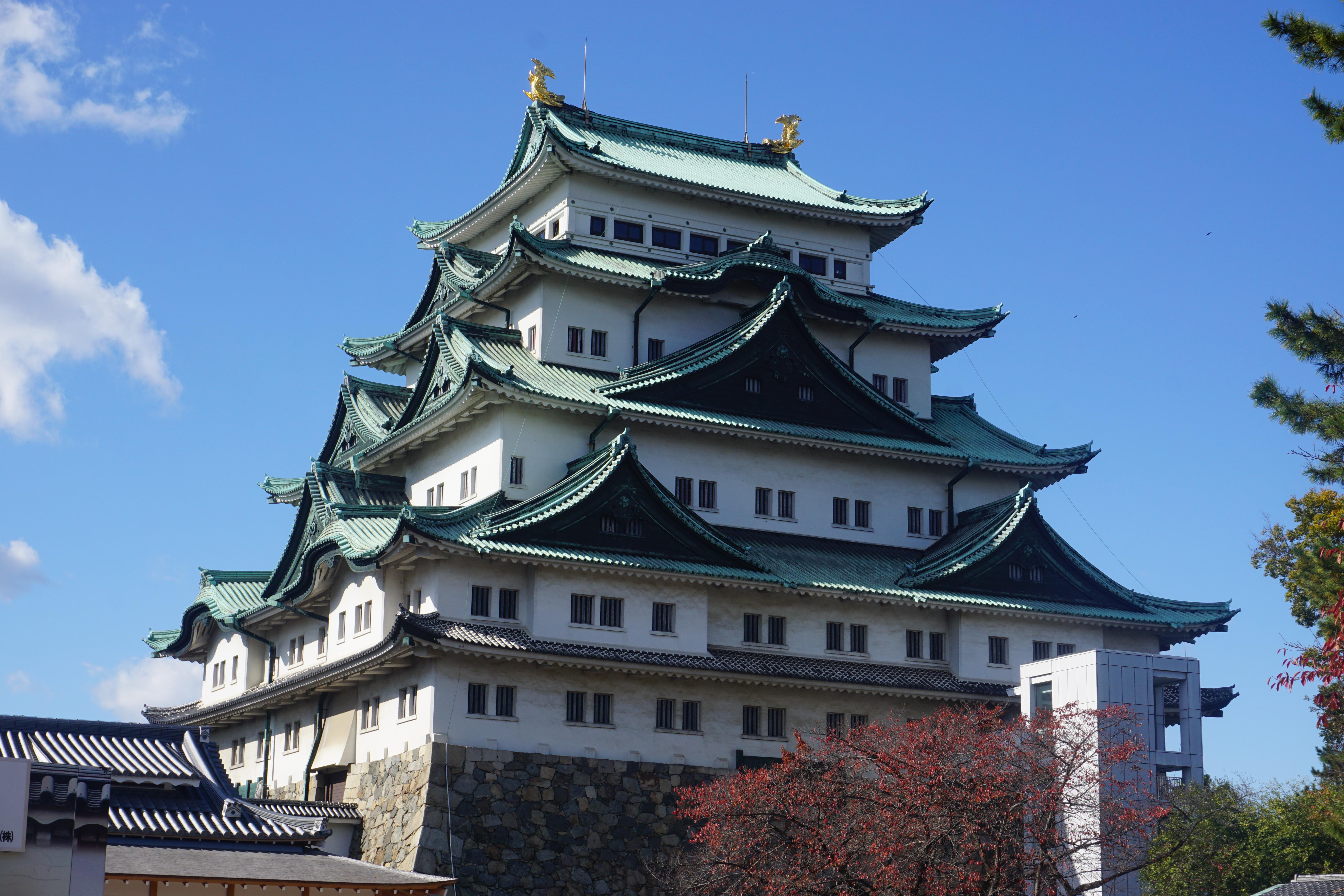
Nagoya, Japan
Osaka, Japan
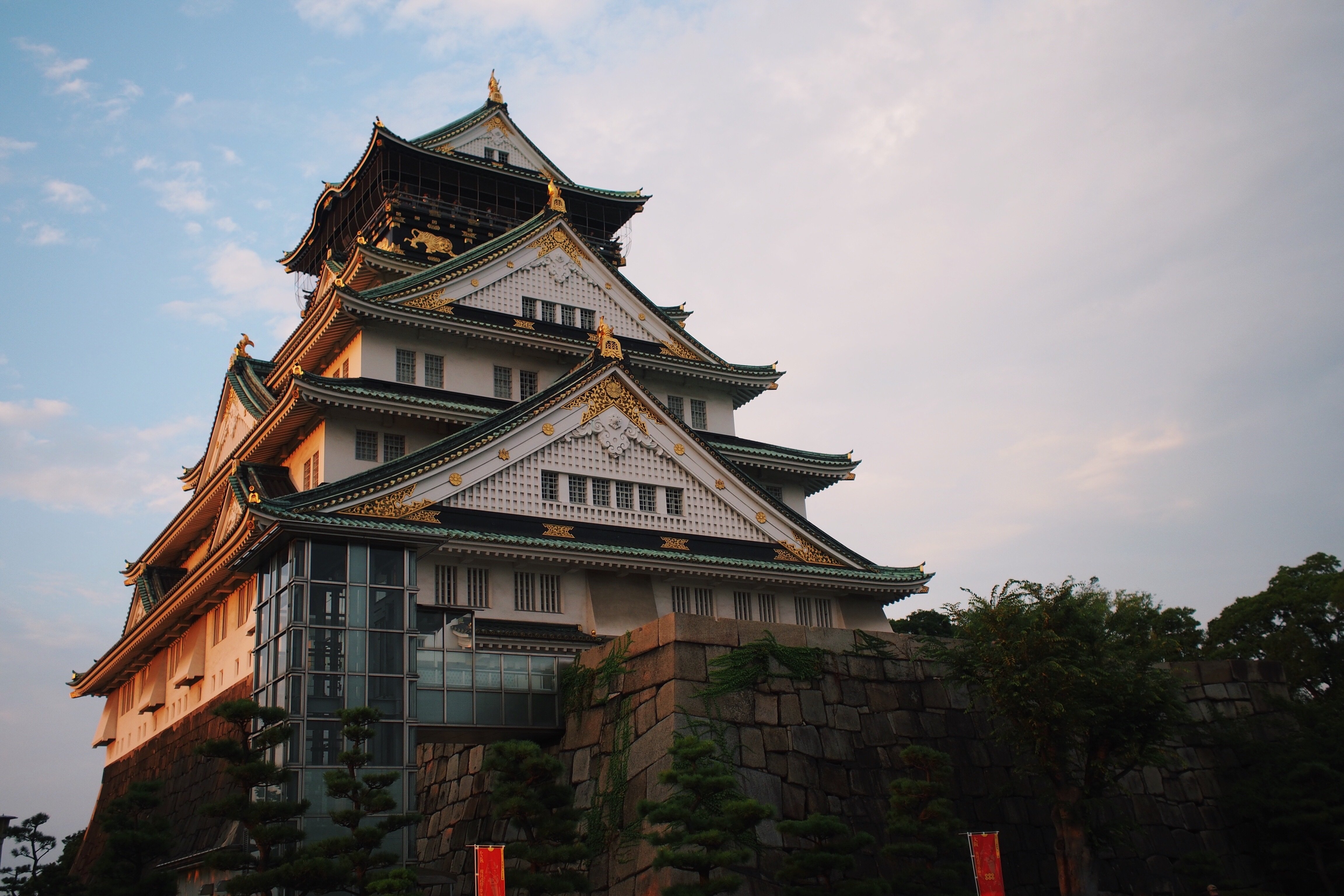
From Minami’s neon-lighted Dotombori and historic Tenno-ji to the high-rise class and underground shopping labyrinths of Kita, Osaka is a city that pulses with its own unique rhythm. Though Osaka has no shortage of tourist sites, it is the city itself that is the greatest attraction. Home to some of Japan’s best food, most unique fashions, and warmest locals, Osaka does not beg to be explored—it demands it. More than anywhere else in Japan, it rewards the impulsive turn down an interesting side street or the chat with a random stranger. People do not come here to see the city, they come to experience it.Excluded from the formal circles of power and aristocratic culture in 16th-century Edo (Tokyo), Osaka took advantage of its position as Japan’s trading center, developing its own art forms such as Bunraku puppet theater and Rakugo comic storytelling. It was in Osaka that feudal Japan’s famed Floating World—the dining, theater, and pleasure district—was at its strongest and most inventive. Wealthy merchants and common laborers alike squandered fortunes on culinary delights, turning Osaka into “Japan’s Kitchen,” a moniker the city still has today. Though the city suffered a blow when the Meiji government canceled all of the samurai class’s outstanding debts to the merchants, it was quick to recover. At the turn of the 20th century, it had become Japan’s largest and most prosperous city, a center of commerce and manufacturing.Today Osaka remains Japan’s iconoclastic metropolis, refusing to fit Tokyo’s norms and expectations. Unlike the hordes of Tokyo, Osakans are fiercely independent. As a contrast to the neon and concrete surroundings, the people of Osaka are known as Japan’s friendliest and most outgoing. Ask someone on the street for directions in Tokyo and you are lucky to get so much as a glance. Ask someone in Osaka and you get a conversation.The main areas of the city, Kita (north) and Minami (south), are divided by two rivers: the Dojima-gawa and the Tosabori-gawa. Between Kita and Minami is Naka-no-shima, an island and the municipal center of Osaka. Kita (north of Chuo Dori) is Osaka’s economic hub and contains Osaka’s largest stations: JR Osaka and Hankyu Umeda. The area is crammed with shops, department stores, and restaurants. Nearby are a nightlife district, Kita-shinchi; Naka-no-shima and the Museum of Oriental Ceramics; Osaka-jo (Osaka Castle); and Osaka Koen (Osaka Park). Restaurants, bars, department stores, and boutiques attract Osaka’s youth to Minami (south Chuo Dori); theatergoers head to the National Bunraku Theatre and electronics-lovers to Den Den Town. For a glimpse of old Osaka, visit Tenno-ji Temple and Shin Sekai. The main stations are Namba, Shin-sai-bashi, Namba Nankai, and Tenno-ji. There’s easy access to the Municipal Museum of Fine Art and Sumiyoshi Taisha (Sumiyoshi Grand Shrine).The bay area, to the west of the city center, is home to the Osaka Aquarium and Universal Studios Japan. The Shinkansen stops at Shin-Osaka, three stops (about five minutes) north of Osaka Station on the Mido-suji subway line. To the north of Shin-Osaka is Senri Expo Park.
Osaka, Japan
From Minami’s neon-lighted Dotombori and historic Tenno-ji to the high-rise class and underground shopping labyrinths of Kita, Osaka is a city that pulses with its own unique rhythm. Though Osaka has no shortage of tourist sites, it is the city itself that is the greatest attraction. Home to some of Japan’s best food, most unique fashions, and warmest locals, Osaka does not beg to be explored—it demands it. More than anywhere else in Japan, it rewards the impulsive turn down an interesting side street or the chat with a random stranger. People do not come here to see the city, they come to experience it.Excluded from the formal circles of power and aristocratic culture in 16th-century Edo (Tokyo), Osaka took advantage of its position as Japan’s trading center, developing its own art forms such as Bunraku puppet theater and Rakugo comic storytelling. It was in Osaka that feudal Japan’s famed Floating World—the dining, theater, and pleasure district—was at its strongest and most inventive. Wealthy merchants and common laborers alike squandered fortunes on culinary delights, turning Osaka into “Japan’s Kitchen,” a moniker the city still has today. Though the city suffered a blow when the Meiji government canceled all of the samurai class’s outstanding debts to the merchants, it was quick to recover. At the turn of the 20th century, it had become Japan’s largest and most prosperous city, a center of commerce and manufacturing.Today Osaka remains Japan’s iconoclastic metropolis, refusing to fit Tokyo’s norms and expectations. Unlike the hordes of Tokyo, Osakans are fiercely independent. As a contrast to the neon and concrete surroundings, the people of Osaka are known as Japan’s friendliest and most outgoing. Ask someone on the street for directions in Tokyo and you are lucky to get so much as a glance. Ask someone in Osaka and you get a conversation.The main areas of the city, Kita (north) and Minami (south), are divided by two rivers: the Dojima-gawa and the Tosabori-gawa. Between Kita and Minami is Naka-no-shima, an island and the municipal center of Osaka. Kita (north of Chuo Dori) is Osaka’s economic hub and contains Osaka’s largest stations: JR Osaka and Hankyu Umeda. The area is crammed with shops, department stores, and restaurants. Nearby are a nightlife district, Kita-shinchi; Naka-no-shima and the Museum of Oriental Ceramics; Osaka-jo (Osaka Castle); and Osaka Koen (Osaka Park). Restaurants, bars, department stores, and boutiques attract Osaka’s youth to Minami (south Chuo Dori); theatergoers head to the National Bunraku Theatre and electronics-lovers to Den Den Town. For a glimpse of old Osaka, visit Tenno-ji Temple and Shin Sekai. The main stations are Namba, Shin-sai-bashi, Namba Nankai, and Tenno-ji. There’s easy access to the Municipal Museum of Fine Art and Sumiyoshi Taisha (Sumiyoshi Grand Shrine).The bay area, to the west of the city center, is home to the Osaka Aquarium and Universal Studios Japan. The Shinkansen stops at Shin-Osaka, three stops (about five minutes) north of Osaka Station on the Mido-suji subway line. To the north of Shin-Osaka is Senri Expo Park.
Cruising the Philippine Sea
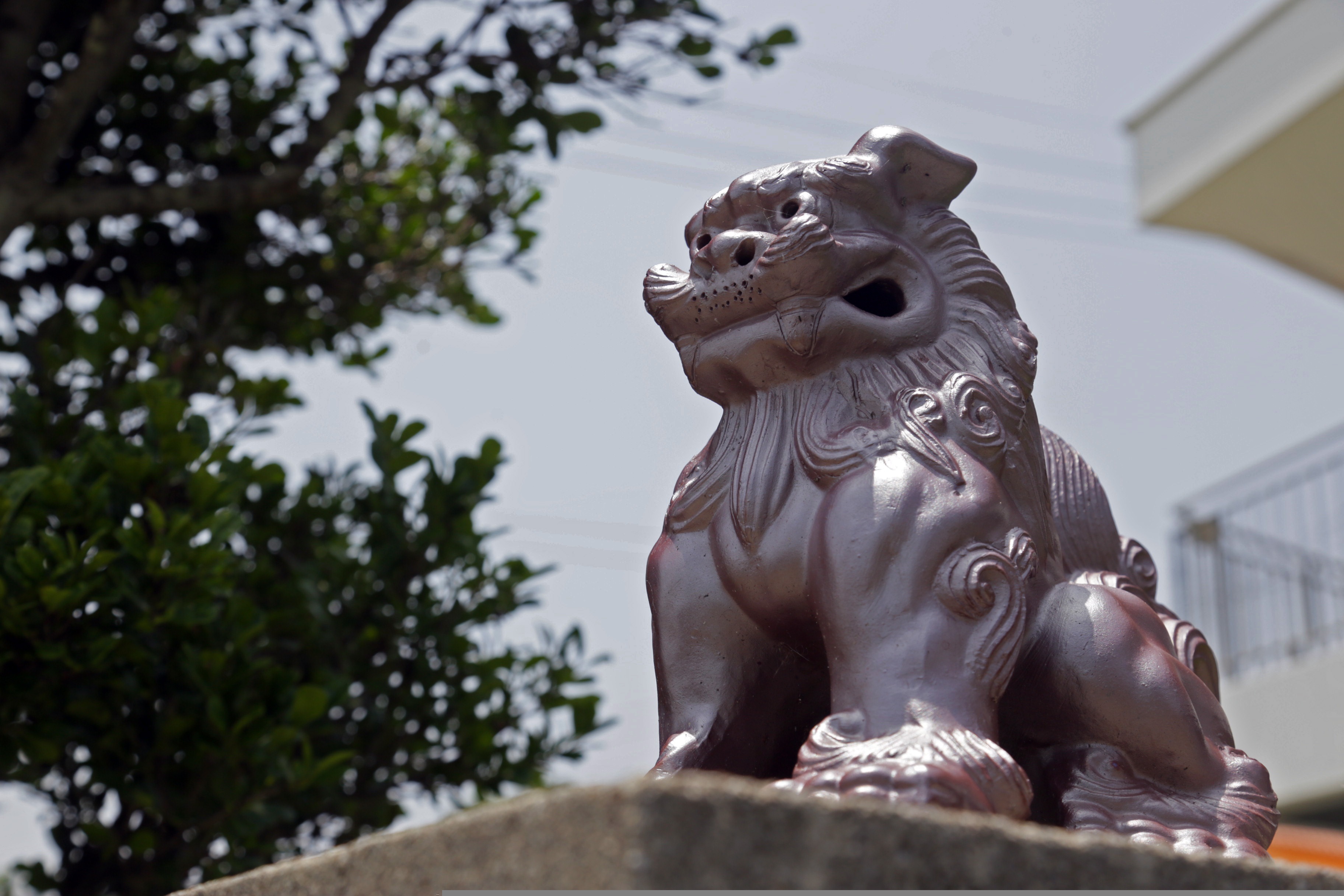
Naha, Okinawa, Japan
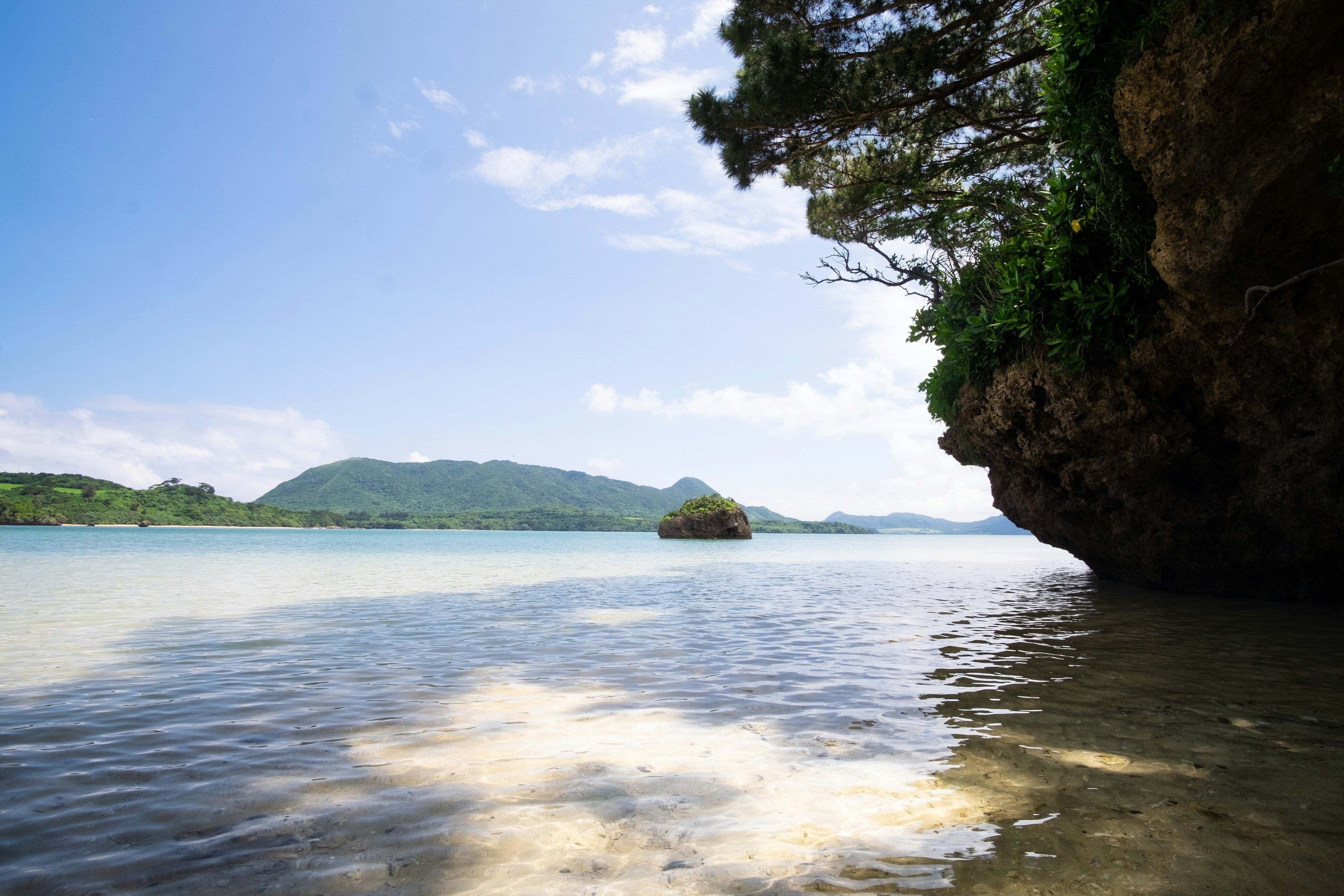
Ishigaki, Japan
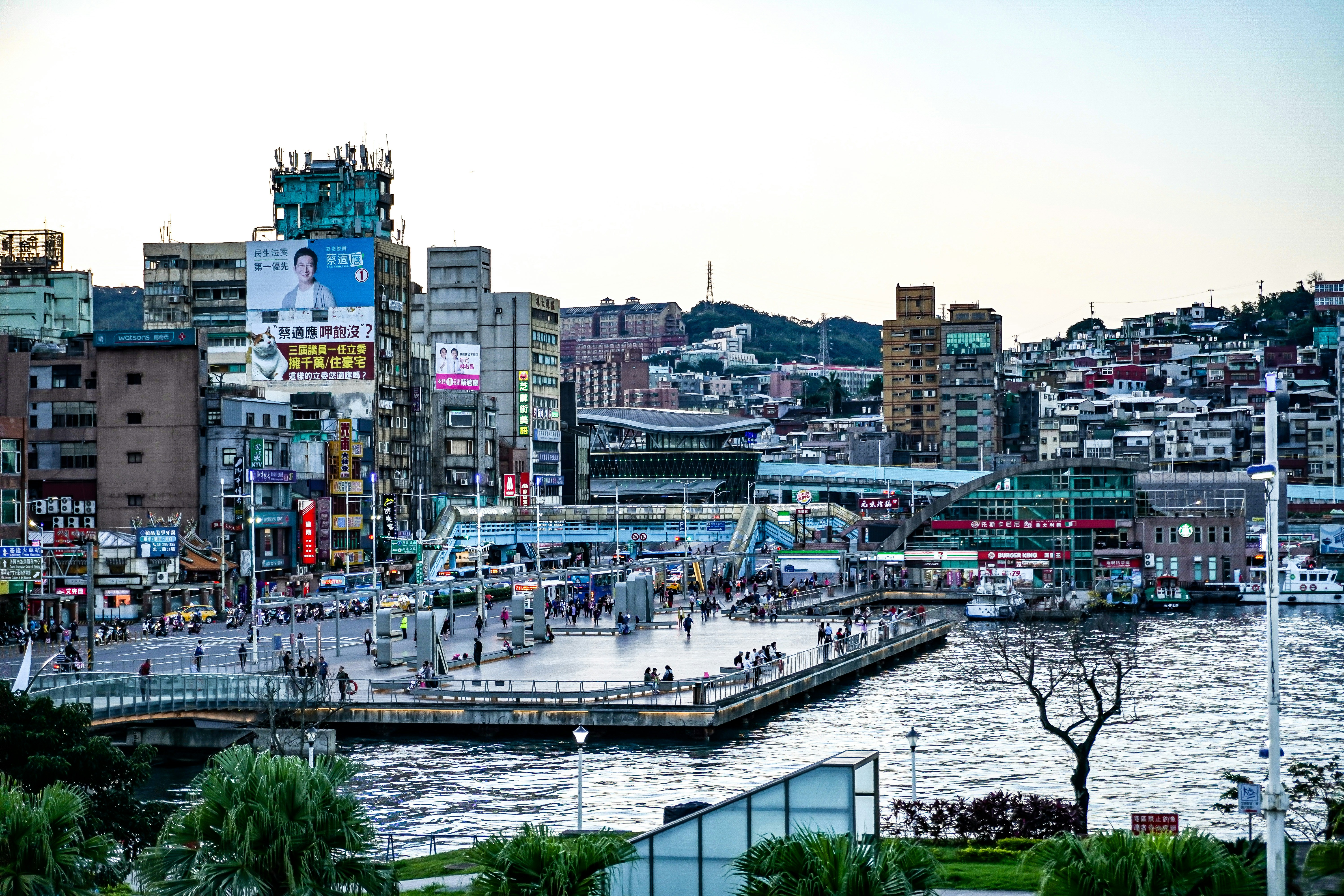
Keelung (Chilung), Taiwan
With the glittering lights of Taipei – a futuristic metropolis of culture and ideas – sparkling nearby, Keelung is the first calling point for many visitors arriving in Taiwan. While this port city essentially serves as Taipei’s ocean gateway, you shouldn’t be too hasty in dashing off to Taipei’s neon-lit magic – first it’s well worth spending some time exploring the famous glowing night market, which hums with life each evening and is famous for its local seafood.
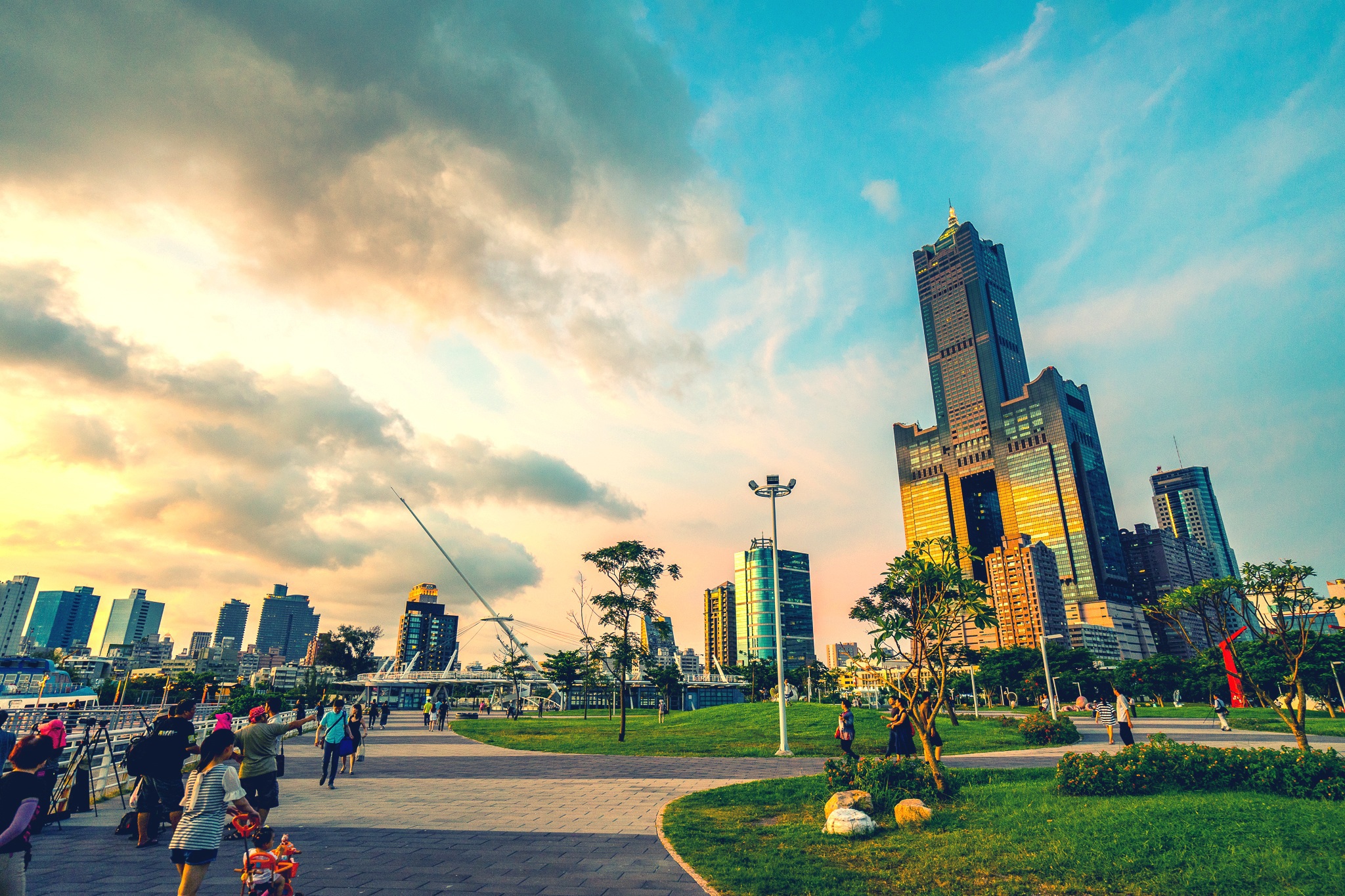
Kaohsiung, Taiwan
Kaohsiung is Taiwan’s second largest city, its biggest seaport, and the world’s fourth largest container port. It entered the 21st century as a newly emerging international metropolis. In the forefront of Taiwan’s expansion and modernisation efforts are the China Steel Corporation and China Shipbuilding. They are perfect examples of what Taiwan’s export-oriented economy is all about. The Love River, which has seen some recent landscaping, adds to the beauty of the city. Coffee shops along its banks offer good opportunities to view the river’s activities and enjoy a nice breeze. A 495-feet (150 metres)-long urban corridor of light, known as Urban Spotlight, was designed by local artists who wanted to make light and shadows the theme of the hall. The result is an urban space in the Central Park area teeming with artistic vision. A very important event in Taiwan’s recent history occurred here in 1979, and is known as the Kaohsiung Incident. It was the day of the first major human rights celebration on the island. Until that time, the authorities had never allowed any expression of discontent. When the day came, however, the celebration ended in chaos when police encircled the peaceful crowd and started using teargas, and pro-government instigators incited violence. Kuomintang (KMT) authorities used this as an excuse to round up all well-known opposition leaders and imprison them. Although it was hardly noticed internationally, it is recognised locally as an important turning point in the island’s transition to democracy, and it galvanised the Taiwanese people into action.
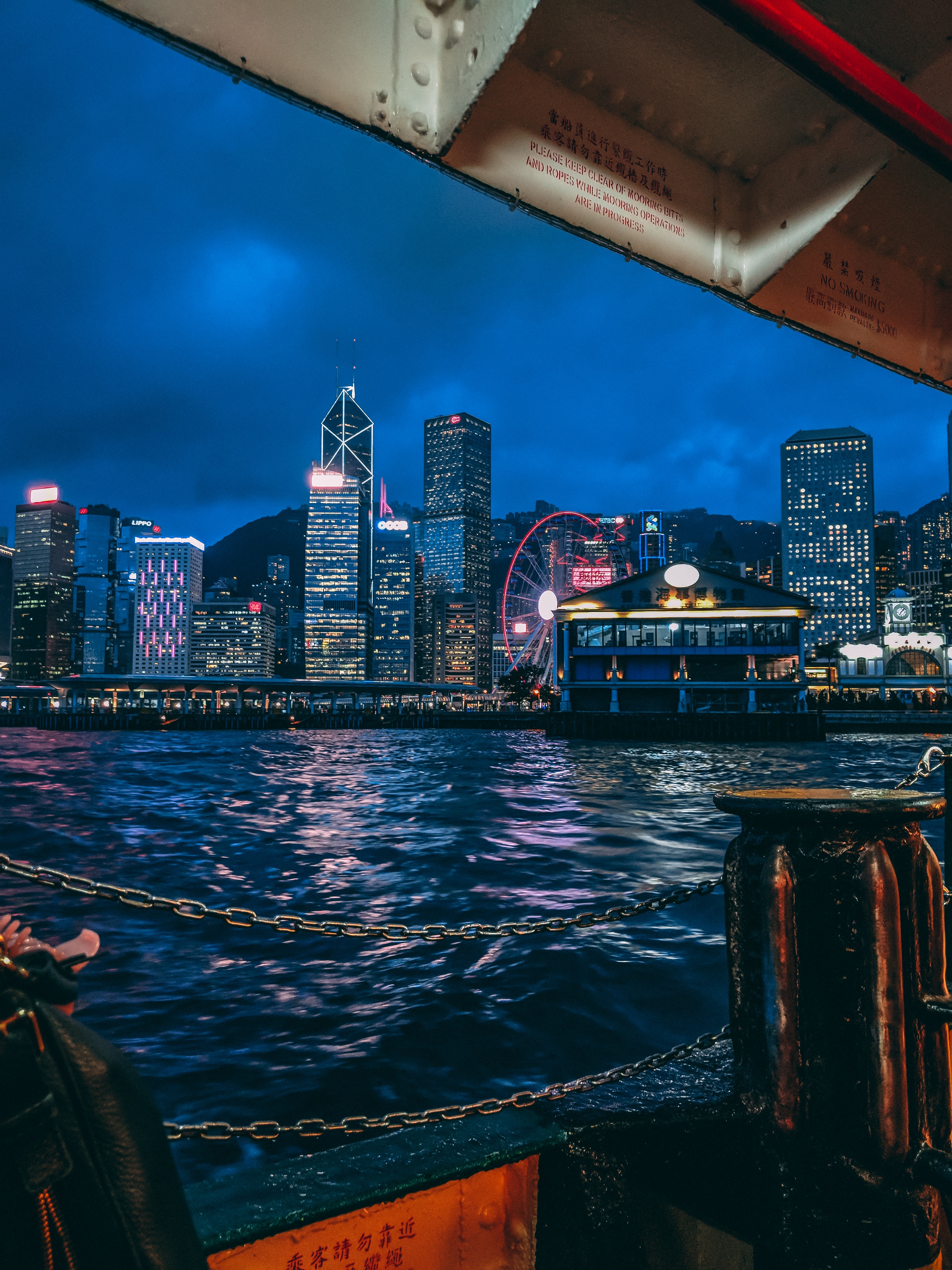
Hong Kong, Hong Kong
The Hong Kong Island skyline, with its ever-growing number of skyscrapers, speaks to ambition and money. Paris, London, even New York were centuries in the making, while Hong Kong’s towers, bright lights, and glitzy shopping emporia weren’t yet part of the urban scene when many of the young investment bankers who fuel one of the world’s leading financial centers were born. Commerce is concentrated in the glittering high-rises of Central, tucked between Victoria Harbor and forested peaks on Hong Kong Island’s north shore. While it’s easy to think all the bright lights are the sum of today’s Hong Kong, you need only walk or board a tram for the short jaunt west into Western to discover a side of Hong Kong that is more traditionally Chinese but no less high-energy. You’ll discover the real Hong Kong to the east of Central, too, in Wan Chai, Causeway Bay, and beyond. Amid the residential towers are restaurants, shopping malls, bars, convention centers, a nice smattering of museums, and—depending on fate and the horse you wager on—one of Hong Kong’s luckiest or unluckiest spots, the Happy Valley Racecourse. Kowloon sprawls across a generous swath of the Chinese mainland across Victoria Harbour from Central. Tsim Sha Tsui, at the tip of Kowloon peninsula, is packed with glitzy shops, first-rate museums, and eye-popping views of the skyline across the water. Just to the north are the teeming market streets of Mong Kok and in the dense residential neighborhoods beyond, two of Hong Kong’s most enchanting spiritual sights, Wong Tai Sin Temple and Chi Lin Nunnery. As you navigate this huge metropolis (easy to do on the excellent transportation network), keep in mind that streets are usually numbered odd on one side, even on the other. There’s no baseline for street numbers and no block-based numbering system, but street signs indicate building numbers for any given block.
Hong Kong, Hong Kong
The Hong Kong Island skyline, with its ever-growing number of skyscrapers, speaks to ambition and money. Paris, London, even New York were centuries in the making, while Hong Kong’s towers, bright lights, and glitzy shopping emporia weren’t yet part of the urban scene when many of the young investment bankers who fuel one of the world’s leading financial centers were born. Commerce is concentrated in the glittering high-rises of Central, tucked between Victoria Harbor and forested peaks on Hong Kong Island’s north shore. While it’s easy to think all the bright lights are the sum of today’s Hong Kong, you need only walk or board a tram for the short jaunt west into Western to discover a side of Hong Kong that is more traditionally Chinese but no less high-energy. You’ll discover the real Hong Kong to the east of Central, too, in Wan Chai, Causeway Bay, and beyond. Amid the residential towers are restaurants, shopping malls, bars, convention centers, a nice smattering of museums, and—depending on fate and the horse you wager on—one of Hong Kong’s luckiest or unluckiest spots, the Happy Valley Racecourse. Kowloon sprawls across a generous swath of the Chinese mainland across Victoria Harbour from Central. Tsim Sha Tsui, at the tip of Kowloon peninsula, is packed with glitzy shops, first-rate museums, and eye-popping views of the skyline across the water. Just to the north are the teeming market streets of Mong Kok and in the dense residential neighborhoods beyond, two of Hong Kong’s most enchanting spiritual sights, Wong Tai Sin Temple and Chi Lin Nunnery. As you navigate this huge metropolis (easy to do on the excellent transportation network), keep in mind that streets are usually numbered odd on one side, even on the other. There’s no baseline for street numbers and no block-based numbering system, but street signs indicate building numbers for any given block.
Cruising the Hainan Strait
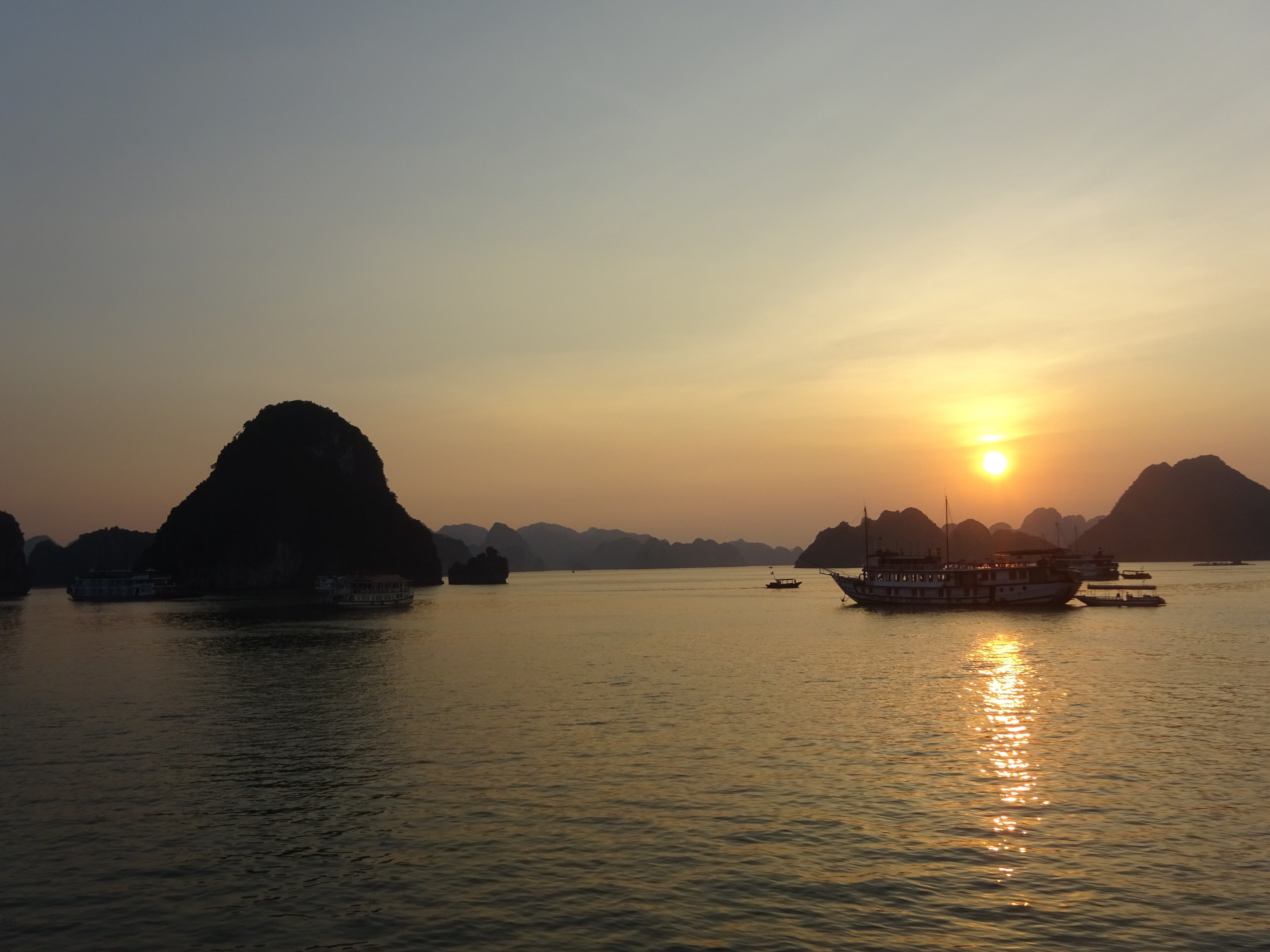
Ha Long Bay, Vietnam
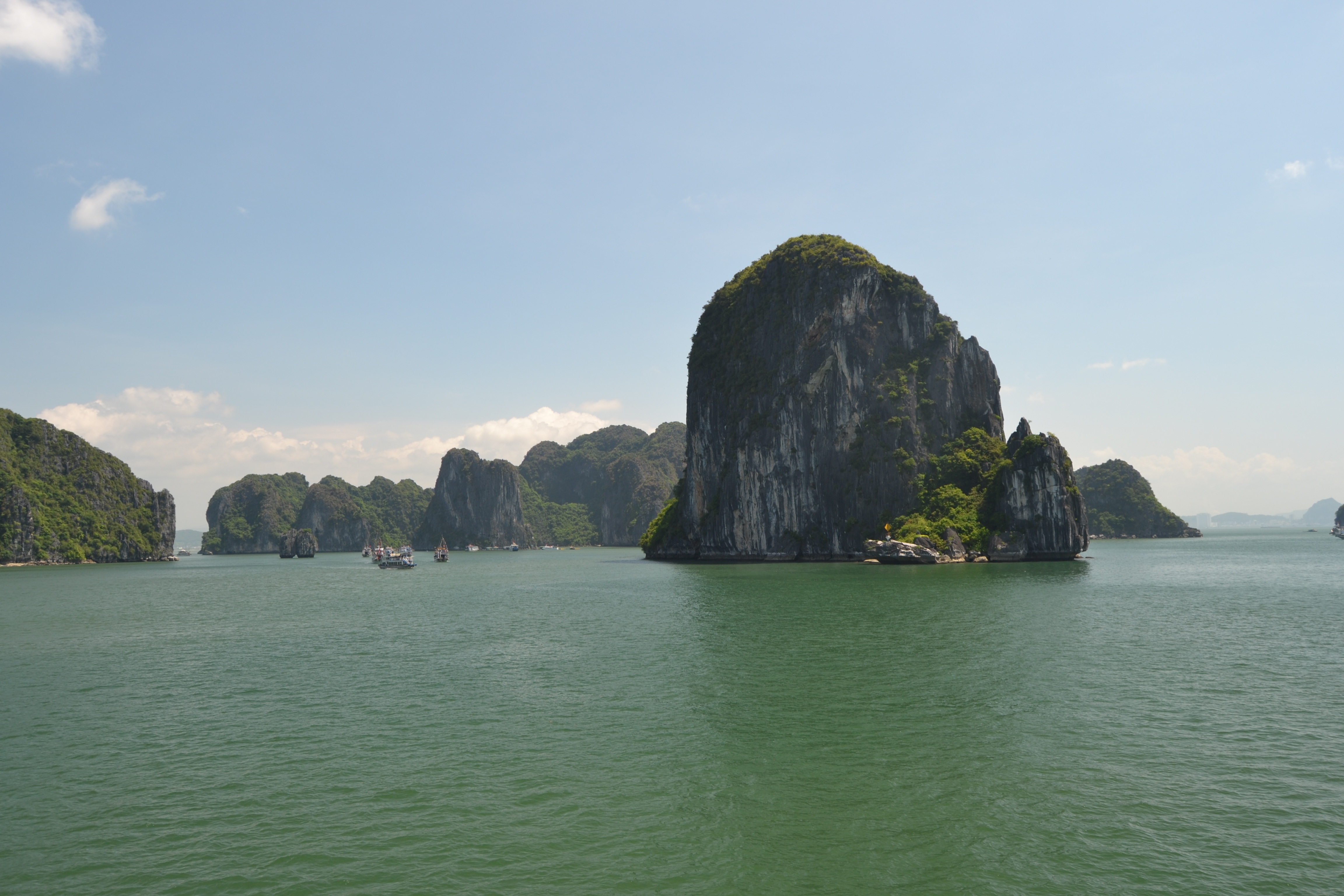
A visit to the north is not complete without a trip to Halong Bay, where placid waters give way to more than 3,000 limestone karsts and wind-sculpted limestone formations that jut from foggy lagoons. Dotting the bay are tiny islands bordered by white sandy coves and hidden caves, adding to the majestic landscape of this UNESCO World Heritage Site. Adding to this naturalist’s dream is the biodiversity of islets, grottos, and Cat Ba Island National Park. The bay, however, shows tourism’s impact: the clearing of mangrove forests to make way for jetties and piers, marine life threatened by game fishing, and garbage from passenger boats and fishing villages washed up on the shores.Beyond its geological uniqueness are activities like hiking, kayaking, rock climbing, or exploring one of the many floating villages where fishermen bring in their daily catch. The downside to all this allure is the large number of unlicensed boats it draws to the bay each day.Boat trips out onto the bay are the main tourism stock in trade farther north, but a more multifaceted side of the area can be experienced at Cat Ba Island. The largest island in Halong Bay, Cat Ba is very much its own entity. Its national park offers incredible biodiversity, with more than a thousand species of plants having been recorded here. Animal life is slightly thinner on the ground, but alert visitors may spy inhabitants such as the endangered golden-headed langur, wild boar, deer, civets, and several species of squirrel. Trekking through the wilderness is a highlight with a number of fascinating trails to follow.Cat Ba Island has also become a firm favorite with the adventure sports set. Indeed, along with Railay Beach in Thailand, it is recognized as one of the top spots in the region for rock climbing. Other outdoor pursuits include sailing and kayaking around the karsts. Although Halong Bay has arguably been tainted by over-exposure, Bai Tu Long Bay farther east toward China, retains all the majesty of Vietnam’s premier bucket-list natural attraction but sees a fraction of the traffic of its immediate neighbor to the west. Here, visitors will find islands of substantial size with deserted beaches and untamed jungle. Halong Bay’s 3,000 islands of dolomite and limestone cover a 1,500-square-km (580-square-mile) area, extending across the Gulf of Tonkin nearly to the Chinese border. According to legend, this breathtaking land- and seascape was formed by a giant dragon that came barreling out of the mountains toward the ocean—hence the name (Halong translates into “descent of the dragon”). Geologists are more likely to attribute the formations to sedimentary limestone that formed here between 300 and 500 million years ago, in the Paleozoic Era. Over millions of years water receded and exposed the limestone to wind, rain, and tidal erosion.Today the limestone formations are exposed to hordes of tourists—but don’t let that discourage you. Hundreds of fishing trawlers and tour boats share space on these crystal waters, yet there seems to be room for everyone. Most people use the main population center, Halong City, as a base from which to venture into the bay. Although it’s now officially one municipality, Halong City was, until 1996, two separate towns: Bai Chay is now Halong City West, where Halong Road winds its way around the coast and past the lifeless central beach; Hon Gai is the grimier Halong City East, where a coal transportation depot dominates the center of town and covers nearby roads and buildings with a sooty film. Locals still refer to the towns by their old names, but they are now inexorably lassoed together by a bridge. Boat trips through Halong Bay are the main attraction. Little of the majesty of this region can be found in the city, so head out onto the water and start exploring. Countless 10- and 30-foot fishing boats have been converted into Halong Bay’s formidable tourist-boat fleet. Hotels or travel agencies in Halong City or Hanoi can arrange boat trips for you (often they are part of organized tours from Hanoi). It is still possible to go down to the wharf and bargain yourself onto a boat for the day, but you are likely to be charged (sometimes significantly) more than you would pay for a prebooked tour, so this is not advised. Self-sufficient travelers have fallen victim to the old bait-and-switch: they’ve arranged a next-day boat tour with local fishermen, only to be told in no uncertain terms the following morning that they could not board their chosen boat, but they could take a different one for quite a bit more money. You may have no choice in the end. Usually travel agencies, however, have their tried-and-true favorites.
Cruising the South China Sea
Cam Ranh, Vietnam
Ho Chi Minh City, Vietnam
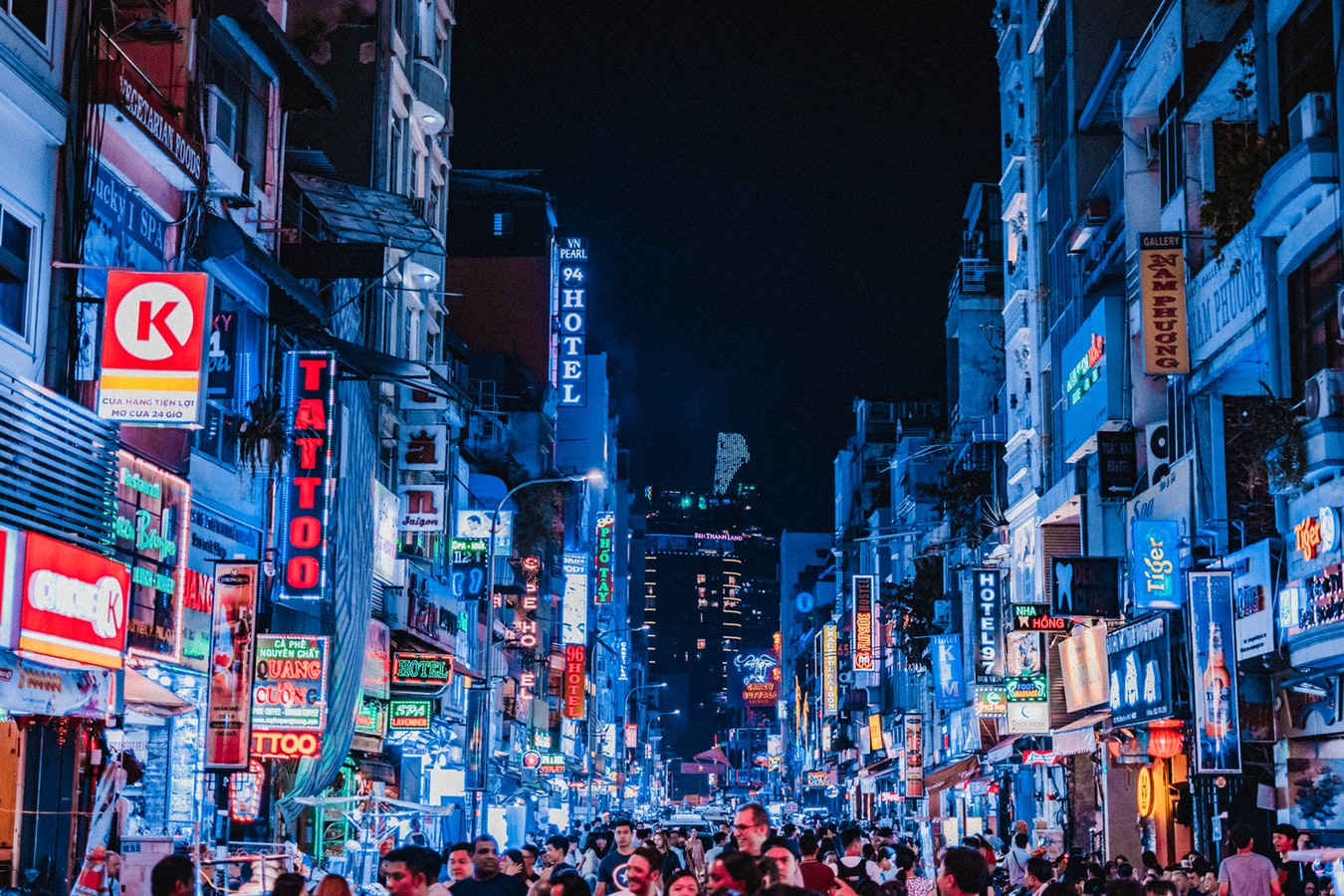
Romantically referred to by the French as the Pearl of the Orient, Ho Chi Minh City today is a super-charged city of sensory overload. Motorbikes zoom day and night along the wide boulevards, through the narrow back alleys and past vendors pushing handcarts hawking goods of all descriptions. Still called Saigon by most residents, this is Vietnam’s largest city and the engine driving the country’s current economic resurgence, but despite its frenetic pace, it’s a friendlier place than Hanoi and locals will tell you the food—simple, tasty, and incorporating many fresh herbs—is infinitely better than in the capital.This is a city full of surprises. The madness of the city’s traffic—witness the oddball things that are transported on the back of motorcycles—is countered by tranquil pagodas, peaceful parks, quirky coffee shops, and whole neighborhoods hidden down tiny alleyways, although some of these quiet spots can be difficult to track down. Life in Ho Chi Minh City is lived in public: on the back of motorcycles, on the sidewalks, and in the parks. Even when its residents are at home, they’re still on display. With many living rooms opening onto the street, grandmothers napping, babies being rocked, and food being prepared, are all in full view of passersby.Icons of the past endure in the midst of the city’s headlong rush into capitalism. The Hotel Continental, immortalized in Graham Greene’s The Quiet American, continues to stand on the corner of old Indochina’s most famous thoroughfare, the rue Catinat, known to American G.I.s during the Vietnam War as Tu Do (Freedom) Street and renamed Dong Khoi (Uprising) Street by the Communists. The city still has its ornate opera house and its old French city hall, the Hôtel de Ville. The broad colonial boulevards leading to the Saigon River and the gracious stucco villas are other remnants of the French colonial presence. Grisly reminders of the more recent past can be seen at the city’s war-related museums. Residents, however, prefer to look forward rather than back and are often perplexed by tourists’ fascination with a war that ended 40 years ago.The Chinese influence on the country is still very much in evidence in the Cholon district, the city’s Chinatown, but the modern office towers and international hotels that mark the skyline symbolize Vietnam’s fixation on the future.
Ho Chi Minh City, Vietnam
Romantically referred to by the French as the Pearl of the Orient, Ho Chi Minh City today is a super-charged city of sensory overload. Motorbikes zoom day and night along the wide boulevards, through the narrow back alleys and past vendors pushing handcarts hawking goods of all descriptions. Still called Saigon by most residents, this is Vietnam’s largest city and the engine driving the country’s current economic resurgence, but despite its frenetic pace, it’s a friendlier place than Hanoi and locals will tell you the food—simple, tasty, and incorporating many fresh herbs—is infinitely better than in the capital.This is a city full of surprises. The madness of the city’s traffic—witness the oddball things that are transported on the back of motorcycles—is countered by tranquil pagodas, peaceful parks, quirky coffee shops, and whole neighborhoods hidden down tiny alleyways, although some of these quiet spots can be difficult to track down. Life in Ho Chi Minh City is lived in public: on the back of motorcycles, on the sidewalks, and in the parks. Even when its residents are at home, they’re still on display. With many living rooms opening onto the street, grandmothers napping, babies being rocked, and food being prepared, are all in full view of passersby.Icons of the past endure in the midst of the city’s headlong rush into capitalism. The Hotel Continental, immortalized in Graham Greene’s The Quiet American, continues to stand on the corner of old Indochina’s most famous thoroughfare, the rue Catinat, known to American G.I.s during the Vietnam War as Tu Do (Freedom) Street and renamed Dong Khoi (Uprising) Street by the Communists. The city still has its ornate opera house and its old French city hall, the Hôtel de Ville. The broad colonial boulevards leading to the Saigon River and the gracious stucco villas are other remnants of the French colonial presence. Grisly reminders of the more recent past can be seen at the city’s war-related museums. Residents, however, prefer to look forward rather than back and are often perplexed by tourists’ fascination with a war that ended 40 years ago.The Chinese influence on the country is still very much in evidence in the Cholon district, the city’s Chinatown, but the modern office towers and international hotels that mark the skyline symbolize Vietnam’s fixation on the future.
Cruising the South China Sea
Singapore, Singapore
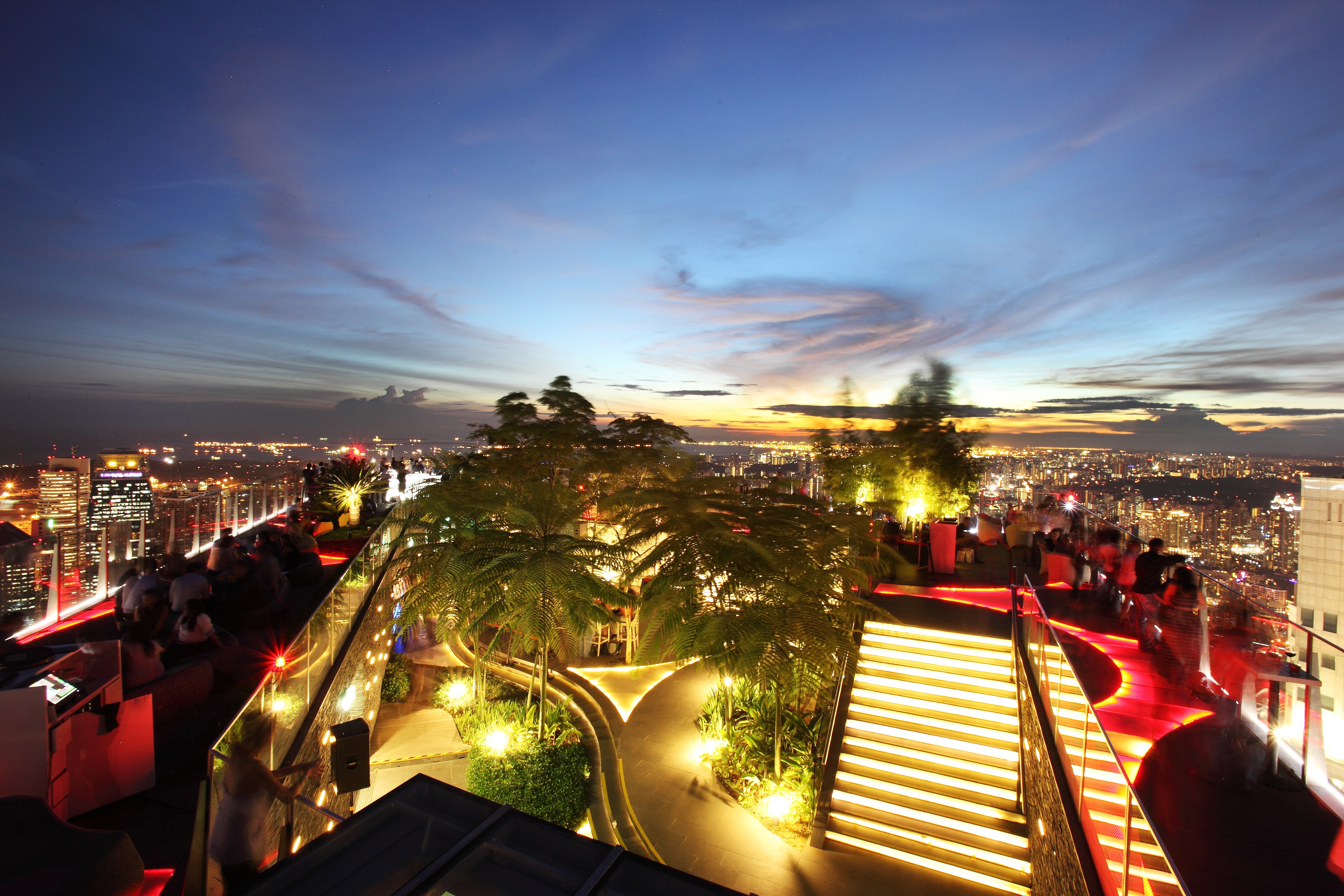
The main island of Singapore is shaped like a flattened diamond, 42 km (26 miles) east to west and 23 km (14 miles) north to south. Near the northern peak is the causeway leading to West Malaysia—Kuala Lumpur is less than four hours away by car. It is at the southern foot where you will find most of the city-state’s action, with its gleaming office towers, working docks, and futuristic “supertrees,” which are solar-powered and serve as vertical gardens. Offshore are Sentosa and over 60 smaller islands, most uninhabited, that serve as bases for oil refining or as playgrounds and beach escapes from the city. To the east is Changi International Airport, connected to the city by metro, bus, and a tree-lined parkway. Of the island’s total land area, more than half is built up, with the balance made up of parkland, farmland, plantations, swamp areas, and rain forest. Well-paved roads connect all parts of the island, and Singapore city has an excellent, and constantly expanding, public transportation system. The heart of Singapore’s history and its modern wealth are in and around the Central Business District. The area includes the skyscrapers in the Central Business District, the 19th-century Raffles Hotel, the convention centers of Marina Square, on up to the top of Ft. Canning. Although most of old Singapore has been knocked down to make way for the modern city, most colonial landmarks have been preserved in the CBD, including early-19th-century buildings designed by the Irish architect George Coleman.
Singapore, Singapore
The main island of Singapore is shaped like a flattened diamond, 42 km (26 miles) east to west and 23 km (14 miles) north to south. Near the northern peak is the causeway leading to West Malaysia—Kuala Lumpur is less than four hours away by car. It is at the southern foot where you will find most of the city-state’s action, with its gleaming office towers, working docks, and futuristic “supertrees,” which are solar-powered and serve as vertical gardens. Offshore are Sentosa and over 60 smaller islands, most uninhabited, that serve as bases for oil refining or as playgrounds and beach escapes from the city. To the east is Changi International Airport, connected to the city by metro, bus, and a tree-lined parkway. Of the island’s total land area, more than half is built up, with the balance made up of parkland, farmland, plantations, swamp areas, and rain forest. Well-paved roads connect all parts of the island, and Singapore city has an excellent, and constantly expanding, public transportation system. The heart of Singapore’s history and its modern wealth are in and around the Central Business District. The area includes the skyscrapers in the Central Business District, the 19th-century Raffles Hotel, the convention centers of Marina Square, on up to the top of Ft. Canning. Although most of old Singapore has been knocked down to make way for the modern city, most colonial landmarks have been preserved in the CBD, including early-19th-century buildings designed by the Irish architect George Coleman.
Cruising the Gulf of Thailand
Bangkok, Thailand
Bangkok, also known as the City of Angels and Venice of the East thrills with energy. There’s such a vast array of sightseeing, shopping, and eating possibilities that you’ll have little time to rest. When you do find a moment, pamper yourself with spa treatments, skyline-view bars, luxurious hotels, and excellent restaurants. The city is a mesmerizing blend of old and new, East and West, and dizzying contradictions. Temples and red-light districts, languid canals and permanent gridlock, streetside vendors and chic upscale eateries, all make their home together, all at the same time. Bangkok rarely fails to make an impression, and yes, you might need to go spend a few days on the beach to recover from it all. Although Bangkok is not known for jaw-dropping tourist attractions, it does have an endless supply of worthwhile pilgrimages. The Grand Palace, Wat Phra Kaew, and the Emerald Buddha are tops on every visitor’s itinerary, and lesser-known temples, such as Wat Benjamabophit, the golden stupa of Wat Sakhet, and Wat Suthat, are all worthy of a stop. Besides temples, there are plenty of other interesting niches and touring possibilities to fit just about every interest. Take in a venom extraction and python feeding show at the Queen Saowapha Snake Farm, or go to the nearby Jim Thompson House to learn all about the famed Thai silk industry. If architecture is your forte, there is the Suan Pakkard Palace with its antique teak house collection, and the even more astounding Vimanmek Palace, which contains the world’s largest golden teak building. Bangkok’s Chinatown merits at least a day on every travel itinerary—be sure to check out the sprawling labyrinthine Flower and Thieves markets. Thai food is unrivaled for spice, taste, and variation. From multicourse meals to small street vendors, the one constant here is fresh and delicious at every level. You can have superlative roast duck or wonton noodles on a street corner for lunch and then be dining on world-class chef creations in the Oriental or Shangri-La hotels for supper. It doesn’t have to be all spicy Thai either, as Bangkok is home to excellent French, Italian, and other world cuisines, and you need a few years just to make a dent in all the options that are available. The Old City is a major destination for travelers, as it’s home to opulent temples like Wat Po and Wat Phra Kaew. Across the river is Thonburi, a mostly residential neighborhood, where you can find Wat Arun. At the northern tip of the Old City is Banglamphu, one of Bangkok’s older residential neighborhoods. It’s best known now for Khao San Road, a backpacker hangout, though the neighborhood has much more to offer, especially when it comes to street food. North of Banglamphu is Dusit, the royal district since the days of Rama V. East of the Old City is Chinatown, a labyrinth of streets with restaurants, shops, and warehouses. Farther down the Chao Phraya River is bustling Silom Road, one of the city’s major commercial districts. Patpong, the city’s most famous of several red-light districts, is also here. Bang Rak is home to some of the city’s leading hotels: the Mandarin Oriental, the Peninsula, the Royal Orchid Sheraton, and the Shangri-La. To the north of Rama IV Road is Bangkok’s largest green area, Lumphini Park. Continue north and you reach Sukhumvit Road, once a residential area. More recently, Thong Lor, farther east along Sukhumvit, has become the “in” neighborhood for those want to see and be seen. The Nana and Asok areas of Sukhumvit are now home to the even busier red-light entertainment districts (Nana and Soi Cowboy) than Patpong.
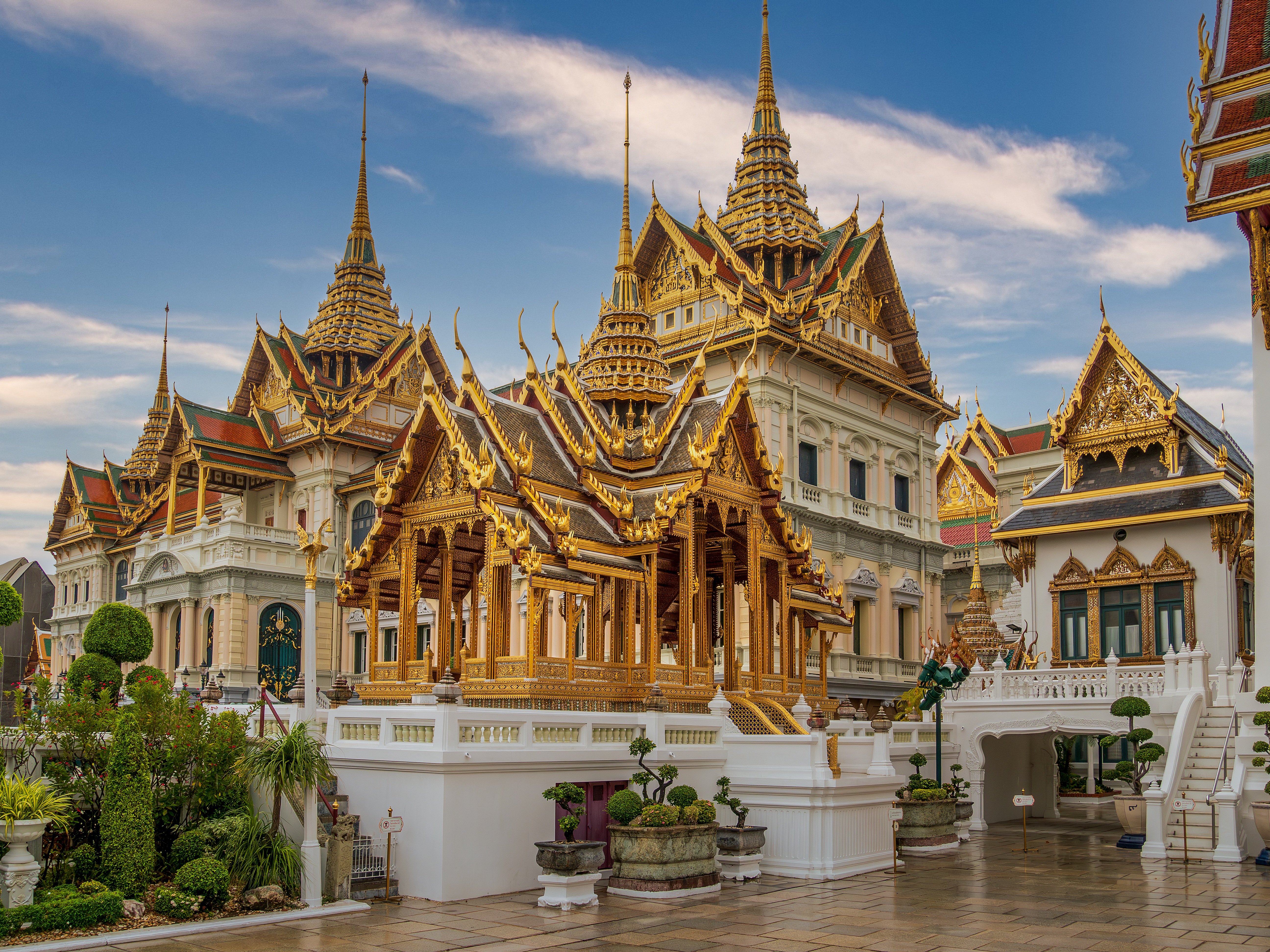
Bangkok, Thailand
Bangkok, also known as the City of Angels and Venice of the East thrills with energy. There’s such a vast array of sightseeing, shopping, and eating possibilities that you’ll have little time to rest. When you do find a moment, pamper yourself with spa treatments, skyline-view bars, luxurious hotels, and excellent restaurants. The city is a mesmerizing blend of old and new, East and West, and dizzying contradictions. Temples and red-light districts, languid canals and permanent gridlock, streetside vendors and chic upscale eateries, all make their home together, all at the same time. Bangkok rarely fails to make an impression, and yes, you might need to go spend a few days on the beach to recover from it all. Although Bangkok is not known for jaw-dropping tourist attractions, it does have an endless supply of worthwhile pilgrimages. The Grand Palace, Wat Phra Kaew, and the Emerald Buddha are tops on every visitor’s itinerary, and lesser-known temples, such as Wat Benjamabophit, the golden stupa of Wat Sakhet, and Wat Suthat, are all worthy of a stop. Besides temples, there are plenty of other interesting niches and touring possibilities to fit just about every interest. Take in a venom extraction and python feeding show at the Queen Saowapha Snake Farm, or go to the nearby Jim Thompson House to learn all about the famed Thai silk industry. If architecture is your forte, there is the Suan Pakkard Palace with its antique teak house collection, and the even more astounding Vimanmek Palace, which contains the world’s largest golden teak building. Bangkok’s Chinatown merits at least a day on every travel itinerary—be sure to check out the sprawling labyrinthine Flower and Thieves markets. Thai food is unrivaled for spice, taste, and variation. From multicourse meals to small street vendors, the one constant here is fresh and delicious at every level. You can have superlative roast duck or wonton noodles on a street corner for lunch and then be dining on world-class chef creations in the Oriental or Shangri-La hotels for supper. It doesn’t have to be all spicy Thai either, as Bangkok is home to excellent French, Italian, and other world cuisines, and you need a few years just to make a dent in all the options that are available. The Old City is a major destination for travelers, as it’s home to opulent temples like Wat Po and Wat Phra Kaew. Across the river is Thonburi, a mostly residential neighborhood, where you can find Wat Arun. At the northern tip of the Old City is Banglamphu, one of Bangkok’s older residential neighborhoods. It’s best known now for Khao San Road, a backpacker hangout, though the neighborhood has much more to offer, especially when it comes to street food. North of Banglamphu is Dusit, the royal district since the days of Rama V. East of the Old City is Chinatown, a labyrinth of streets with restaurants, shops, and warehouses. Farther down the Chao Phraya River is bustling Silom Road, one of the city’s major commercial districts. Patpong, the city’s most famous of several red-light districts, is also here. Bang Rak is home to some of the city’s leading hotels: the Mandarin Oriental, the Peninsula, the Royal Orchid Sheraton, and the Shangri-La. To the north of Rama IV Road is Bangkok’s largest green area, Lumphini Park. Continue north and you reach Sukhumvit Road, once a residential area. More recently, Thong Lor, farther east along Sukhumvit, has become the “in” neighborhood for those want to see and be seen. The Nana and Asok areas of Sukhumvit are now home to the even busier red-light entertainment districts (Nana and Soi Cowboy) than Patpong.
Ko Samui, Thailand
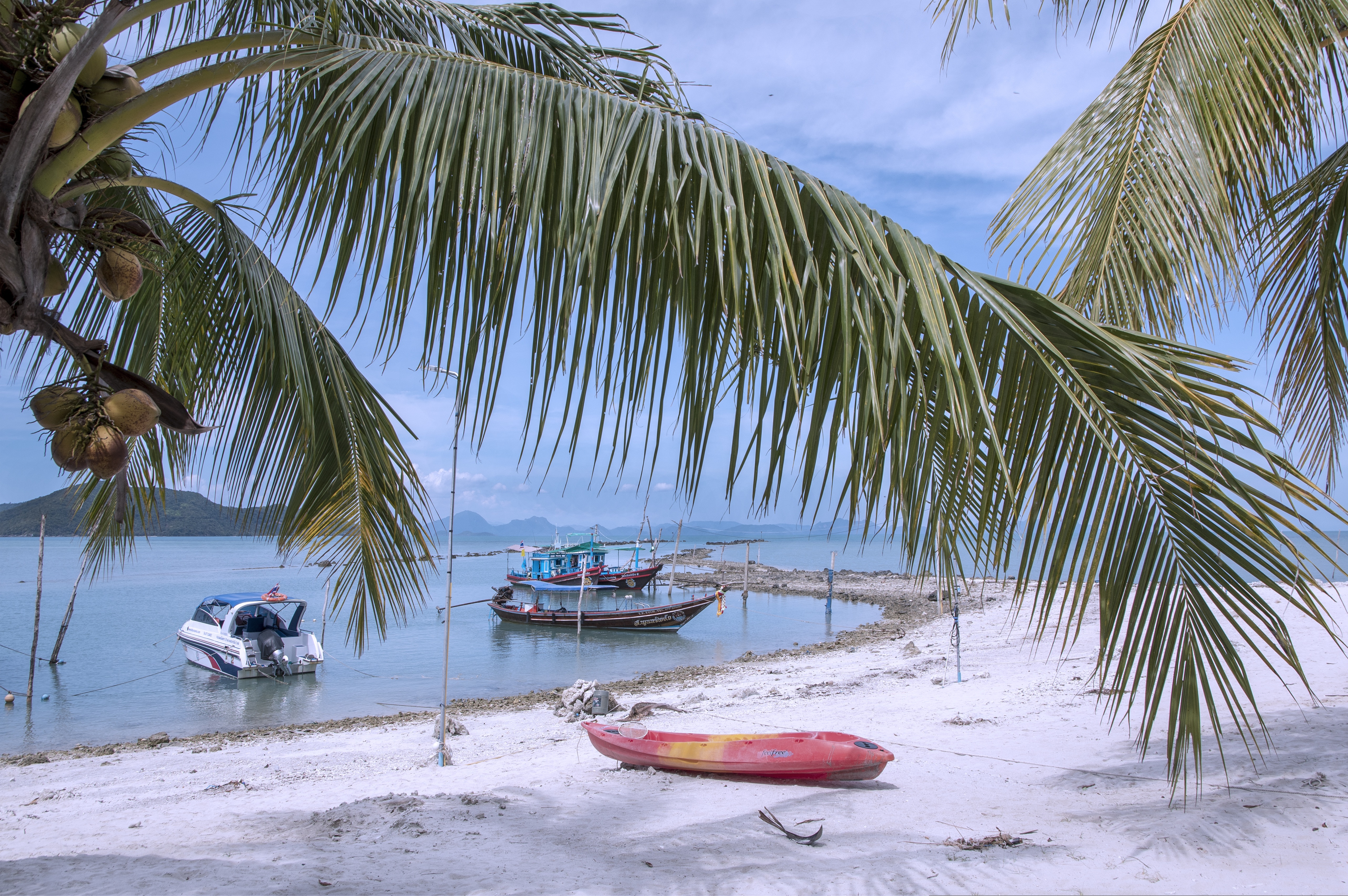
Koh Samui is the most popular tourist destination on the Western Gulf coast, which isn’t surprising, considering the island’s gorgeous beaches, perfect weather, and sparkling blue, almost turquoise, water. Koh Samui has seen rapid development since the 1990s, and you’ll encounter hotels in all price ranges.Koh Samui is half the size of Phuket, so you could easily drive around it in a day. But Koh Samui is best appreciated by those who take a slower, more casual approach. Most people come for the sun and sea, so they head straight to their hotel and rarely venture beyond its beach. But it’s worth exploring beyond your lodging. Every beach has its own character, and you might find the perfect one for you. One beach many visitors find to their liking is Chawaeng. On Koh Samui’s east coast, this stretch of glistening white sand is divided into two main sections—Chawaeng Yai (yai means “big”) and Chawaeng Noi (noi means “little”). You’ll find the greatest variety of hotels, restaurants, and bars here. Despite the crowds, Chawaeng is no Pattaya or Patong—the mood is very laid-back. A rocky headland separates Chawaeng Lamai Beach, whose clear water and long stretch of sand were the first place on the island to attract developers. More budget accommodations are available here than in Chawaeng, and there are some happening nightclubs.On the west coast of Koh Samui, Na Thon is the island’s primary port and the spot where ferries arrive from the mainland. It’s home to the island’s governmental offices, including the Tourism Authority of Thailand, and there are banks, foreign-exchange booths, travel agents, shops, restaurants, and cafés by the ferry pier. A few places rent rooms, but there’s really no reason to stay here—nicer accommodations can be found a short songthaew ride away.To the north and east of Na Thon lie a few beaches worthy of exploration. Laem Yai, 5 km (3 miles) north, has great seafood. East of here, a small headland separates two low-key communities on the northern shore, Mae Nam and Bophut Beach. Mae Nam is also the departure point for boats bound for Koh Phangan and Koh Tao . Just south of the Samui’s northeastern tip you’ll find sandy Choengmon Beach, a good area for swimming that’s not overdeveloped.
Cruising the Gulf of Thailand
Port Klang, Malaysia
Kuala Lumpur, or KL as locals refer to it, intrigues visitors with its diversity and multicultural character. The city’s old quarter features stretches of shop houses that hint at its colonial past, while modern buildings—including the iconic Petronas Towers—give a glimpse of its modern financial ambitions. The city is filled with culturally colorful quarters dedicated to Chinese, Malay, and Indian communities. New shopping malls with designer labels, five-star hotels, and top-notch restaurants also proliferate in this bustling city of 1.6 million.
Port Klang, Malaysia
Kuala Lumpur, or KL as locals refer to it, intrigues visitors with its diversity and multicultural character. The city’s old quarter features stretches of shop houses that hint at its colonial past, while modern buildings—including the iconic Petronas Towers—give a glimpse of its modern financial ambitions. The city is filled with culturally colorful quarters dedicated to Chinese, Malay, and Indian communities. New shopping malls with designer labels, five-star hotels, and top-notch restaurants also proliferate in this bustling city of 1.6 million.
Cruising the South China Sea
Cruising the Java Sea
Jakarta, Indonesia
Semarang, Indonesia
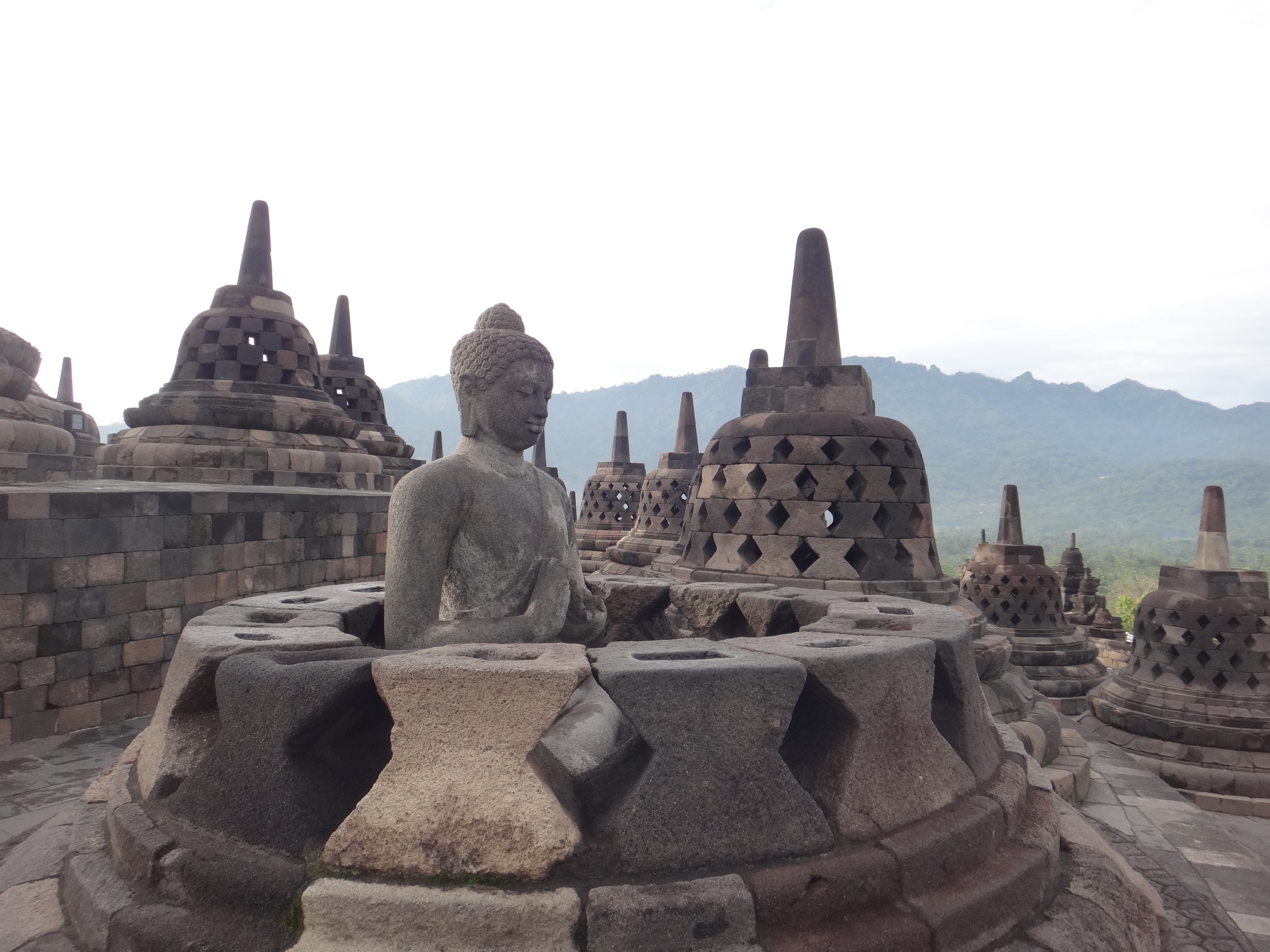
Semarang is one of the oldest cities in Indonesia, situated on Java’s north coast between the shore of the Java Sea and a small ridge of mountains. Ceded to the Dutch West India Company in 1677 by King Amangkurat I in payment of his debts, it became their headquarters and the seat of the Dutch governor of the northeast provinces. Semarang’s usefulness as a port waned due to the gradual silting up of the harbor; by the 19th century, Surabaya had eclipsed Semarang as Java’s premier port. With a population of over one million, a third of whom are thought to be of Chinese extraction, Semarang is the largest city in Central Java and its administrative capital. The city consists of two parts: the coastal lowland where most of the commercial activities are found; and the hilly residential area. Although more a business center than a city for tourists, Semarang serves as a popular gateway to the mountainous interior of Central Java and to fabled Borobudur.
Surabaya, Indonesia
Benoa, Bali, Indonesia
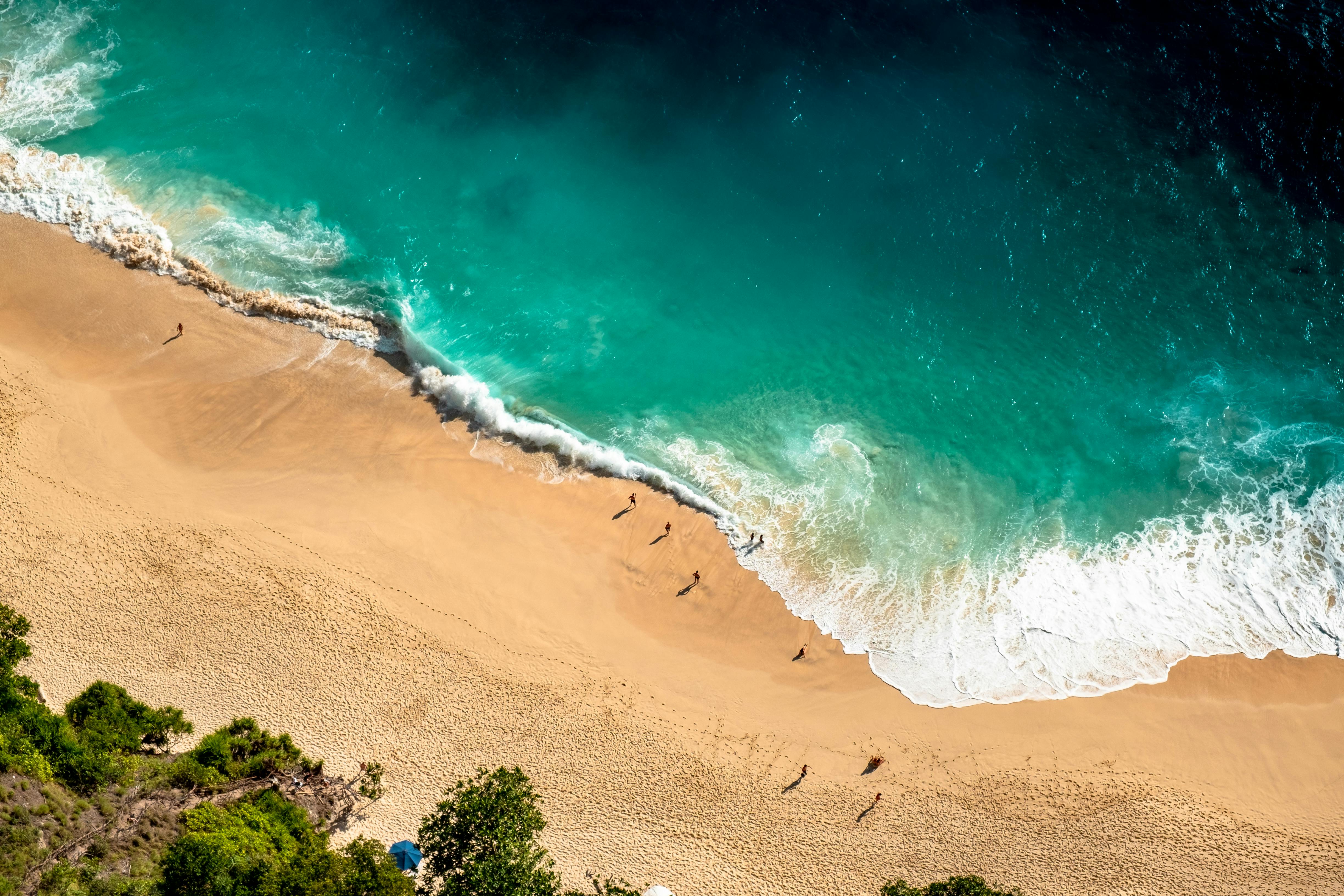
Bali really is as alluring as everyone says. This island, slightly bigger than Delaware, has it all: beaches, volcanoes, terraced rice fields, forests, renowned resorts, surfing, golf, and world-class dive sites. But what sets Bali apart from other nearby tropical destinations is Balinese tradition, and villagers dedicated to celebrating it. The hundreds of temples, dances, rituals, and crafts linked to their ancient Hindu faith aren’t a show for tourists, but a living, breathing culture in which visitors are warmly received by the Balinese, who cherish their own identities.
Benoa, Bali, Indonesia
Bali really is as alluring as everyone says. This island, slightly bigger than Delaware, has it all: beaches, volcanoes, terraced rice fields, forests, renowned resorts, surfing, golf, and world-class dive sites. But what sets Bali apart from other nearby tropical destinations is Balinese tradition, and villagers dedicated to celebrating it. The hundreds of temples, dances, rituals, and crafts linked to their ancient Hindu faith aren’t a show for tourists, but a living, breathing culture in which visitors are warmly received by the Balinese, who cherish their own identities.
Gali Mas, Indonesia
Komodo Island, Indonesia
Pink Beach earned its name for the way the beach can appear to have a rosy hue in certain lights. The color comes from small flecks of red coral mixed in with the fine white reef sand. With a few trees along the beach for shade, this stretch of coast makes a fine place to relax or enjoy a snorkel or dive in the crystal clear waters. It is possible to spot a striped clown fish nestled among the protective tentacles of its sea anemone host, or to see a grouper lazily swimming by a flamboyant soft coral. The reef here is now protected by law and the maturing corals are a joy to behold.
Cruising the Timor Sea
Darwin, Northern Territory, Australia
Darwin is Australia’s most colorful, and exotic, capital city. Surrounded on three sides by the turquoise waters of the Timor Sea, the streets are lined with tropical flowers and trees. Warm and dry in winter, hot and steamy in summer, it’s a relaxed and casual place, as well as a beguiling blend of tropical frontier outpost and Outback hardiness. Thanks to its close proximity to Southeast Asia and its multicultural population it also seems more like Asia than the rest of Australia. Darwin is a city that has always had to fight for its survival. The seductiveness of contemporary Darwin lifestyles belies a history of failed attempts that date from 1824 when Europeans attempted to establish an enclave in this harsh, unyielding climate. The original 1869 settlement, called Palmerston, was built on a parcel of mangrove wetlands and scrub forest that had changed little in 15 million years. It was not until 1911, after it had already weathered the disastrous cyclones of 1878, 1882, and 1897, that the town was named after the scientist who had visited Australia’s shores aboard the Beagle in 1839. During World War II it was bombed more than 60 times, as the harbor full of warships was a prime target for the Japanese war planes. Then, on the night of Christmas Eve 1974, the city was almost completely destroyed by Cyclone Tracy, Australia’s greatest natural disaster. It’s a tribute to those who stayed and to those who have come to live here after Tracy that the rebuilt city now thrives as an administrative and commercial center for northern Australia. Old Darwin has been replaced by something of an edifice complex—such buildings as Parliament House and the Supreme Court all seem very grand for such a small city, especially one that prides itself on its casual, outdoor-centric lifestyle. Today Darwin is the best place from which to explore Australia’s Top End, with its wonders of Kakadu and the Kimberley region.
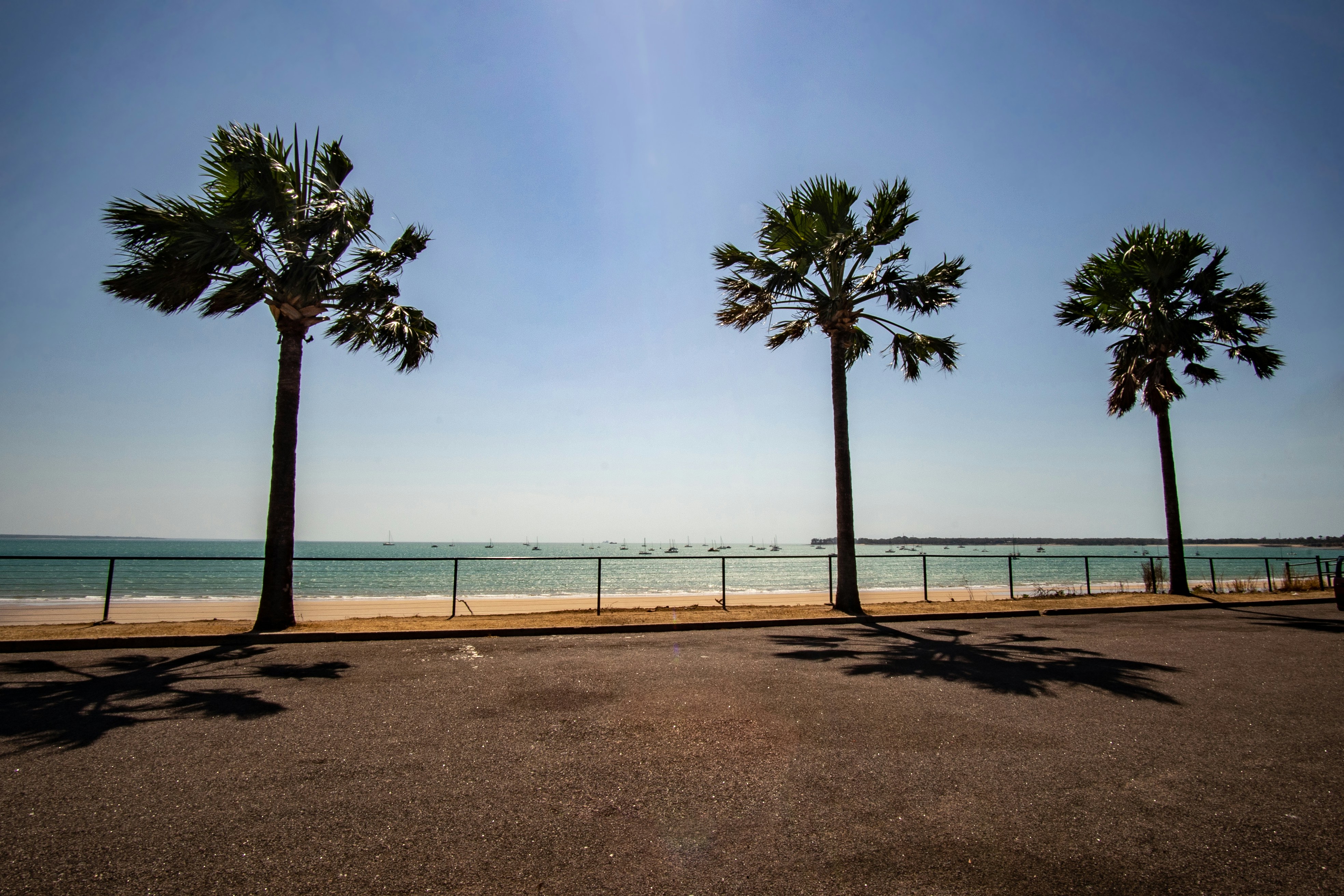
Darwin, Northern Territory, Australia
Darwin is Australia’s most colorful, and exotic, capital city. Surrounded on three sides by the turquoise waters of the Timor Sea, the streets are lined with tropical flowers and trees. Warm and dry in winter, hot and steamy in summer, it’s a relaxed and casual place, as well as a beguiling blend of tropical frontier outpost and Outback hardiness. Thanks to its close proximity to Southeast Asia and its multicultural population it also seems more like Asia than the rest of Australia. Darwin is a city that has always had to fight for its survival. The seductiveness of contemporary Darwin lifestyles belies a history of failed attempts that date from 1824 when Europeans attempted to establish an enclave in this harsh, unyielding climate. The original 1869 settlement, called Palmerston, was built on a parcel of mangrove wetlands and scrub forest that had changed little in 15 million years. It was not until 1911, after it had already weathered the disastrous cyclones of 1878, 1882, and 1897, that the town was named after the scientist who had visited Australia’s shores aboard the Beagle in 1839. During World War II it was bombed more than 60 times, as the harbor full of warships was a prime target for the Japanese war planes. Then, on the night of Christmas Eve 1974, the city was almost completely destroyed by Cyclone Tracy, Australia’s greatest natural disaster. It’s a tribute to those who stayed and to those who have come to live here after Tracy that the rebuilt city now thrives as an administrative and commercial center for northern Australia. Old Darwin has been replaced by something of an edifice complex—such buildings as Parliament House and the Supreme Court all seem very grand for such a small city, especially one that prides itself on its casual, outdoor-centric lifestyle. Today Darwin is the best place from which to explore Australia’s Top End, with its wonders of Kakadu and the Kimberley region.
Cruising the Arafura Sea
Cruising the Coral Sea
Cooktown, Queensland, Australia
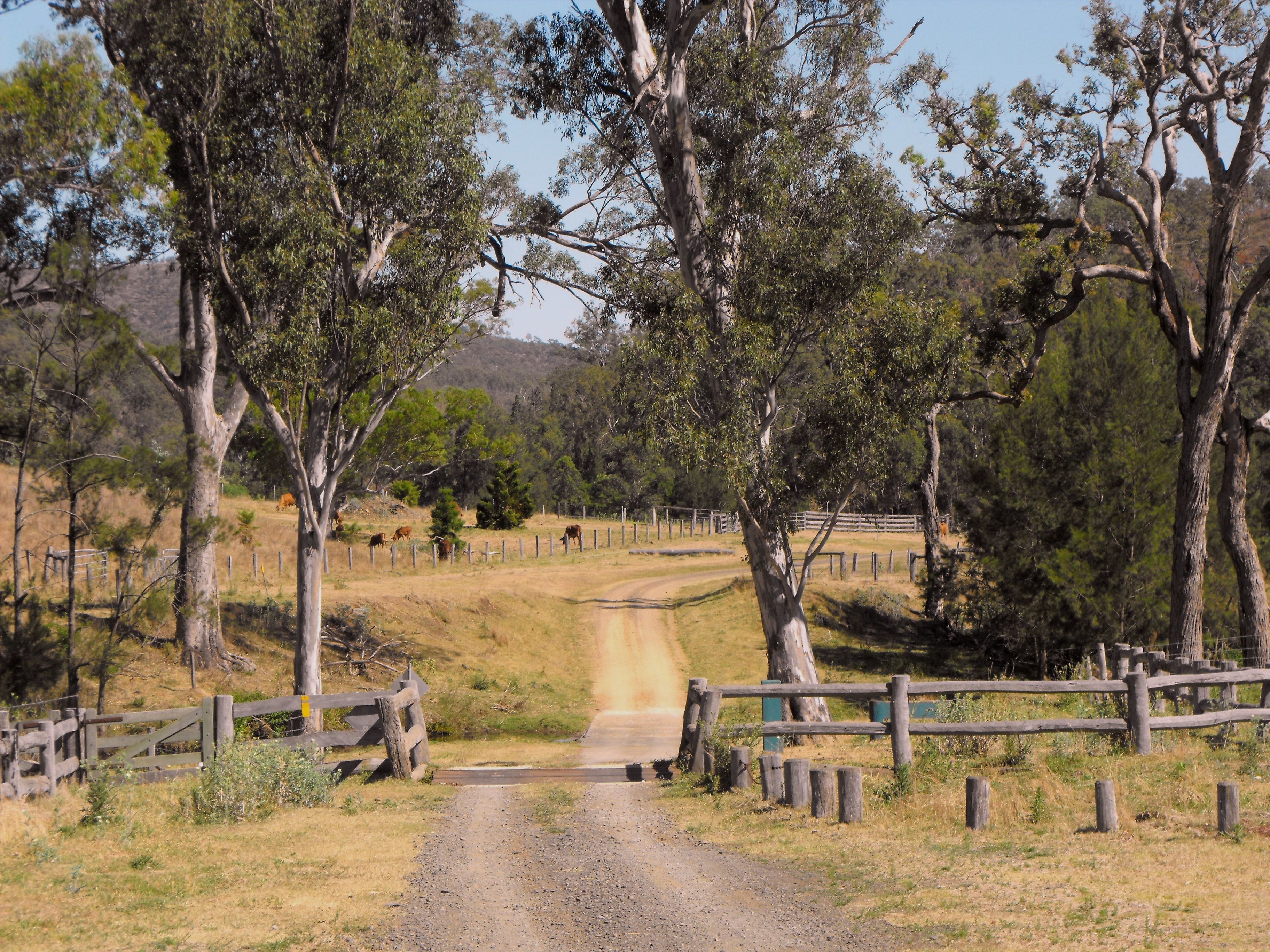
Cairns, Queensland, Australia
Tourism is the lifeblood of Cairns (pronounced Caans). The city makes a good base for exploring the wild top half of Queensland, and tens of thousands of international travelers use it as a jumping-off point for activities such as scuba diving and snorkeling trips to the Barrier Reef, as well as boating, fishing, parasailing, scenic flights, and rain-forest treks.It’s a tough environment, with intense heat and fierce wildlife. Along with wallabies and grey kangaroos in the savannah and tree kangaroos in the rain forest, you’ll find stealthy saltwater crocodiles, venomous snakes, and jellyfish so deadly they put the region’s stunning beaches off- limits to swimmers for nearly half the year. Yet despite this formidable setting, Cairns and tropical North Queensland are far from intimidating places. The people are warm and friendly, the sights spectacular, and—at the right time of year—the beachside lounging is world-class.
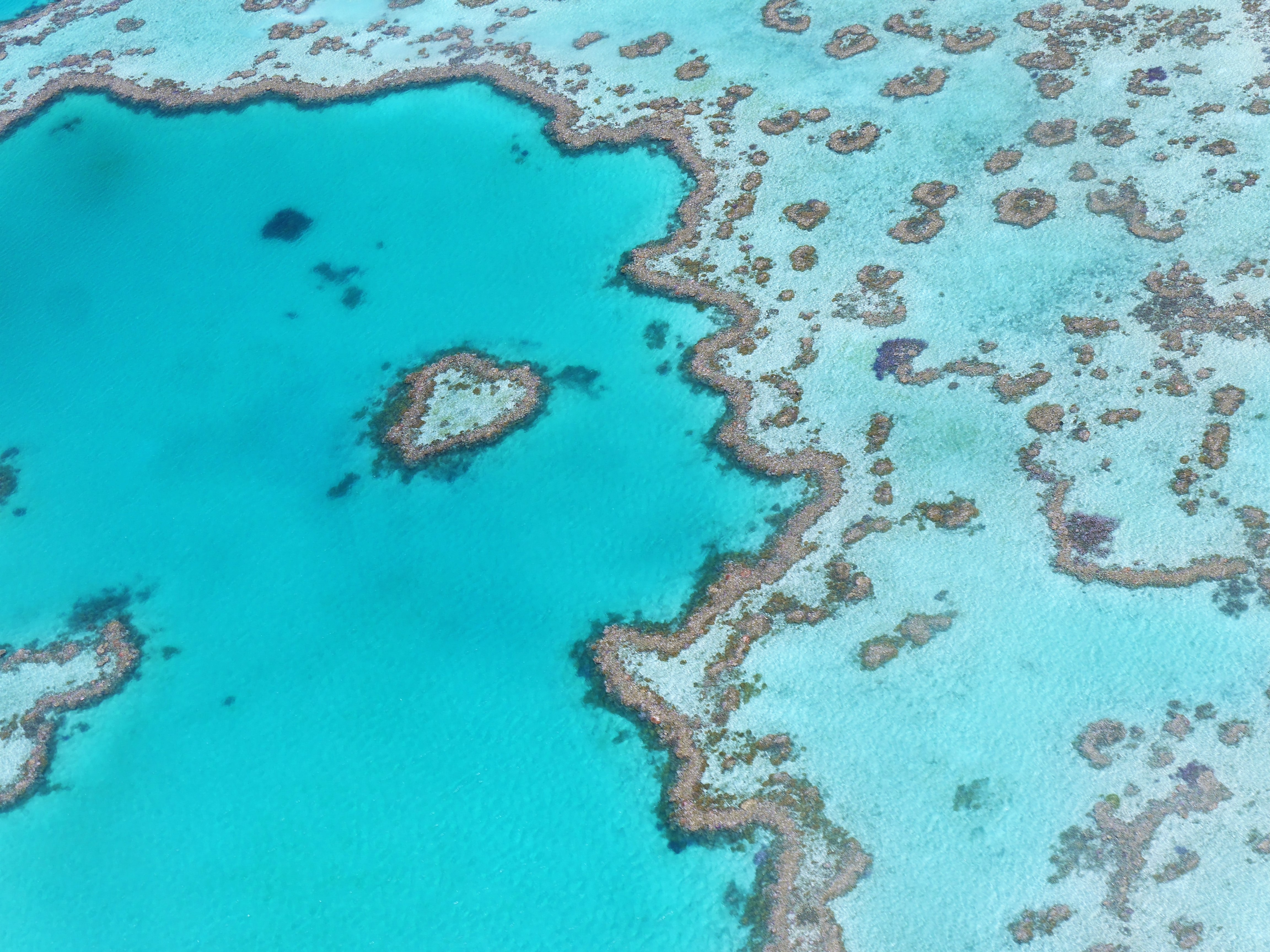
Townsville, Queensland, Australia
This coastal city has little in the way of sandy beaches or surf, but it does have shady parks, charming colonial buildings, and a boardwalk-flanked waterfront Esplanade with a terrific man-made beach and picnic facilities. The historic town center has thrived recently, with an influx of lively eateries and bars. There are also some excellent museum and a world-class aquarium.Queensland Parks and Wildlife Service has an office on Magnetic Island, but Townsville Enterprise’s information kiosks in Flinders Square and the Museum of Tropical Queensland (MTQ), on the mainland, are the best sources of visitor info about the island.
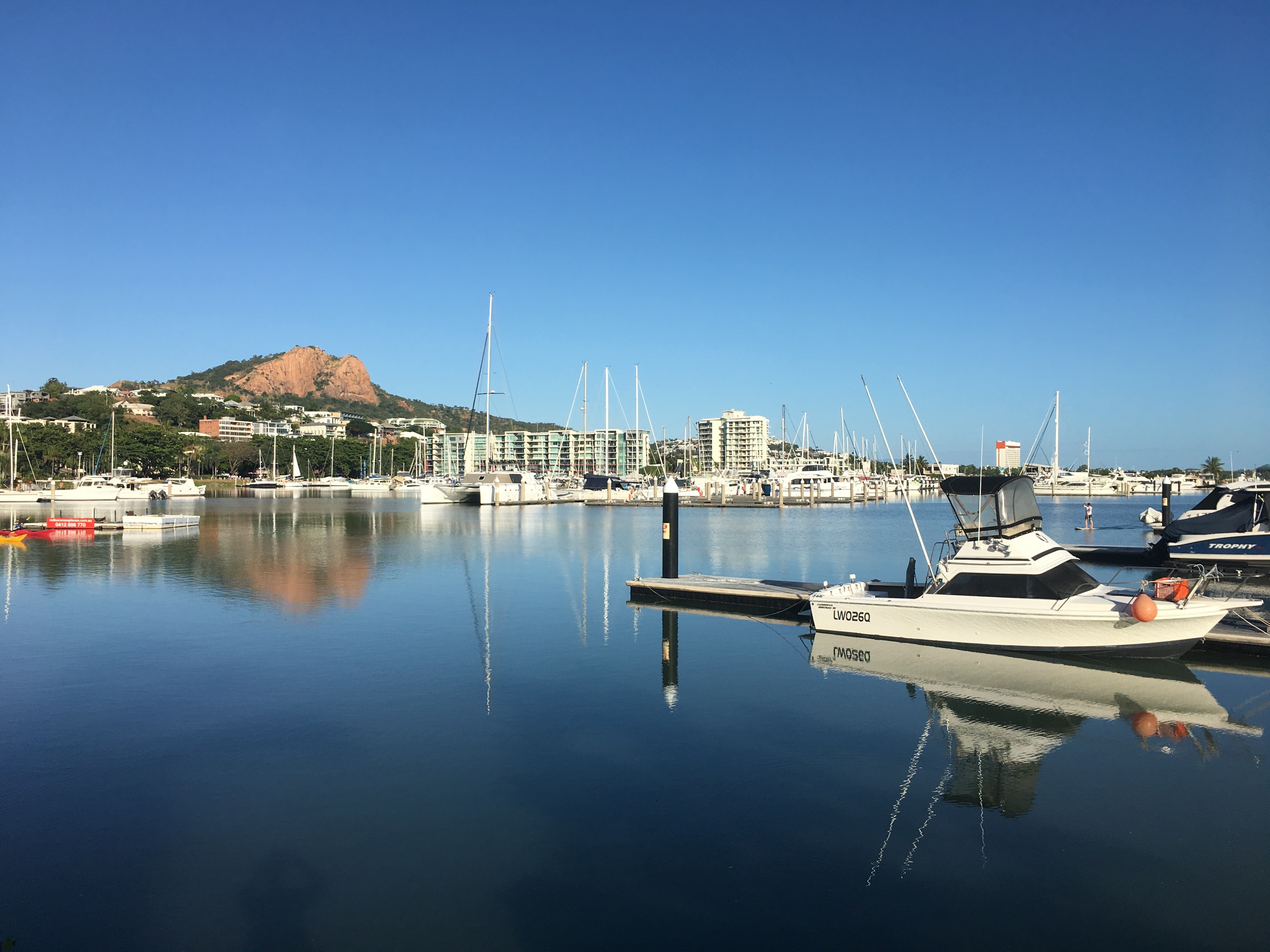
Airlie Beach, Australia
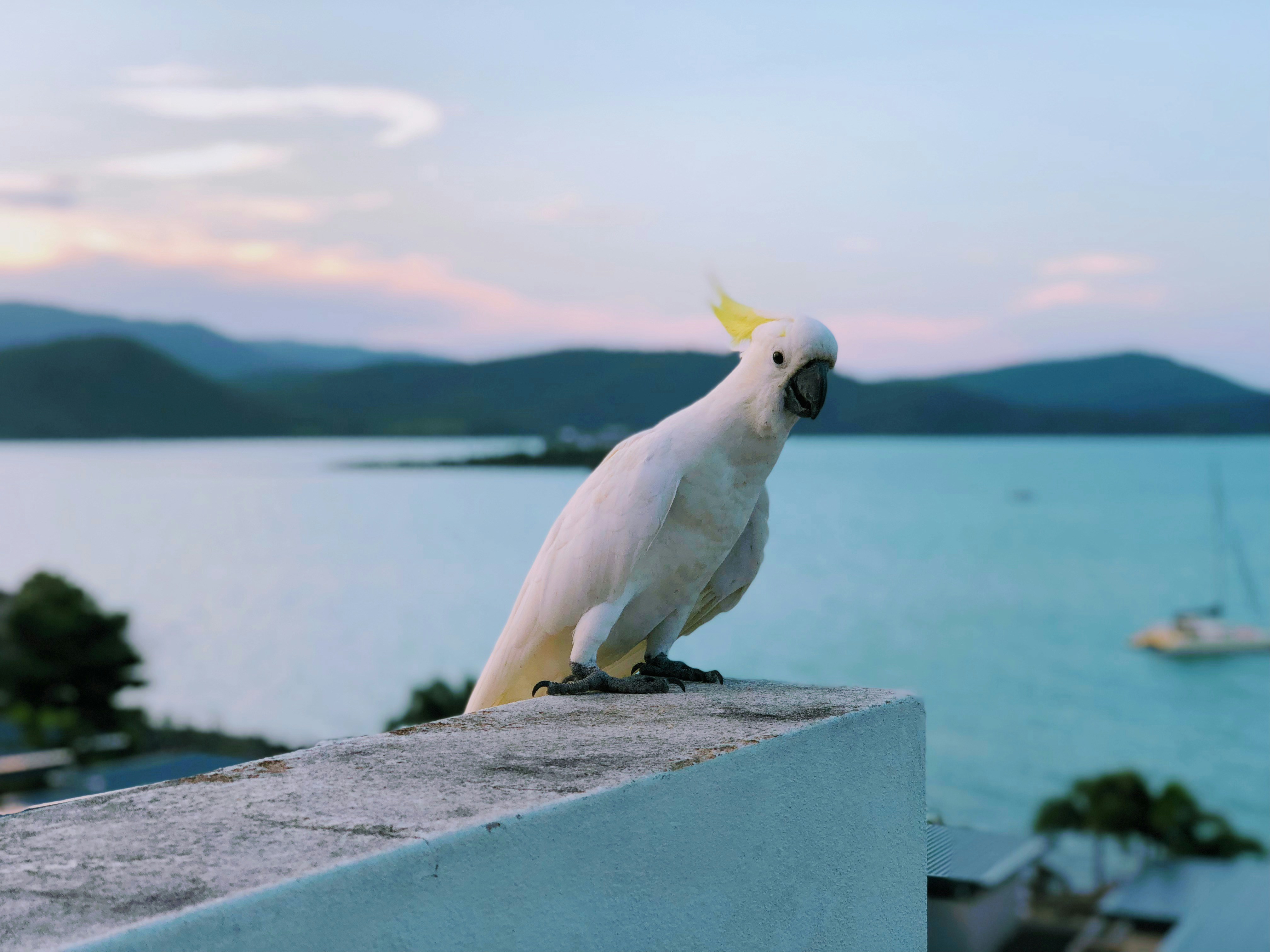
Airlie Beach, nestled in Queensland’s tropical Whitsunday Region, is a vibrant gateway to the Great Barrier Reef and the idyllic Whitsunday Islands. Renowned for its stunning waterfront, the town offers a relaxed yet lively atmosphere, with a picturesque lagoon perfect for swimming and sunbathing. Adventure seekers can enjoy sailing, snorkeling, scuba diving, and skydiving, while the surrounding rainforest and hiking trails provide scenic escapes for nature lovers. The town’s bustling streets are lined with cafés, restaurants, and lively nightlife, ensuring entertainment for all tastes. Airlie Beach is also a launch point for unforgettable island tours, including trips to the world-famous Whitehaven Beach. With its combination of natural beauty, adventure opportunities, and welcoming local culture, Airlie Beach is a must-visit destination for travelers seeking both relaxation and excitement in tropical paradise.
Cruising the Coral Sea
Brisbane, Queensland, Australia
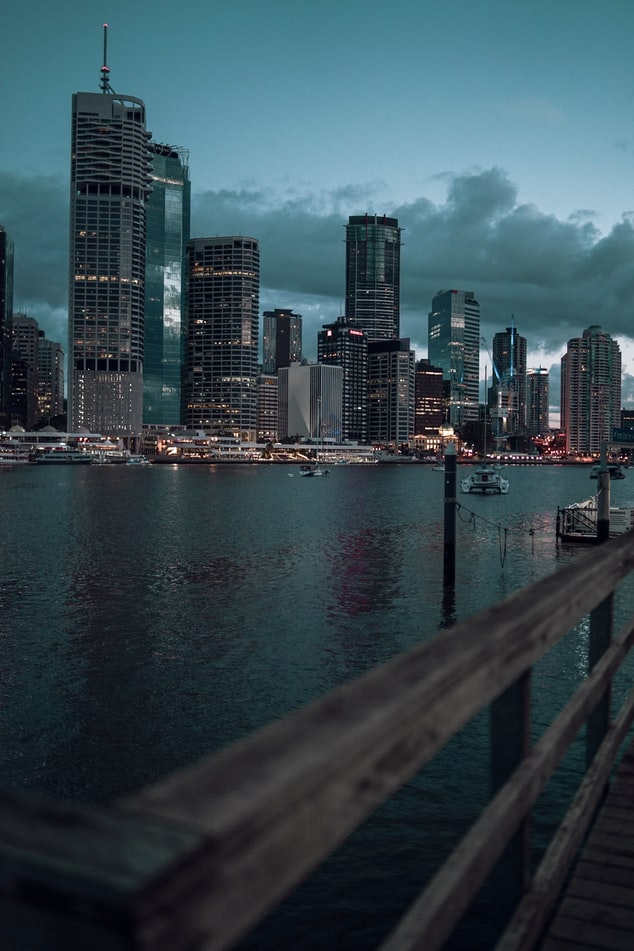
Founded in 1824 on the banks of the wide, meandering Brisbane River, the former penal colony of Brisbane was for many years regarded as just a big country town. Many beautiful timber Queenslander homes, built in the 1800s, still dot the riverbanks and inner suburbs, and in spring the city’s numerous parks erupt in a riot of colorful jacaranda, poinciana, and bougainvillea blossoms. Today the Queensland capital is one of Australia’s most up-and-coming cities: glittering high-rises mark its polished business center, slick fashion boutiques and restaurants abound, and numerous outdoor attractions beckon. In summer, temperatures here are broilingly hot and days are often humid, a reminder that this city is part of a subtropical region. Wear SPF 30-plus sunscreen and a broad-brimmed hat outdoors, even on overcast days.Brisbane’s inner suburbs, a 5- to 10-minute drive or 15- to 20-minute walk from the city center, have a mix of intriguing eateries and quiet accommodations. Fortitude Valley combines Chinatown with a cosmopolitan mix of clubs, cafés, and boutiques. Spring Hill has several high-quality hotels, and Paddington, New Farm, Petrie Terrace, West End, and Woolloongabba are full of an eclectic mix of restaurants and bars. Brisbane is also a convenient base for trips to the Sunshine and Gold coasts, the mountainous hinterlands, and the Moreton Bay islands.
Cruising the Tasman Sea
Sydney, New South Wales, Australia
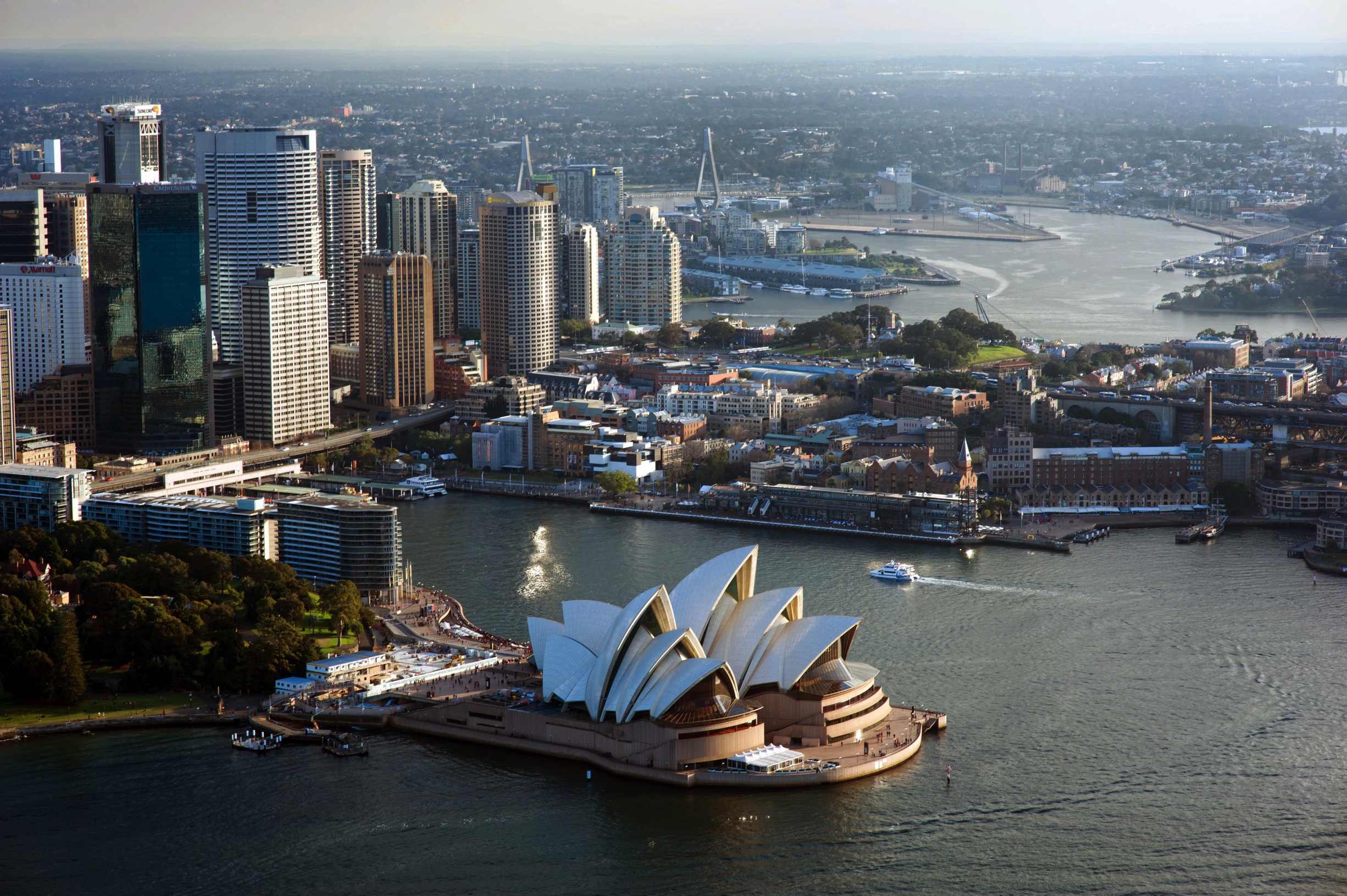
Sydney, capital of New South Wales and one of Australia’s largest cities, is best known for its harbourfront Sydney Opera House, with a distinctive sail-like design. Massive Darling Harbour and the smaller Circular Quay port are hubs of waterside life, with the arched Harbour Bridge and esteemed Royal Botanic Garden nearby. Sydney Tower’s outdoor platform, the Skywalk, offers 360-degree views of the city and suburbs.
Sydney, New South Wales, Australia
Sydney, capital of New South Wales and one of Australia’s largest cities, is best known for its harbourfront Sydney Opera House, with a distinctive sail-like design. Massive Darling Harbour and the smaller Circular Quay port are hubs of waterside life, with the arched Harbour Bridge and esteemed Royal Botanic Garden nearby. Sydney Tower’s outdoor platform, the Skywalk, offers 360-degree views of the city and suburbs.
Sydney, New South Wales, Australia
Sydney, capital of New South Wales and one of Australia’s largest cities, is best known for its harbourfront Sydney Opera House, with a distinctive sail-like design. Massive Darling Harbour and the smaller Circular Quay port are hubs of waterside life, with the arched Harbour Bridge and esteemed Royal Botanic Garden nearby. Sydney Tower’s outdoor platform, the Skywalk, offers 360-degree views of the city and suburbs.
Cabin Options
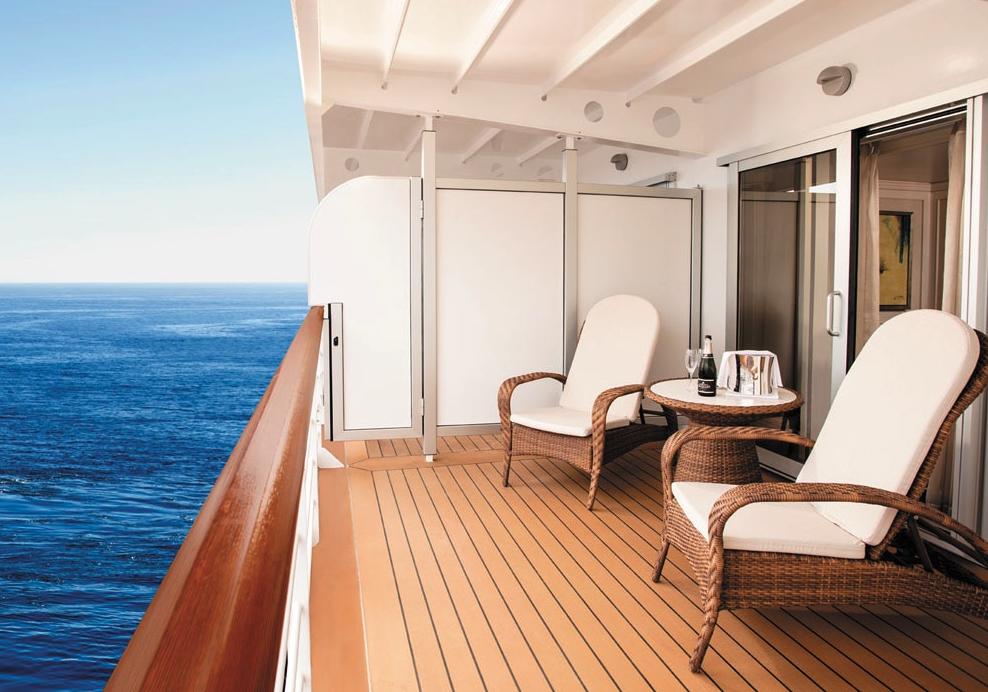
Veranda Suite
Deluxe Veranda Suite
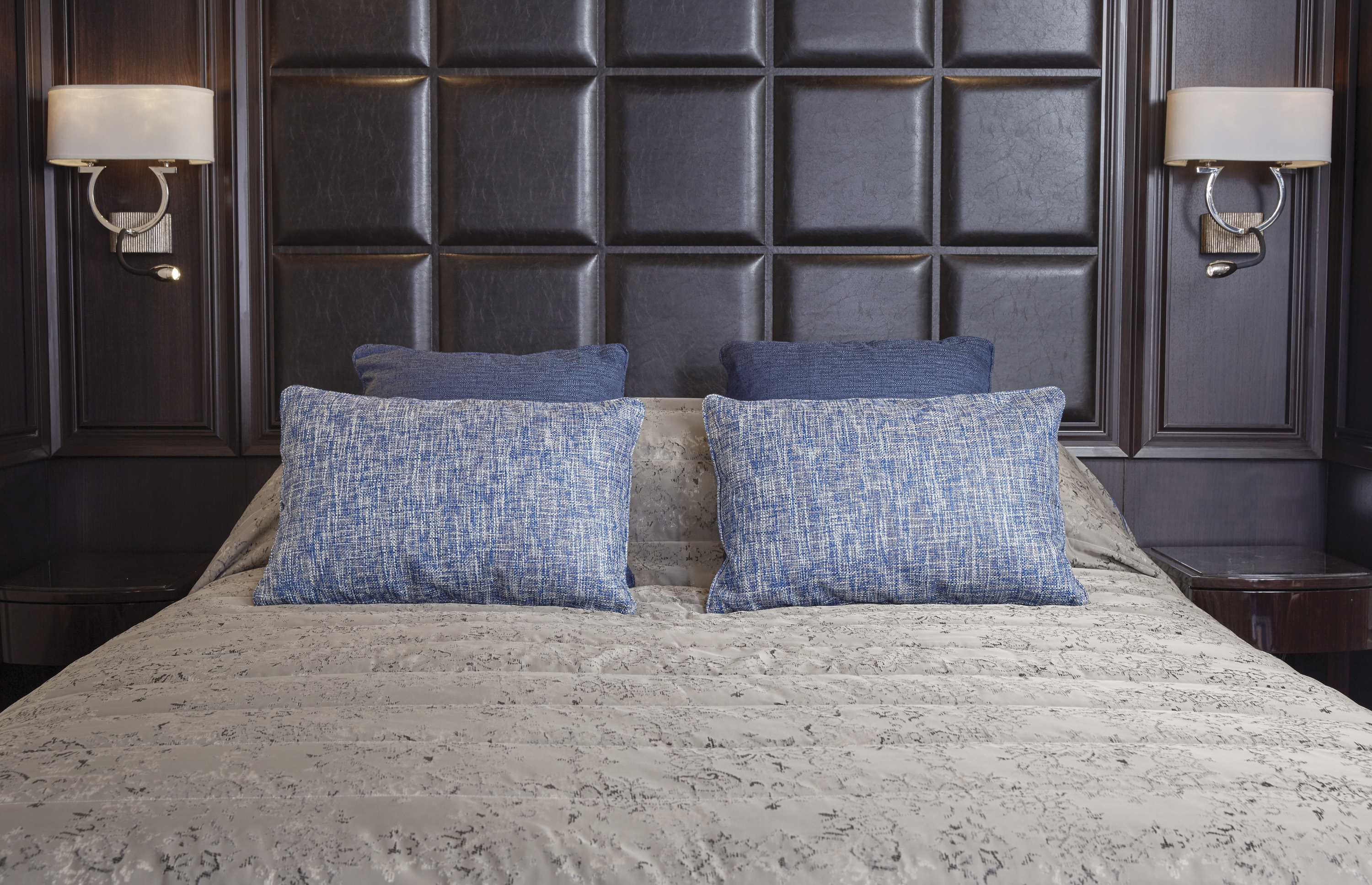
Serenity Suite
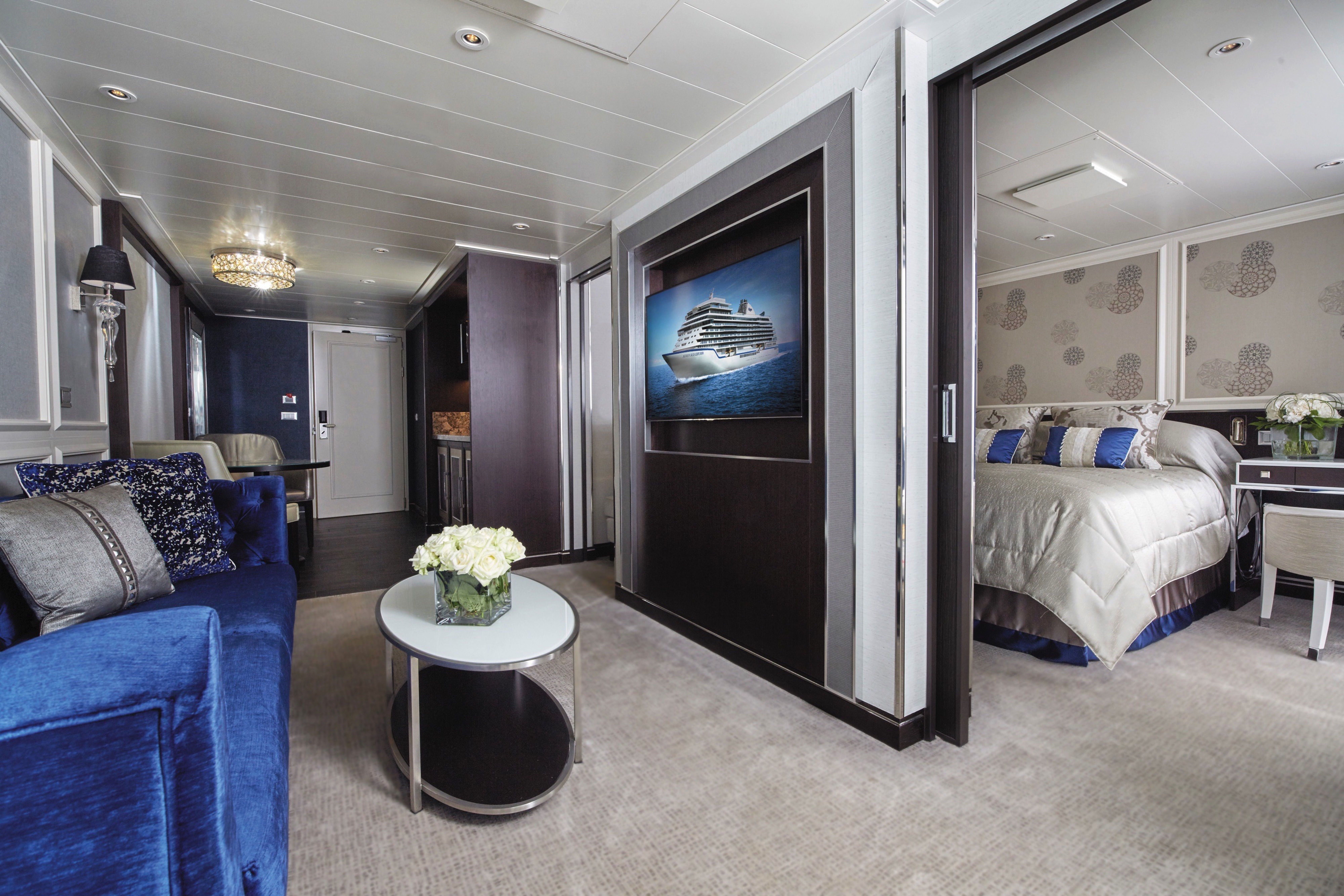
Concierge Suite
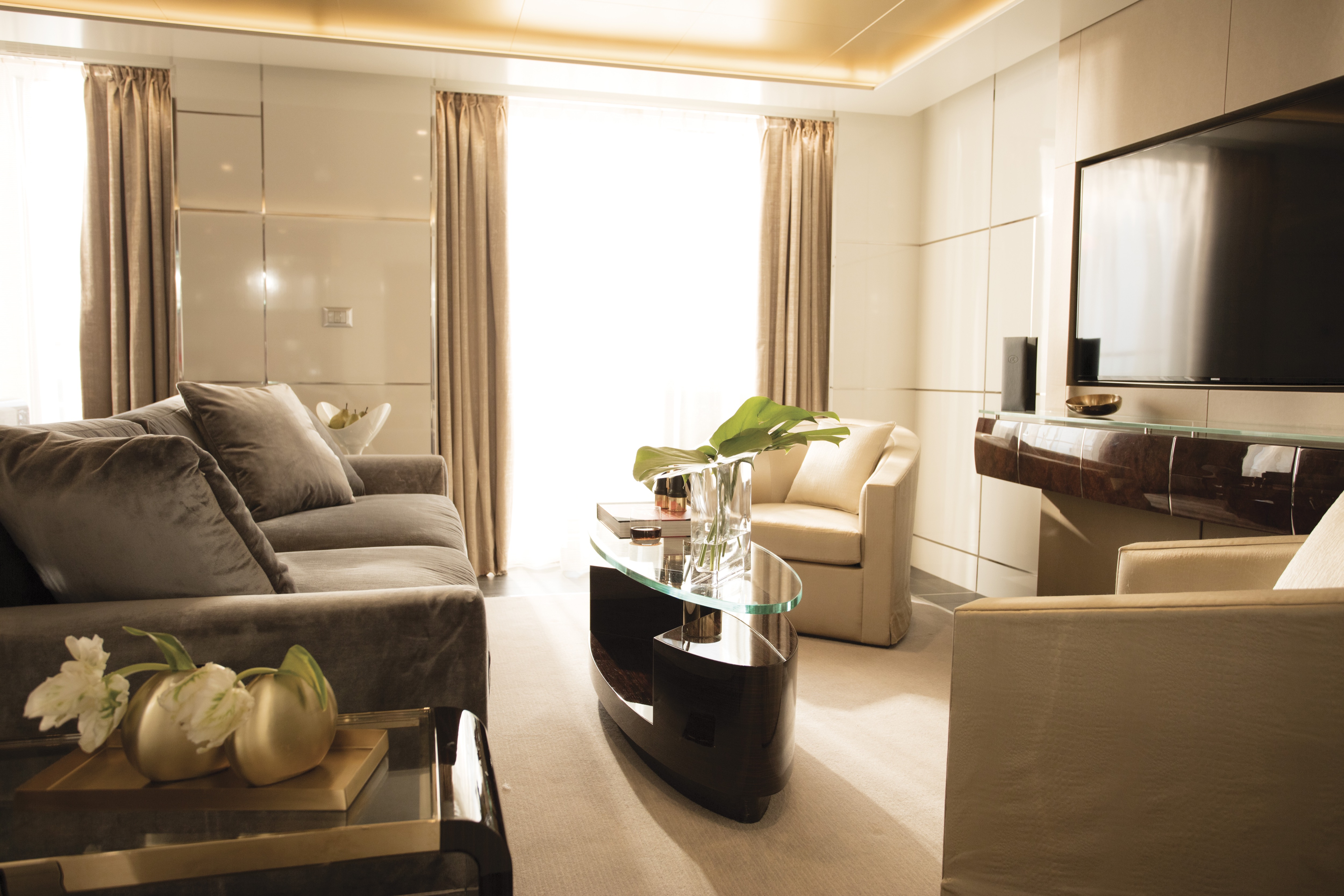
Penthouse Suite
Seven Seas Suite
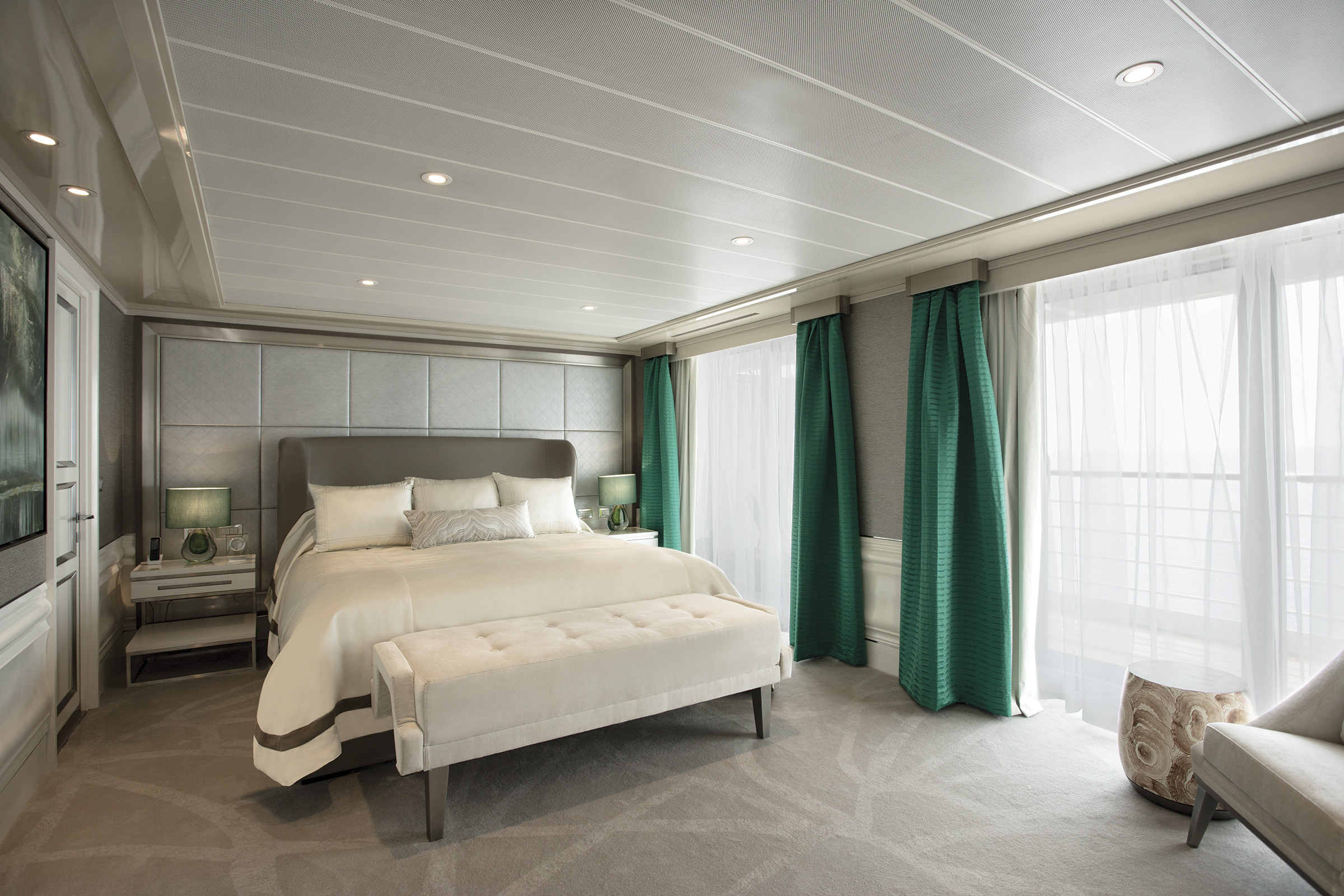
Explorer Suite
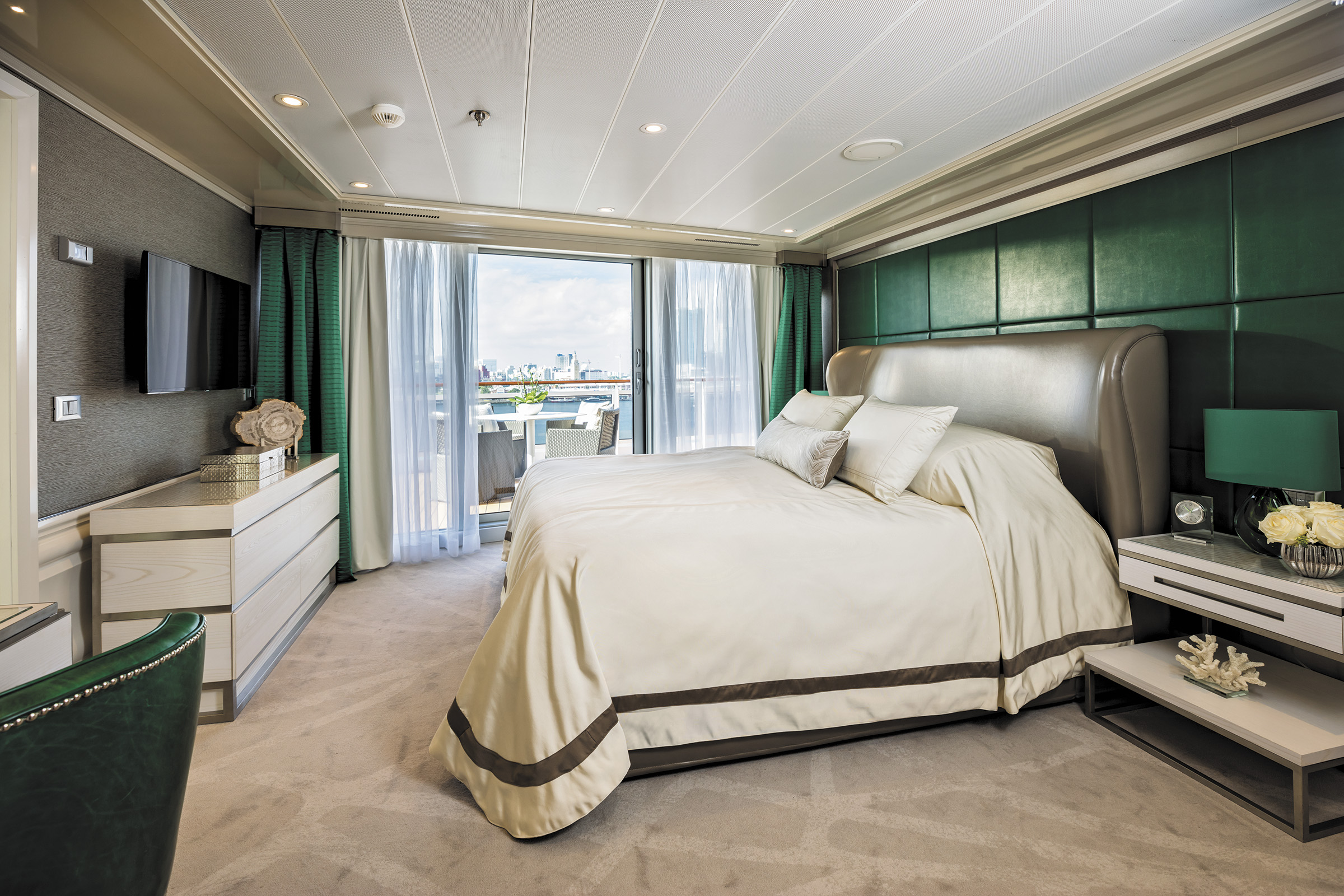
Grand Suite
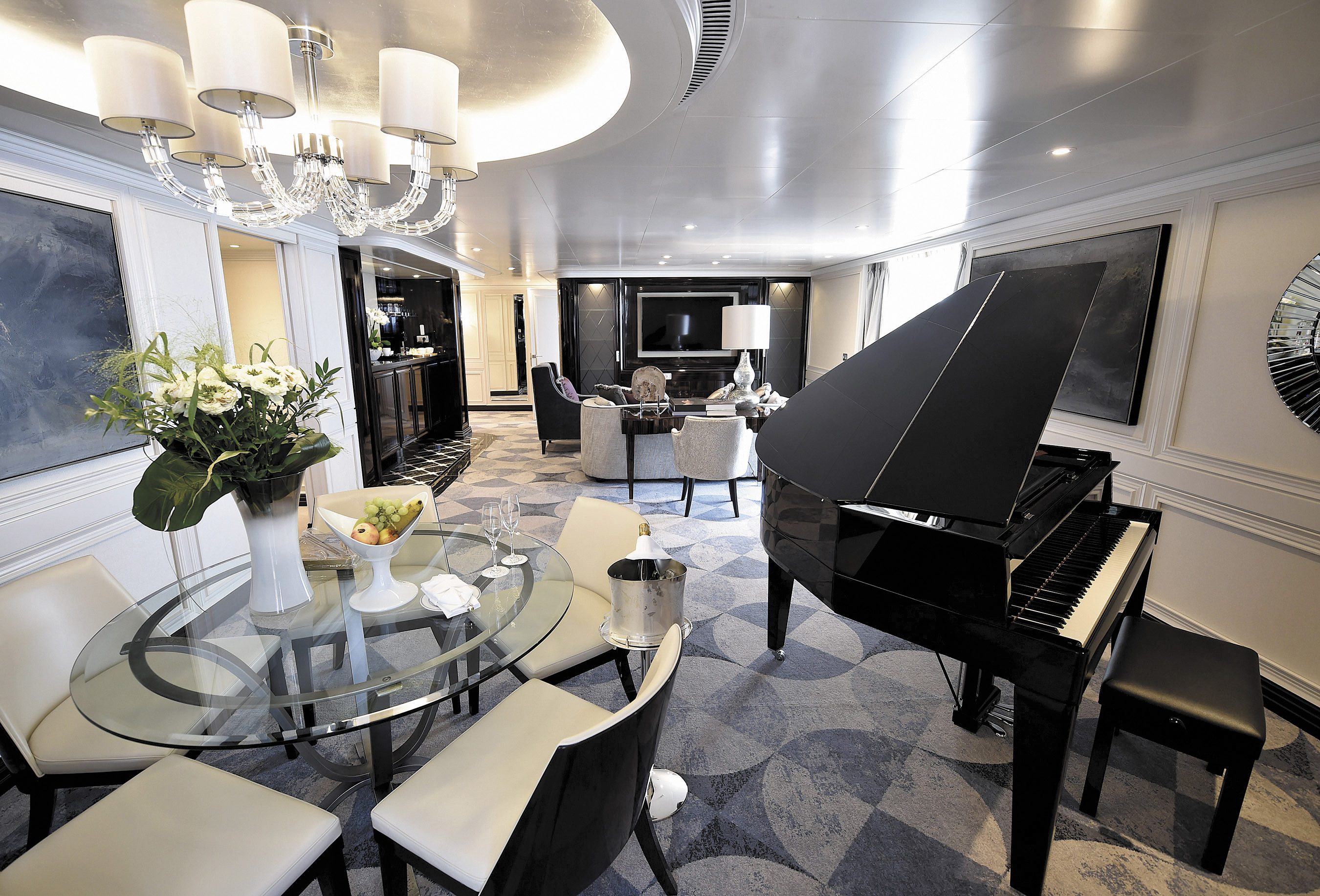
Signature Suite

Regent Suite
Ship Facilities
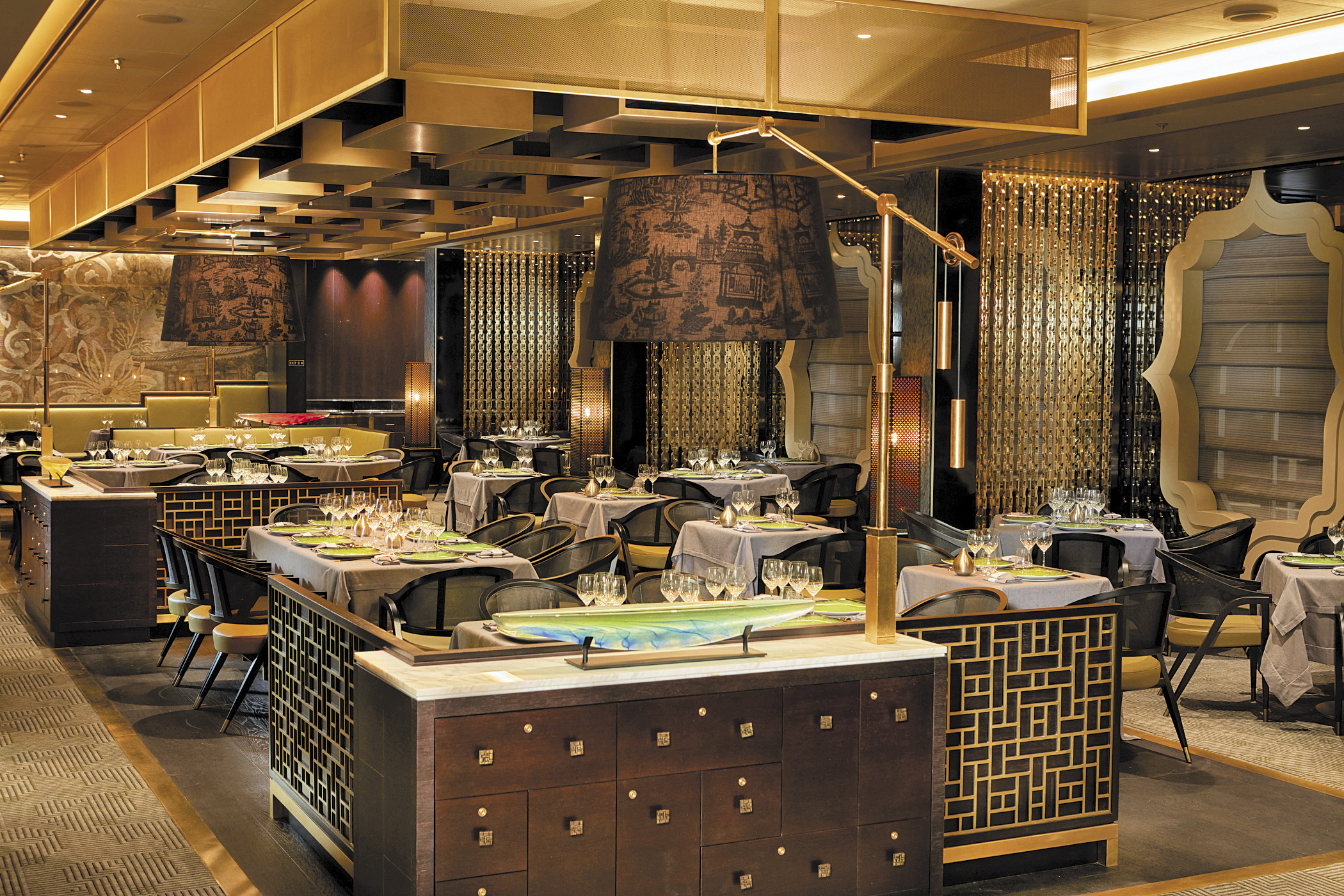
Pacific Rim
Walk past the Tibetan Prayer wheel at the Pacific Rim entrance and be prepared for an evening of culinary perfection with an array of Pan-Asian flavors and dishes. An elegantly exotic eatery.
Maximise your sense of the exotic as you pass a large Tibetan Prayer wheel on your way into Pacific Rim, our dining masterpiece that celebrates the culinary traditions of Asia. Taking a seat beneath huge lanterns and a hand-painted mural covering the entire back wall, you’ll receive a signature cocktail and the promise of an extraordinary culinary journey. Be sure to check out the ocean views through Pacific Rim’s lotus-shaped windows.
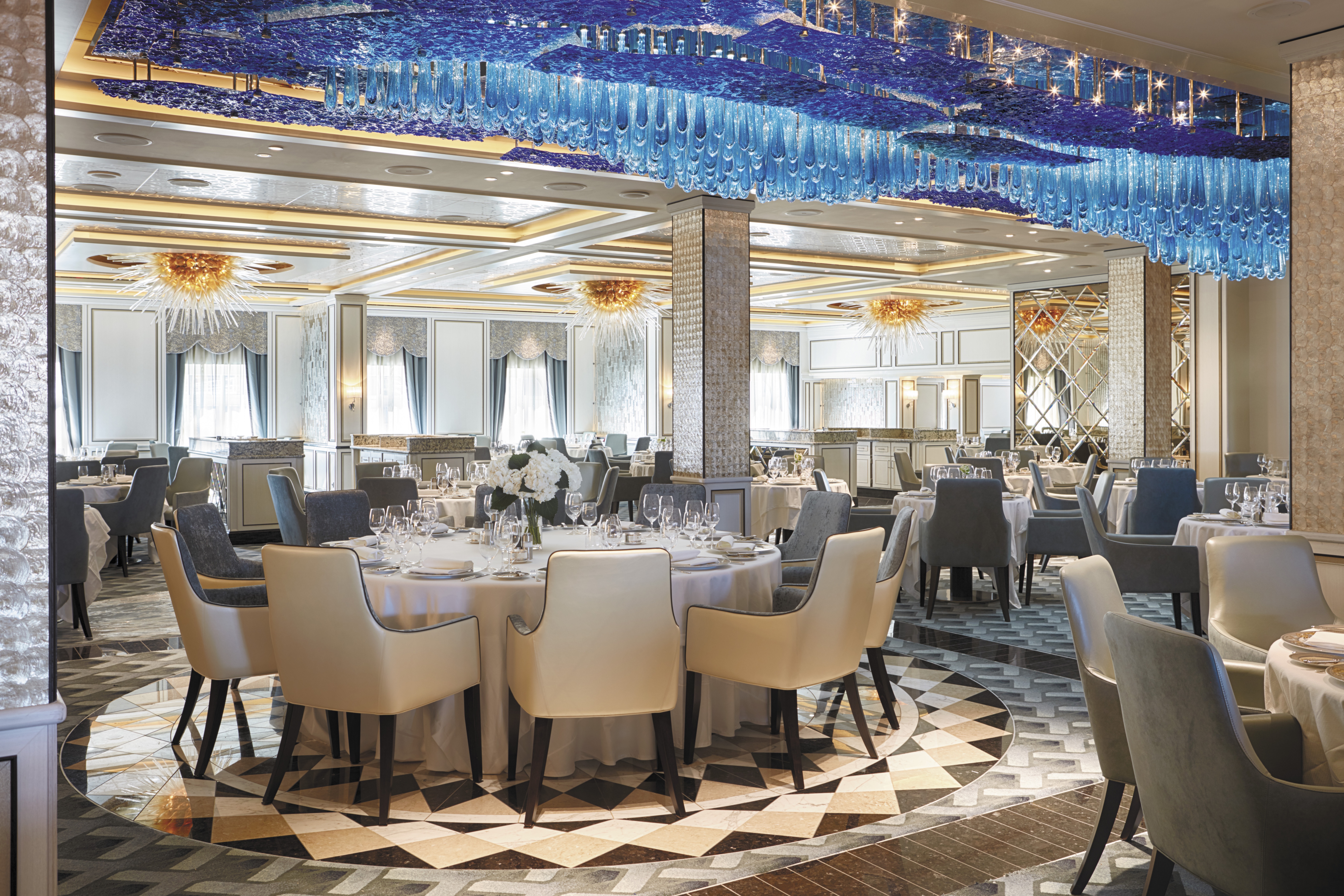
Compass Rose
The wondrous colors outside Seven Seas Explorer® are no match for the vivid cobalt-blue glass installation on the ceiling of our elegant Compass Rose, a perfect setting for breakfast and dinner.
We are pleased to re-introduce the elegantly enhanced Compass Rose, the largest specialty restaurant across our fleet. Ensuring a tantalizing mix of new and familiar items on every visit, the new lunch and dinner menus offer a vast selection to meet your discerning tastes. Exclusively aboard Seven Seas Mariner®, Seven Seas Voyager®, and Seven Seas Navigator® for lunch, you may choose from a robust list of appetizers and main courses from our specialty restaurants. And across our fleet for dinner, you have the unique ability to design your very own entrée from preferred sides, sauces, pastas and main features of beef, poultry and fish. This is in addition to sinfully indulgent desserts made by talented bakers and pastry chefs. With daily changing menus, the refreshed Compass Rose offers more choices than ever before.
Pool Grill
When you desire a quick bite after sunbathing or swimming in the pool, our Pool Grill is the place for grilled-to-order burgers, seafood, sandwiches, even hand-dipped ice cream sprinkled with tasty toppings.
The Pool Grill is truly a come-as-you-are venue. Enjoy this casual dining experience whether you’re getting a bite after sunbathing or swimming in the pool. The Pool Grill is open-air, yet abundantly shaded for comfortable dining at lunch or dinner. Enjoy grilled-to-order burgers, grilled seafood, sandwiches, and fresh salads. Treat yourself to milkshakes and malts or an old-fashioned hand-dipped ice cream dessert with toppings.
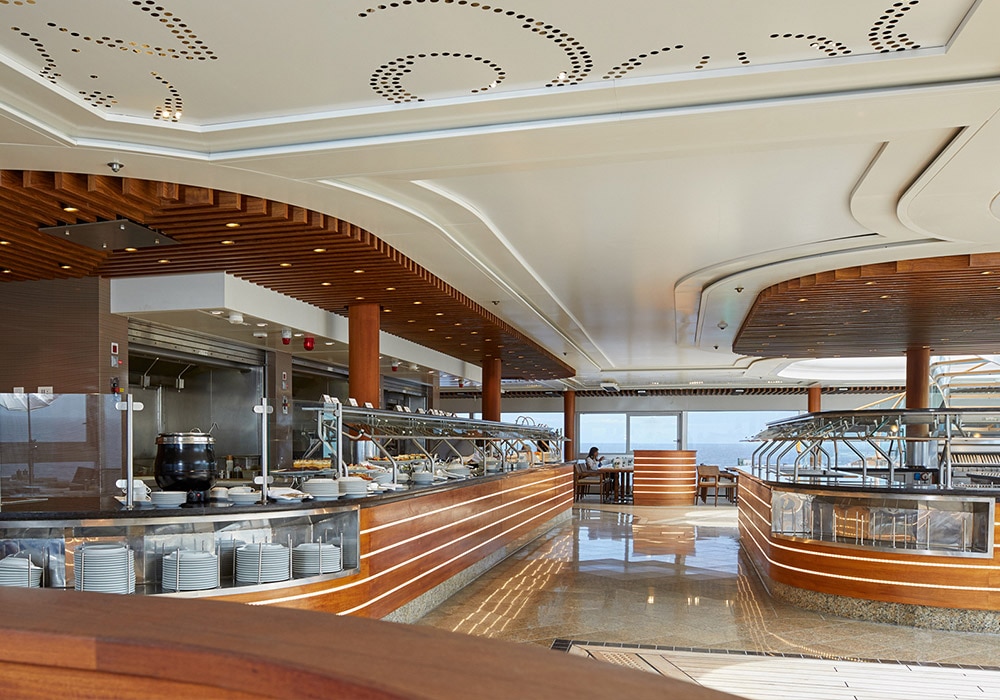
La Veranda
Located on Deck 11 aft, guests take in stunning ocean views while enjoying elegant breakfast and lunch buffets in the chic indoor dining room or al fresco on the shaded, open-air deck.
Take in stunning ocean views while enjoying elegant breakfast and lunch buffets in the chic indoor dining room or al fresco on the shaded, open-air deck. Breakfasts include traditional favorites, as well as a made-to-order omelet station, a variety of fresh fruits and pastries, along with daily specials, like fluffy Belgian waffles with fresh blueberry compote. For lunch indulge in an array of choices from a bountiful salad bar, gourmet sandwiches, hot carving stations and delicious desserts.
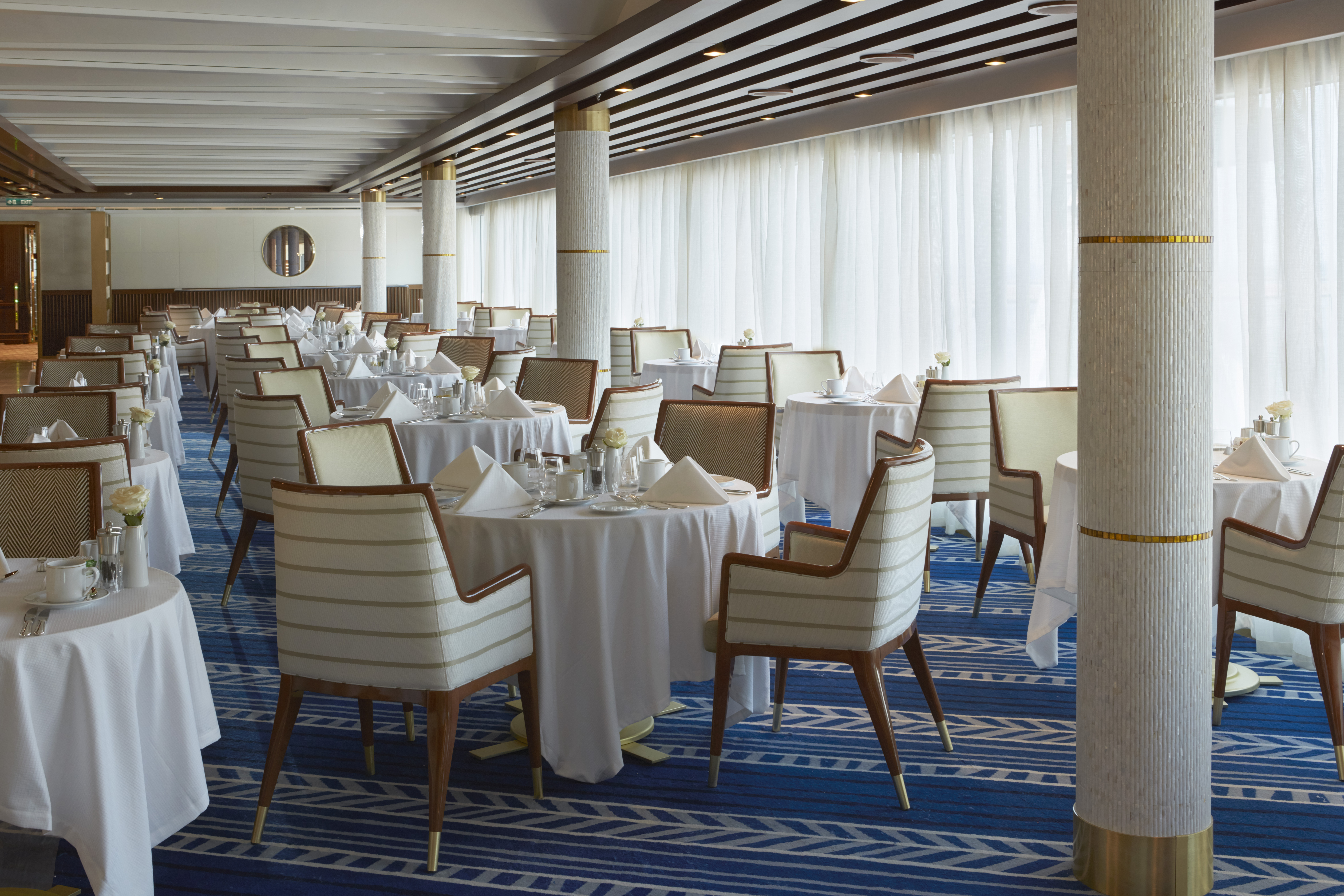
Prime 7
From perfectly aged New York strip, porterhouse and succulent filet mignon to smoked salmon with a phenomenal tamarind-whiskey sauce, Prime 7 elevates classic American fare to lofty heights.
A true classic in every sense, Prime 7 sets a new standard in steakhouse fare with its contemporary interpretation of an American classic. Handsomely decorated with supple leather wing-back chairs, burnished woods and rich earth-toned fabrics, Prime 7 exudes a distinct, intimate elegance. This is sophistication redefined, a luxurious setting to enjoy classic steakhouse cuisine with a modern flair.
All the traditional starters are here, including Jumbo Lump Crab Cakes, Classic Steak Tartare, and Clam Chowder. Of course, beef is the undisputed star, and it is aged for a minimum of 40 days to ensure the ultimate tenderness and juiciness. New York Strip, Porterhouse Steak and succulent Filet Mignon only touch upon the selections. Mouthwatering alternatives include Applewood Smoked Salmon and Dover Sole.
Reservations Required
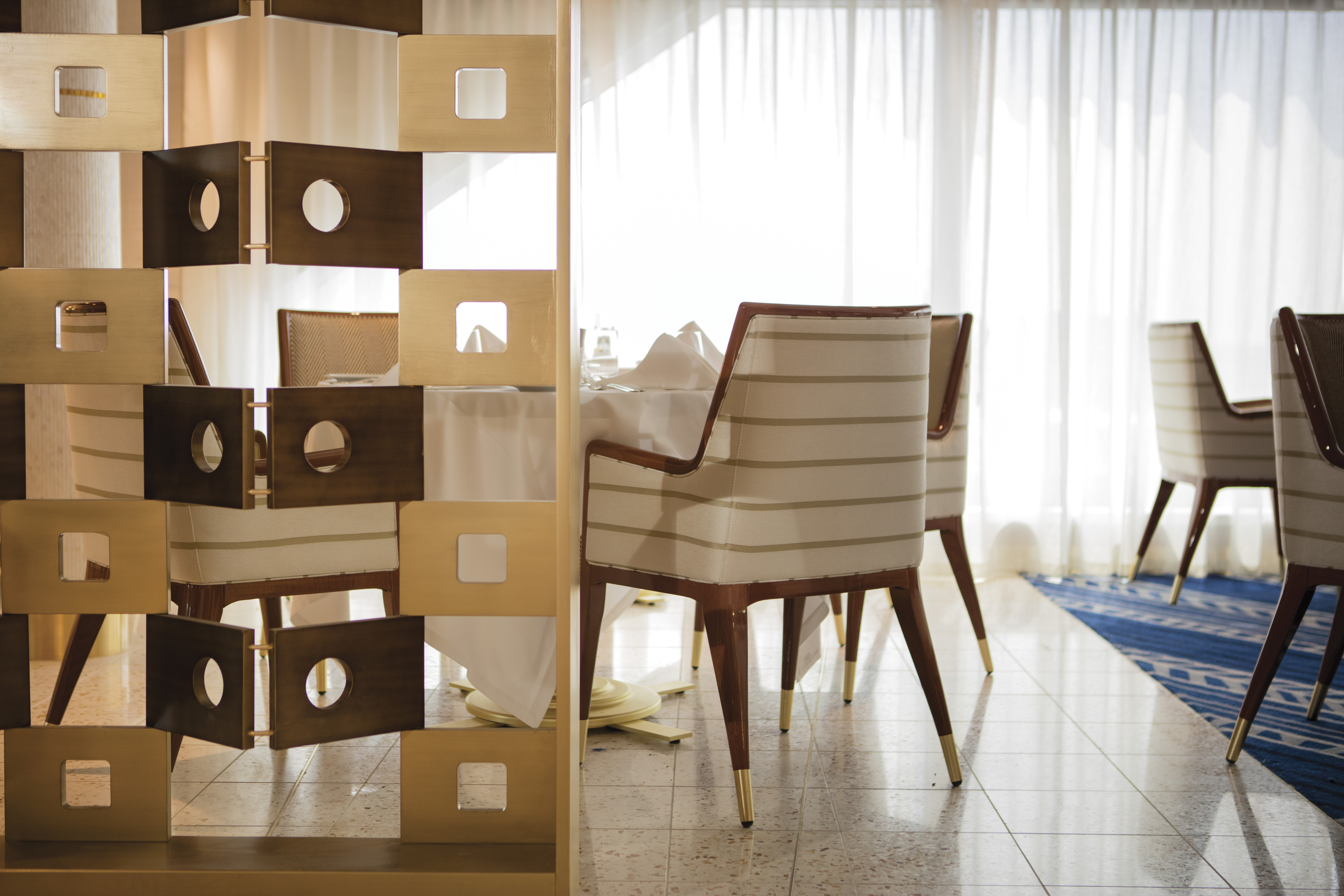
Sette Mari at La Veranda
Enjoy an extensive menu of authentic antipasti and Italian specialties served á la carte and paired with fine Italian wines. All dishes are prepared with the freshest gourmet ingredients and served by our attentive waiters.
Each evening, La Veranda transforms into Sette Mari at La Veranda, a casual, intimate dining experience. Choose from authentic Italian specialties inspired by family recipes that span generations, or opt for something with a modern twist like a spice-crusted tuna steak with braised endive, polenta and salmoriglio. Savour it all with a perfectly paired Tuscan wine. Sette Mari at La Veranda is open for dinner only.
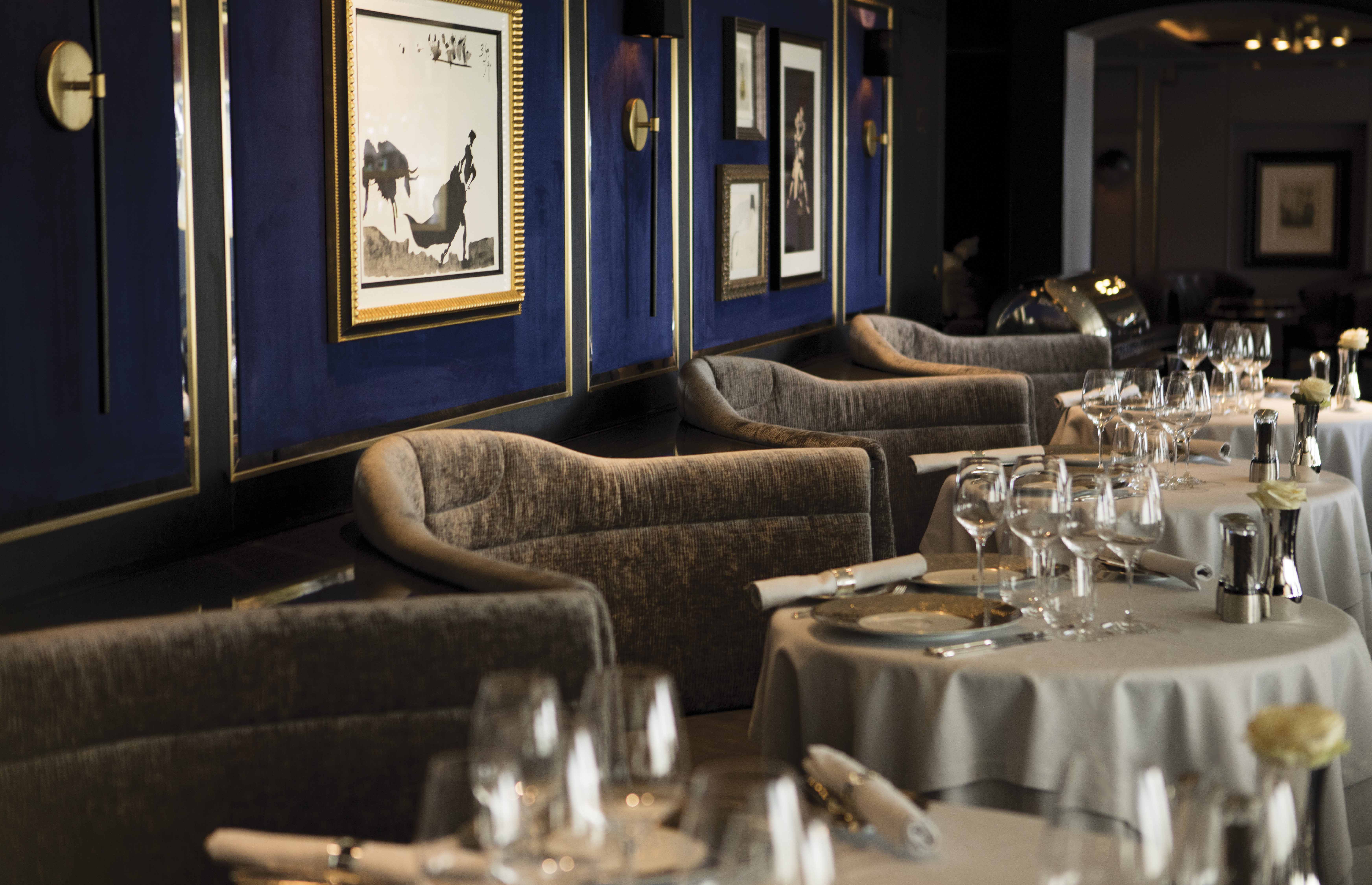
Chartreuse
A restaurant with a modern French menu and attention to detail you’ll notice in its Parisian décor, expertly prepared dishes and wait staff. About the closest thing to a Parisian culinary gem on the high seas.
Chartreuse evokes memories of a chic Parisian fine dining restaurant discovered during an evening stroll. Wherever you are seated in this regal restaurant, you will be treated to a succulent dinner while enjoying incredible ocean views. The restaurant ambiance is complemented by a menu that features modern French dishes. Available on Seven Seas Grandeur™, Seven Seas Splendor®, Seven Seas Explorer®, Seven Seas Mariner® and Seven Seas Voyager® with reservations each evening for dinner, and open for lunch on Seven Seas Explorer on alternate port days. French bistro style food is offered.
Reservations Required
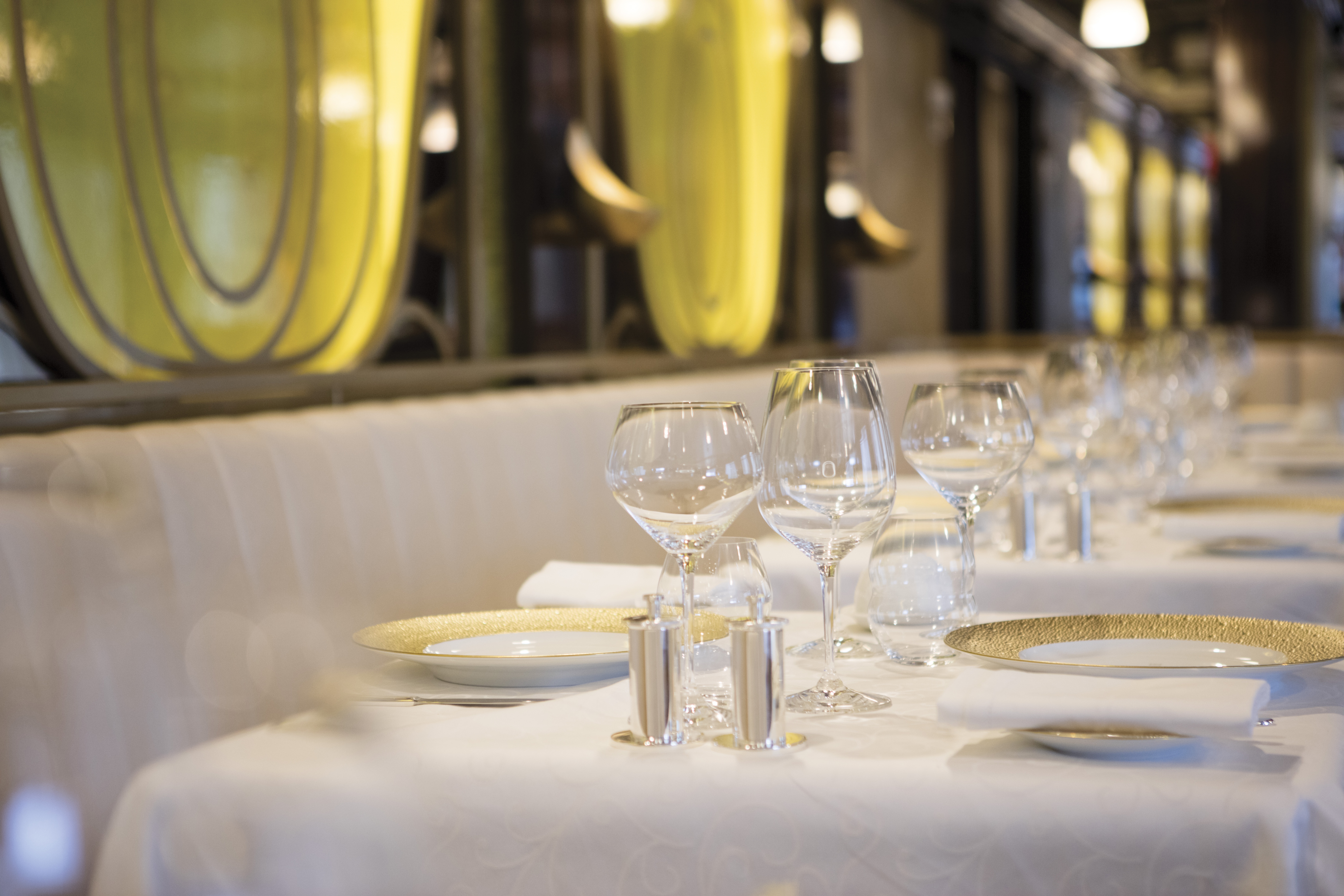
Coffee Connection
Grab a barista-made coffee, check the headlines of international newspapers or choose from a variety of handmade pastries in our cozy café which is open throughout the day.
Enjoy complimentary coffee drinks prepared by our baristas, as well as delicious pastries, gourmet sandwiches and homemade cookies. Whether perusing international newspapers or simply taking in an always spectacular view, our café is the perfect place to relax, converse and enjoy coffee and snacks throughout the day.
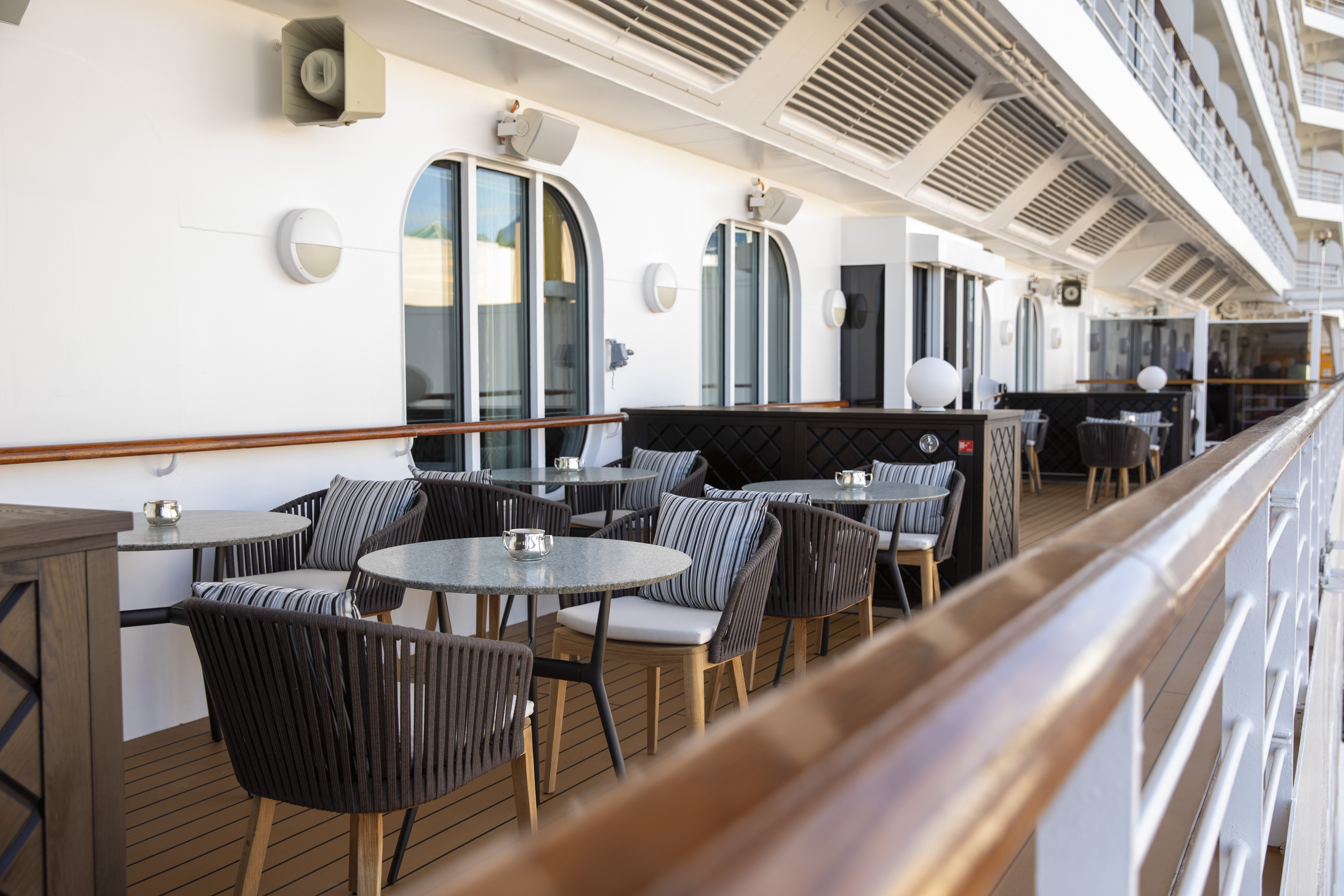
Room Service
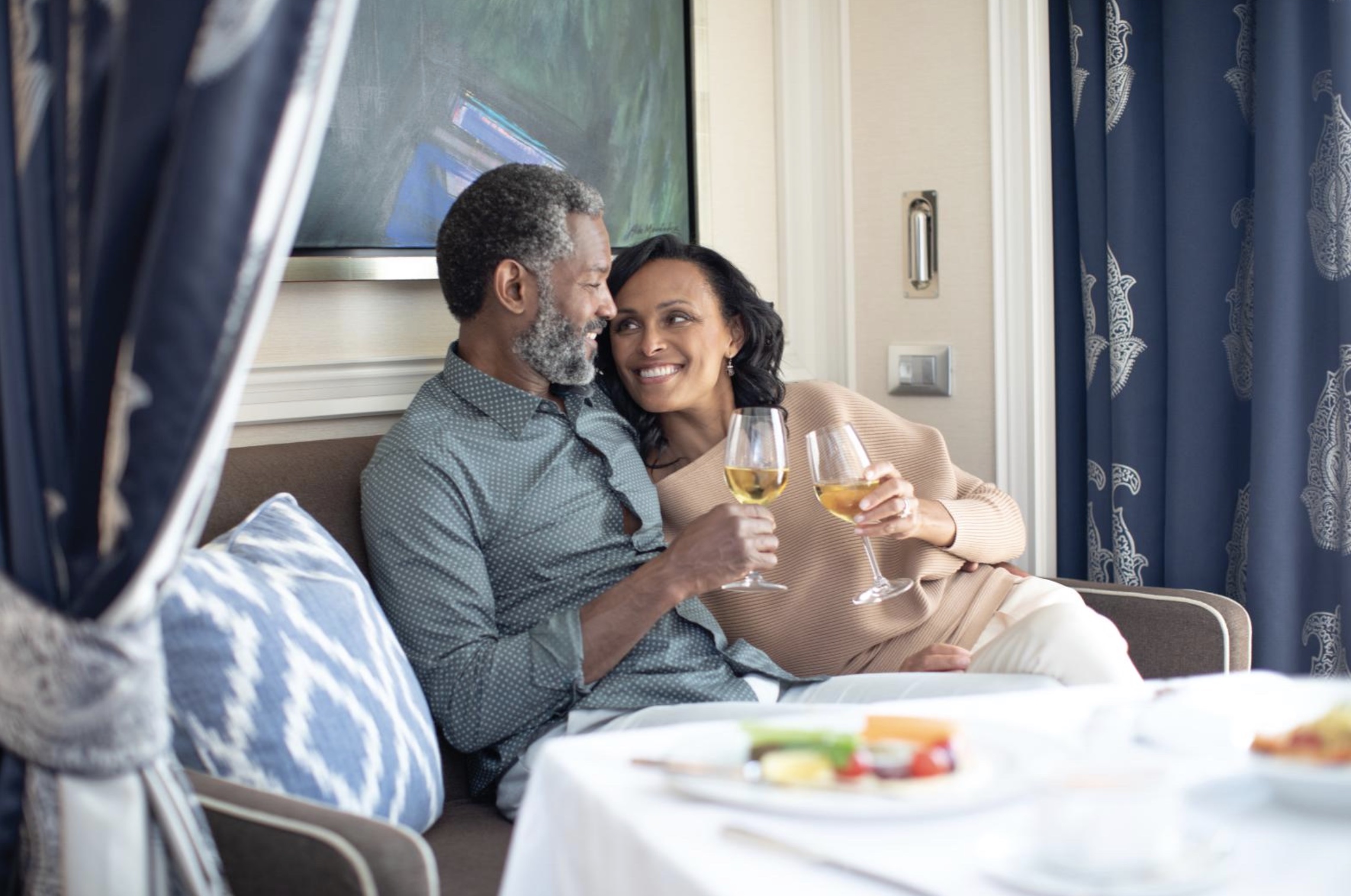
Knowing that guests sometimes prefer to simply dine in the comfort of their suites, we offer room service around the clock. Select from an extensive room service menu and the wait staff will promptly serve your order in the comfort of your suite. During normal dining hours, guests may also order from the Compass Rose menu, which changes daily and features Continental, vegetarian, and kosher cuisines. Dinners will be graciously served course-by-course.
The Study
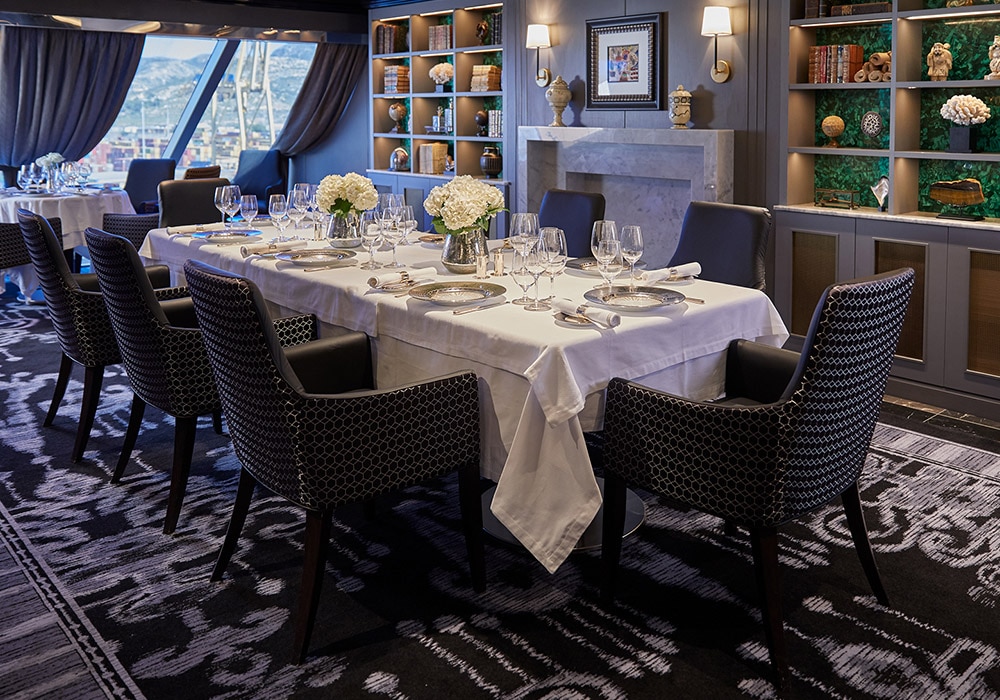
Guests of the most luxurious suite on the high seas — the Regent Suite on Seven Seas Explorer® — have exclusive access to The Study, a private, ornately decorated dining room that seats up to 12 guests.
In an atmosphere that’s reminiscent of a personal library in an elegant, stately home, Regent Suite guests may gather in The Study to privately dine on meals from the adjacent Chartreuse and Prime 7 restaurants. Such an exclusive opportunity further establishes the Regent Suite on Seven Seas Explorer® as the pre-eminent luxury accommodation on the high seas.
Gourmet Explorer Tours
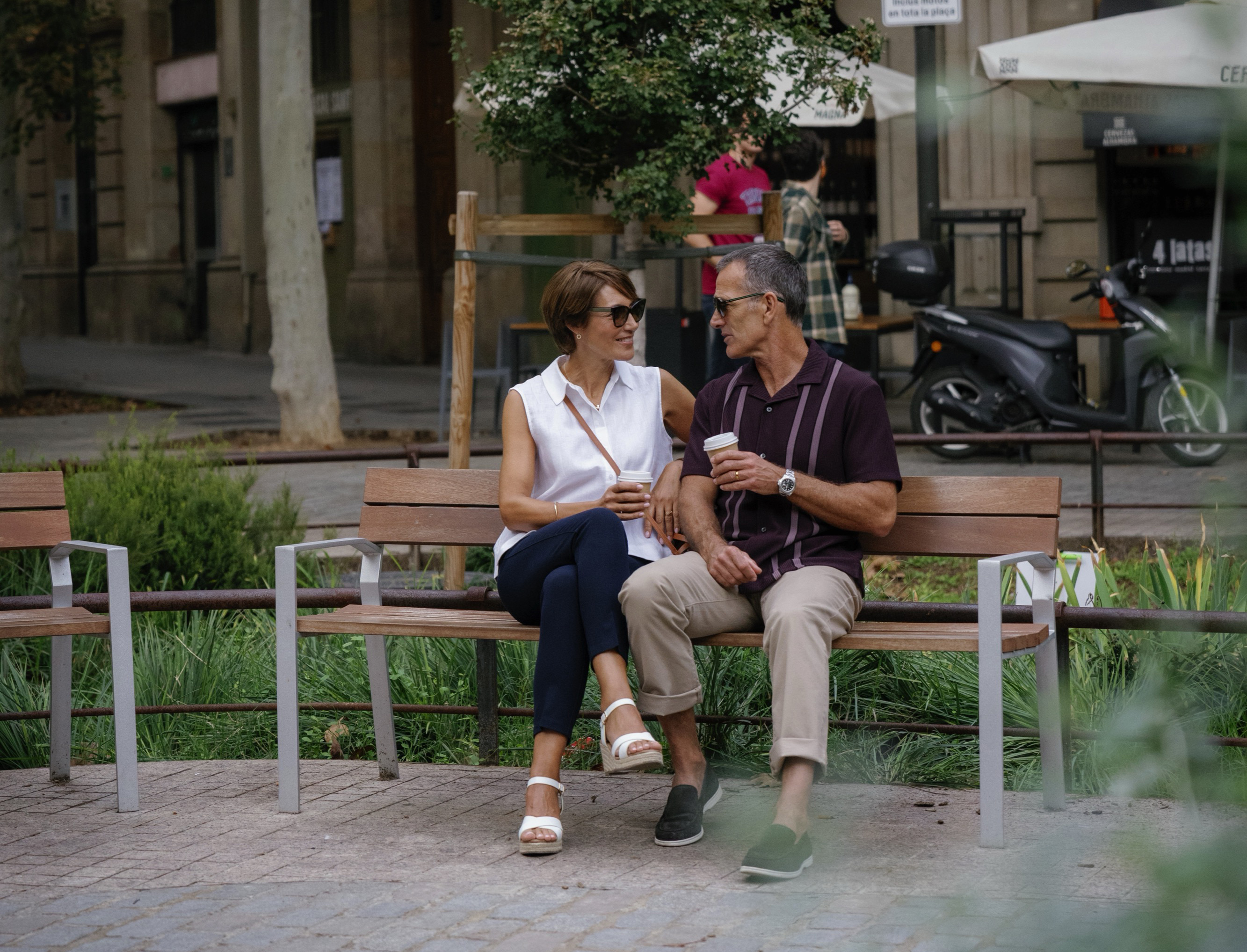
Our distinctive Gourmet Explorer Tours, offered exclusively aboard Seven Seas Explorer, allows guests the unique opportunity to experience the culinary culture of the world’s most delicious destinations. From savouring the authentic flavours of a region to learning new techniques in local cooking classes, guests can choose from a variety of optional tours that take them to local markets to find exotic spices, sample delicious wines at breathtaking estates and savour gourmet meals expertly prepared by renowned chefs. Due to their unique itineraries, Gourmet Explorer tours require a discounted, supplementary charge.
Regent Choice Shore Excursions
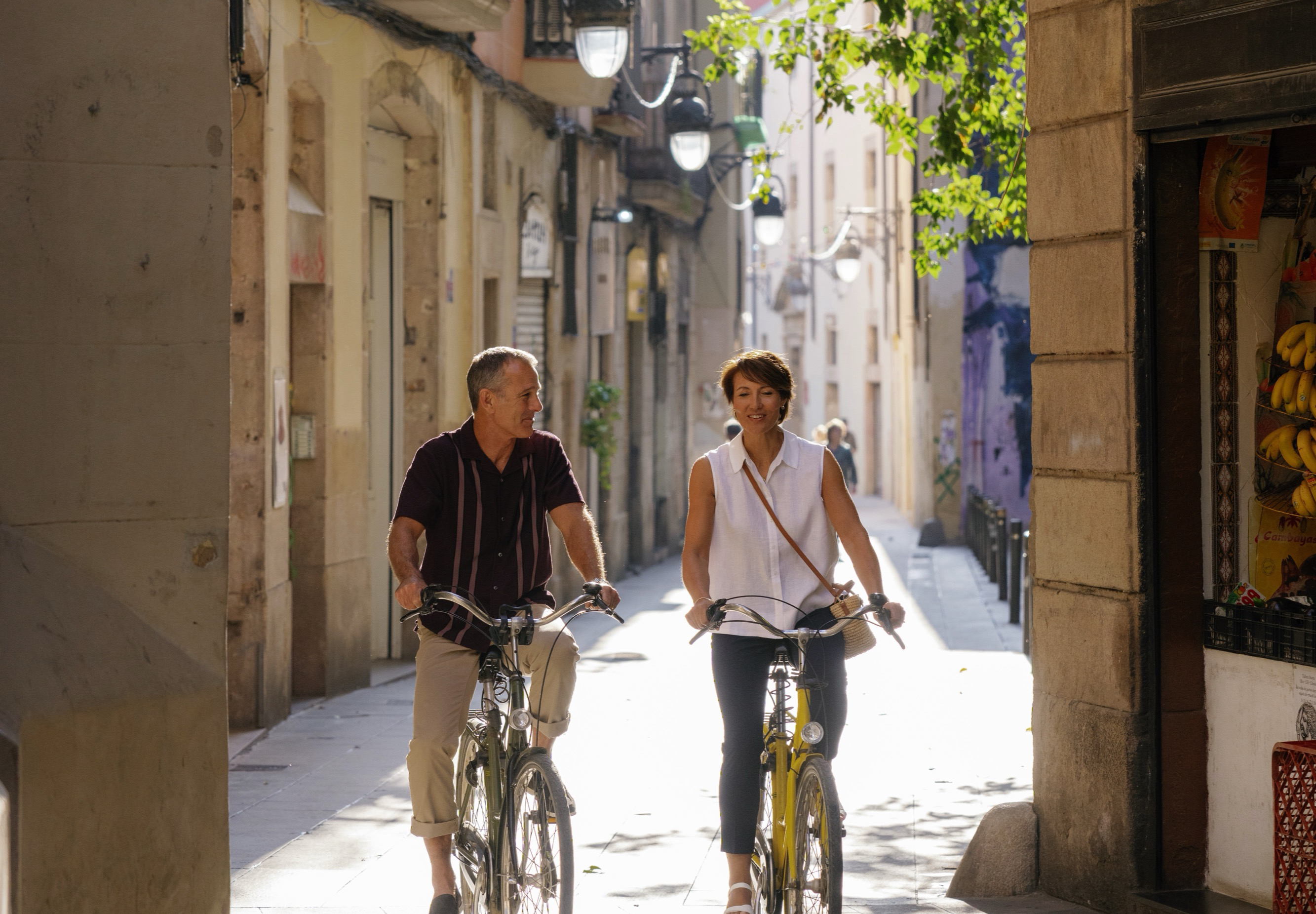
Take your experience to another level with the select itineraries and smaller group tours offered by our Regent Choice Shore Excursions. These unique opportunities require a discounted, supplementary charge and invite you to discover the heights of travel, from our Gourmet Explorer Tours to special experiences that take you off the beaten path.
As the name suggests, these excursions work a little harder to engage your explorer spirit. Unique itineraries and smaller groups create more personal experiences… and memories of a lifetime.
UNIQUE, UNPARALLELED EXPERIENCES
Soaring over Alaskan forests and mountains via helicopter en route to feeling the majesty of Mendenhall Glacier beneath your feet. Discover the best our world has to offer through the unparalleled experiences you’ll enjoy with Regent Choice Shore Excursions.
Enhance your shoreside experience with a Regent Choice Small Group tour. Hosting up to 16 guests, these tours provide a more intimate experience and allow for more personal engagement with your knowledgeable guide.
Culinary Arts Kitchen
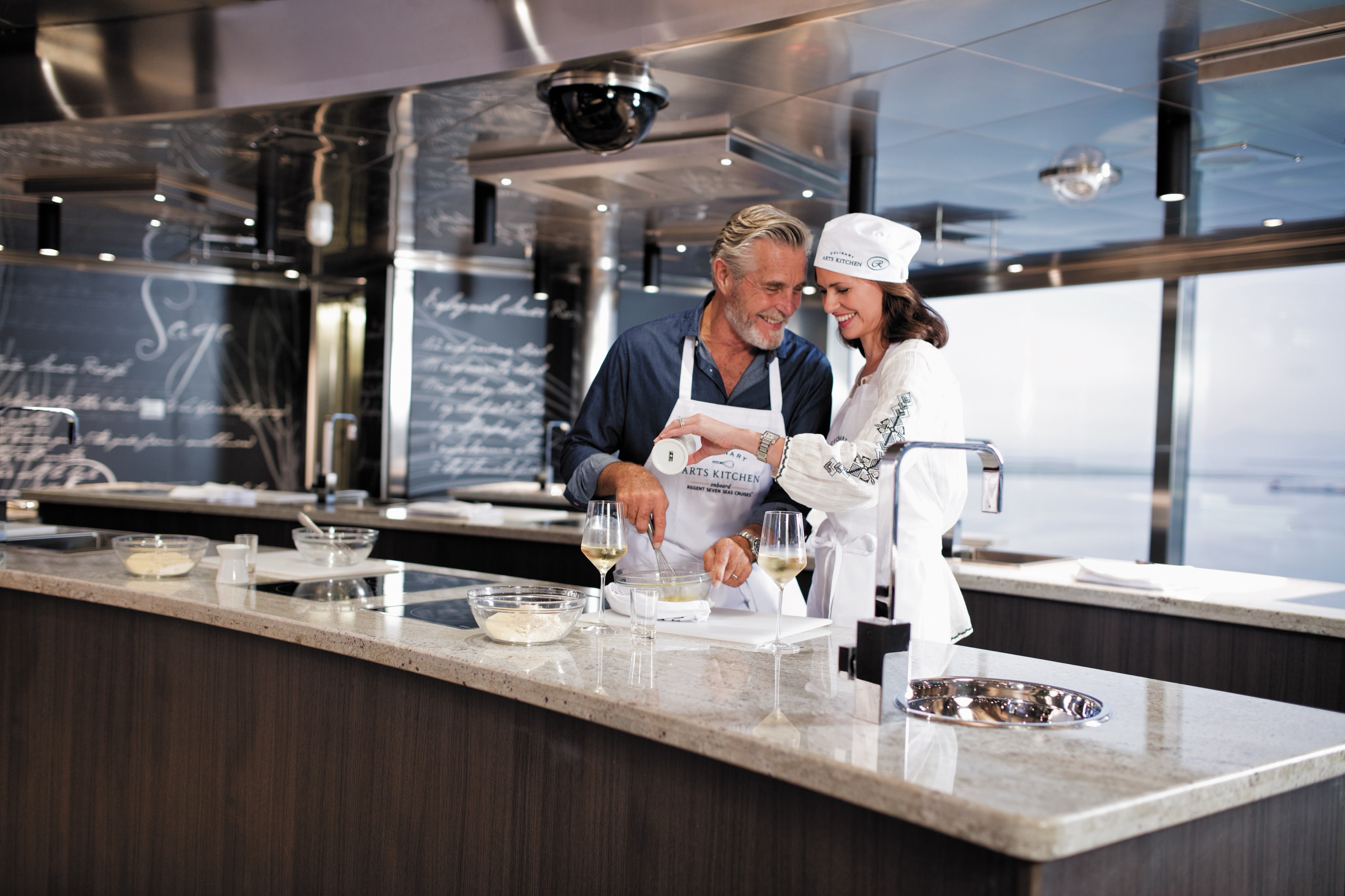
Step into a welcoming environment, reminiscent of the world’s distinguished culinary institutions in both layout and design, with workstations fully equipped with top-of-the-line induction cooktops, stainless steel sinks and a comprehensive collection of cooking essentials. Guests attending classes in the Culinary Arts Kitchen will receive highly individualised, hands-on instruction. The curriculum will appeal to a wide range of tastes and cater to all levels of aptitude, from beginner to experienced chefs.
Taste, learn and share with the Culinary Arts Kitchen and Regent Seven Seas Cruises®.
Please note: Classes vary by destination and voyage to view voyages and availability click here.
Join expert chefs in a state-of-the-art teaching kitchen on board Seven Seas GrandeurTM, Seven Seas Splendor® or Seven Seas Explorer®. Learn to prepare authentic local recipes, and savour the flavours of the regions you are visiting.
From Our Kitchen, To Yours
Executive Chef and Director of Culinary Enrichment, Kathryn Kelly, has travelled throughout the world, tasting and exploring the many different cuisines and the cultures that create them. Her experience and expertise make her a natural fit to develop the curriculum for the Culinary Arts Kitchen. Exclusively aboard Seven Seas Grandeur®, Seven Seas Splendor®, Seven Seas Explorer® and Seven Seas Prestige™.
The Culinary Arts Kitchen provides everything you need to elevate your culinary skills in a welcoming environment inspired by France’s finest cooking schools. Designed with both style and functionality, the space features fully equipped workstations complete with top-of-the-line induction cooktops, stainless steel sinks, and a comprehensive collection of cooking essentials. Whether you’re a novice in the kitchen or a seasoned chef, you’ll enjoy highly personalised, hands-on instruction from expert instructors.
Culinary Classes Details
ARABESQUE
Based on the travels of Executive Chef Kelly in Morocco and Turkey, this cruise ship cooking class explores the trending culinary traditions and recipes of two ancient and revered cuisines. Learn the basics of tagine cookery and gain an appreciation for how the foods of these two great countries have influenced modern world gastronomy. Learn how to make nut milks and preserved lemons – prized in the Arabesque region and around the world. These cuisines are a favourite amongst our chefs, and the recipes are beyond delicious.
ANYTIME BRUNCH FAVOURITES
Whether celebrating the weekend with a group of friends, spending Sunday watching your favourite sports team or gathering the family for the holidays, brunch is always a great meal for casual, comforting and delicious dishes. Brunch is also a meal we want to host effortlessly, so our chefs have assembled their favorite crowd-pleasing recipes that make brunch a breeze to host. Not a meal to be served without spectacular drinks, this culinary class also features favourite mid-day libations.
BEYOND PATAGONIAN DELICIOUSNESS
The culinary world has its eyes on the cuisine of the Patagonia region. Regarded as the hot new cuisine, chefs have travelled to these remote parts to learn the secrets of Argentine grilling, as well as Chilean roasting and baking. Attend this cook-out class that features delicious and hearty dishes that you will definitely want to make at home to impress your friends. No meal in Patagonia is complete without wine, so a special focus will be made on sampling and pairing the region’s varietals.
BOUNTY OF THE SEA
Fish is something we often order when dining out, but rarely feel comfortable making at home. In this class technique-driven class, master the basics of fish cookery: sauté and grill, deep poach, shallow poach, curing, baking, and healthy pan fry. Your Chef Instructor shares personal tips for purchasing fish from your local fish monger and adding more variety to your favourite fish choices.
EPICURIAN SAFARI
Embark on a culinary safari around the diverse countries of Africa. Enjoy mastering dishes from Morocco, such as tagine and b’stilla. Then head south and learn the secrets of mouth-watering grilled meats from South Africa and Namibia. Like all great safaris, this adventure begins with a delicious and artisan-created gin and tonic.
FIESTA ON THE HIGH SEAS
If you love Mexican food, but are reluctant to cook it at home, then this class is for you! Taking inspiration from Spanish tapas, this class provides a robust menu for a tasty Mexican snacking party, including a lesson on how to make the perfect Mexican cocktails.
FRESH HEALTHY COMFORT KITCHEN
This class was designed in collaboration with Canyon Ranch® with a focus on healthy eating. Discover the secrets and methods for preparing foods that are flavourful, comforting, plentiful…and good for you. From ingredients to cooking methods, learn the many ways you can maintain a healthy kitchen — while serving fabulous food — at home.
LA TECHNIQUE FRANCAISE
As the cuisine against which all others are compared, this class is designed around the pillars of classic French culinary technique. Learn the difference between French bistro and haute cuisine as you explore the various regional cuisines of France. Steeped in the fundamentals this class focuses on classic techniques designed to elevate your kitchen skills at home. Sample two French wines and learn the art of pairing French food and wine.
MASTER OF FIRE, HEAT & GRILL
Mastering the skill of cooking with high heat — whether on a grill or in a sauté pan — is at the core of this popular cruise ship cooking class. From achieving the perfect sear marks on a rib eye to bringing forth the flavour-enhancing char of a grilled flatbread, your Chef Instructor teaches techniques for perfect high heat cooking every time. Also learn how to use a digital thermometer, achieving internal cooking temperatures and the pillars of perfect protein cookery.
MASTERING KNIFE SKILLS
Regent Seven Seas Cruises® partnered with Zwilling Company, the makers of the chef-favorite J.A. Henckels knives, to develop one of our top guest-requested classes: Mastering Knife Skills. You’ll get a chef’s look at a complete pantry of knives and enjoy the chance to try out a few chef knives to discover the best option for you. You’ll also learn how to sharpen and maintain this essential kitchen tool, practice various knife cuts and discover how to safely use the mandolin slicer. At the conclusion of your class, you’ll receive a special Knife Skills certificate along with a savings voucher for your favourite Zwilling Company knives.
MEDITERRANEAN MELODY
The Mediterranean is revered for its cuisine and this culinary class allows you to take a virtual trip around region, celebrating signature dishes of Greece, Israel, France, Spain, Italy, Turkey, and Morocco. Each class is a reflection of your Chef Instructor’s personal favourites from their years of tasting and travelling across the Mediterranean. Expand your food and wine repertoire as part of this enrichment programme.
NORTHERN LIGHTS
Our chefs have collected their favourite recipes from Finland, Iceland and Norway to create this class that matches culinary delights to the extraordinary sight of the Northern Lights. In recent years, the culinary world has followed these trending cuisines as many of the world’s most revered chefs fuse traditional recipes with innovative ingredients and cooking methods. A highlight of the class is our signature sparkling cocktail celebrating the auroras.
PASTA PASTA PASTA
This class is a celebration of the mouthwatering mainstay dish of Italian cuisine — pasta. Pasta is traditionally served for lunch or at dinner as the second course, or secondi, in most Italian homes. Learn the fundamentals of making this dish in a traditional way, from dry and fresh pasta to pasta cookery and favourite sauces, and impress your friends and family with this new skill when you return home.
PERFECTLY SAUCED & TOSSED
Most chefs will confess that the secret to finishing most dishes is the sauce — sometimes taking years to achieve. A perfectly executed sauce is as elemental to French cuisine as a great dressing is to a composed salad. This class focuses on the nuisances of sauces and emulsions, all while mastering some delicious dishes. If you have ever wanted to learn the secrets of the classic French pan sauce or understanding the magic of vinegars and extra virgin olive oil, then this is the class for you.
A TASTE OF SPAIN
For centuries, beginning with the migration of the Moors followed by the explorers returning to Spain from the New World, Spain has held court as the epicenter of the culinary universe. Modern Spanish chefs have transformed traditional dishes through molecular gastronomy while maintaining a reverence for traditional tapas and dishes like Valencian paella. Learn to enlighten your home kitchen with some of Spain’s signature dishes, wines and of course — the festive Sangria.
SIMPLE & ELEGANT DINNER PARTY
Our Chef Instructors are frequently asked about their personal favourite dishes that they enjoy making at home. In response, they assembled some of those simple yet elegant recipes to transform the Culinary Arts Kitchen into an elegant dinner party. Take what you learn to your home kitchen and impress your friends when you return by hosting your own dinner party, complete with exquisite wine pairings.
THE CONTENTED VIKING
Culinary historians have seen a renewed interested in the Viking diet in recent years with the emergence in popularity of lower carbohydrate diets, such as the Paleo Diet. The diet of modern Nordic countries continues to feature clean, sustainable and seasonal food. In this class learn about recipes that are famously celebrated at the top restaurants across Denmark, Norway and Sweden. Indulging in the Swedish Glogg is reason enough to join the class!
THE PERFECT PAIR
As luxury travellers, we indulge in fine wines paired with delicious food, which is the main focus of this class. Whether you are interested in learning how to properly select the right wine for your preferred dish or are searching for the right meal to pair with your absolute favourite wine, this class will expand your horizons. Your curriculum includes cooking several recipes and then pairing them with wines to explore how different varietals complement the dishes.
YAYA’S GREEK FEAST
Greeks are famous for their home-cooked, savory and generously portioned meals with family gathered — singing, dancing and eating! Greek recipes are passed down from Yaya (grandmother) by showing rather than writing down recipes. So, we recreated those hands-on recipes from our favorite yayas from Santorini, Crete, Rhodes, Corfu, and Athens for this popular cooking class. Learn to make healthy, comforting Greek-inspired dishes, imbibe in our favorite Cretan Rose cocktail and plan your next party around the recipes you master.
1493: THE FOODIES’S NEW WORLD
Delight in learning about the evolution of the Mediterranean cuisine when new ingredients were introduced after the Portuguese and Spanish returned from exploring “The New World.” Discover the way tomatoes, potatoes, corn, peppers, chocolate, blueberries, and zucchini (to name a few) found their way into the Mediterranean diet and changed their traditional dishes for the better.
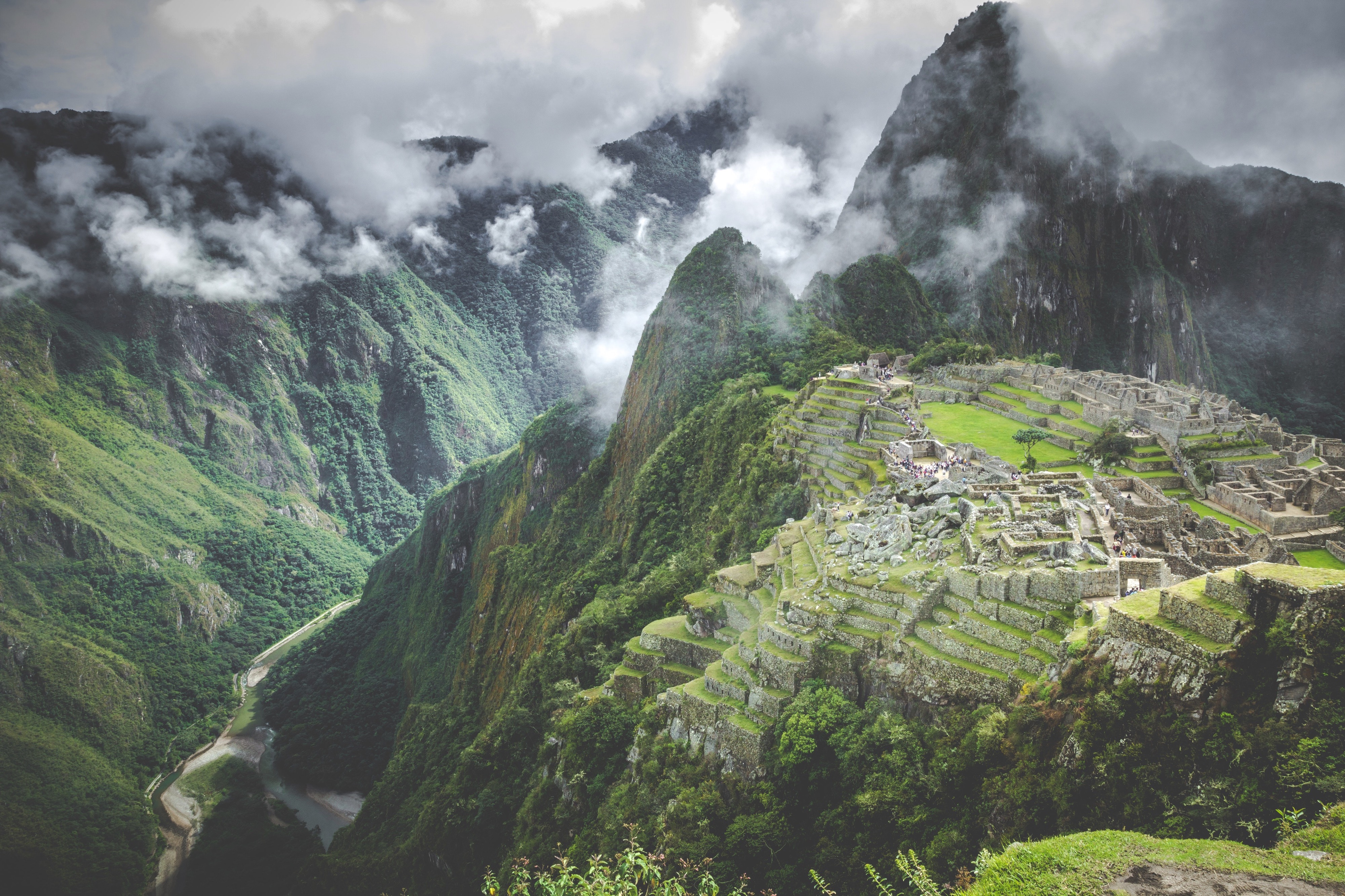
Eco-Connect Tours
Eco-Connect Tours invite you to discover and experience how local communities and groups are endeavouring to conserve, sustain and improve the environments they live in.
Engage with local groups and businesses to learn about how they are transforming the world around them while experiencing the impact of their efforts first-hand.
CONNECT & GROW
Our Eco-Connect Tours provide enriching opportunities to interact with and learn from local communities around the world as they work to conserve and sustain their surrounding environments.
Discover the valuable and beautiful flora and fauna of places like Costa Rica, Vietnam and Australia. Sample the products of sustainable farming practices in regions like France, New Zealand and Argentina. Absorb the inspiring innovations in energy production at facilities in Portugal, Iceland and Japan. This is only a sampling of the more than 150 unique Eco-Connect Tours we offer.
Reinvigorate your love for the world around you with these insightful experiences — many of which are available as part of our FREE Unlimited Shore Excursions.
Behind The Design Tours
Every captivating design has a story to tell. Join us as we go Behind the Design to explore how and why some of the world’s great architectural designs came to be.
Glimpse behind the scenes of some of the most captivating and brilliant designs around the world.
BRILLIANT ARCHITECTURAL ACHIEVEMENTS
Our Behind the Design Tours invite guests to go beyond the surface and into the beauty of the design processes and inspirations that made some of the world’s most fascinating architectural structures.
Explore a myriad of architectural marvels across Europe and the Mediterranean, including buildings like the Munchmuseet in Oslo, Norway, the MuCEM in Marseille, France, Toree Glòries in Barcelona, and many more. This is only a sampling of the Behind the Design Tours available, with many more to come.
Expand your appreciation for architecture and design with these intriguing explorations — many of which are available as part of our FREE Unlimited Shore Excursions.
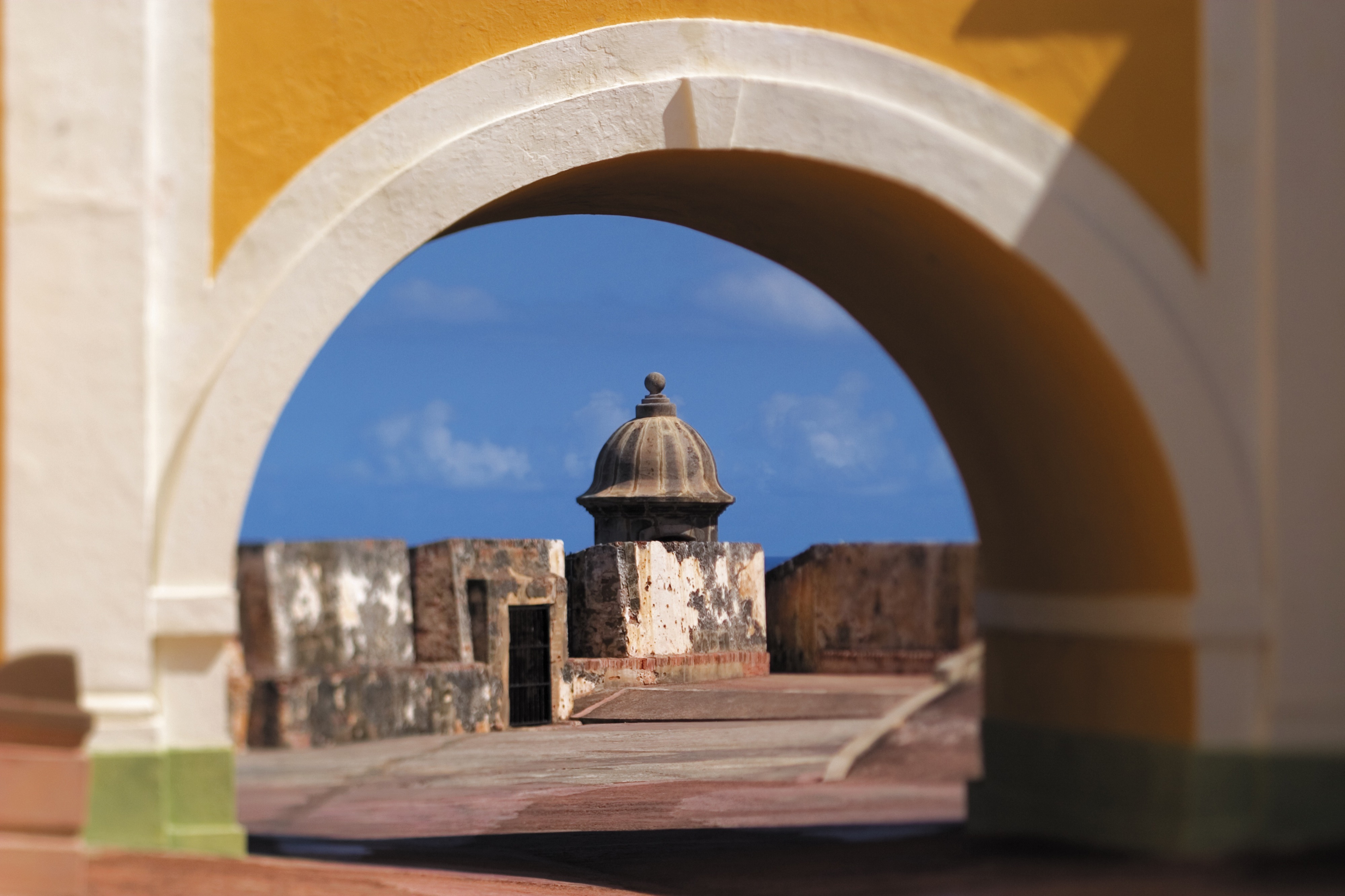
Go Local Tours
Uncover off-the-beaten-path experiences with our Go Local Tours providing a more direct way for you to learn the culture of a destination through the communities within. Spend a day at a family-owned goat farm in the countryside of Andalusia to learn the generations-old way of making cheese or observe skilled, local artists in their personal studios on Palma de Mallorca. Experience the world through the eyes of those who actually live there and discover the best of what you didn’t know about your favourite destinations with Go Local Tours.
Sometimes the best solution for the well-traveled guest and anyone looking to uncover off-the-beaten-path places and experiences is to start thinking like a local.
CULTURAL DISCOVERY
Go Local Tours provide a more direct way for you to experience the culture of a destination through the communities within. Spend a day at a family-owned goat farm in the countryside of Andalusia to learn the generations-old way of making cheese, discover the joy of fishing with the residents of Portofino or observe skilled local artists in their personal studios on Palma de Mallorca. Many Go Local tours are part of our Unlimited Shore Excursions, while some require a discounted, supplementary charge. Experience the world through the eyes of those who actually live there and discover the best of what you didn’t know about your favourite destination with Go Local Tours.
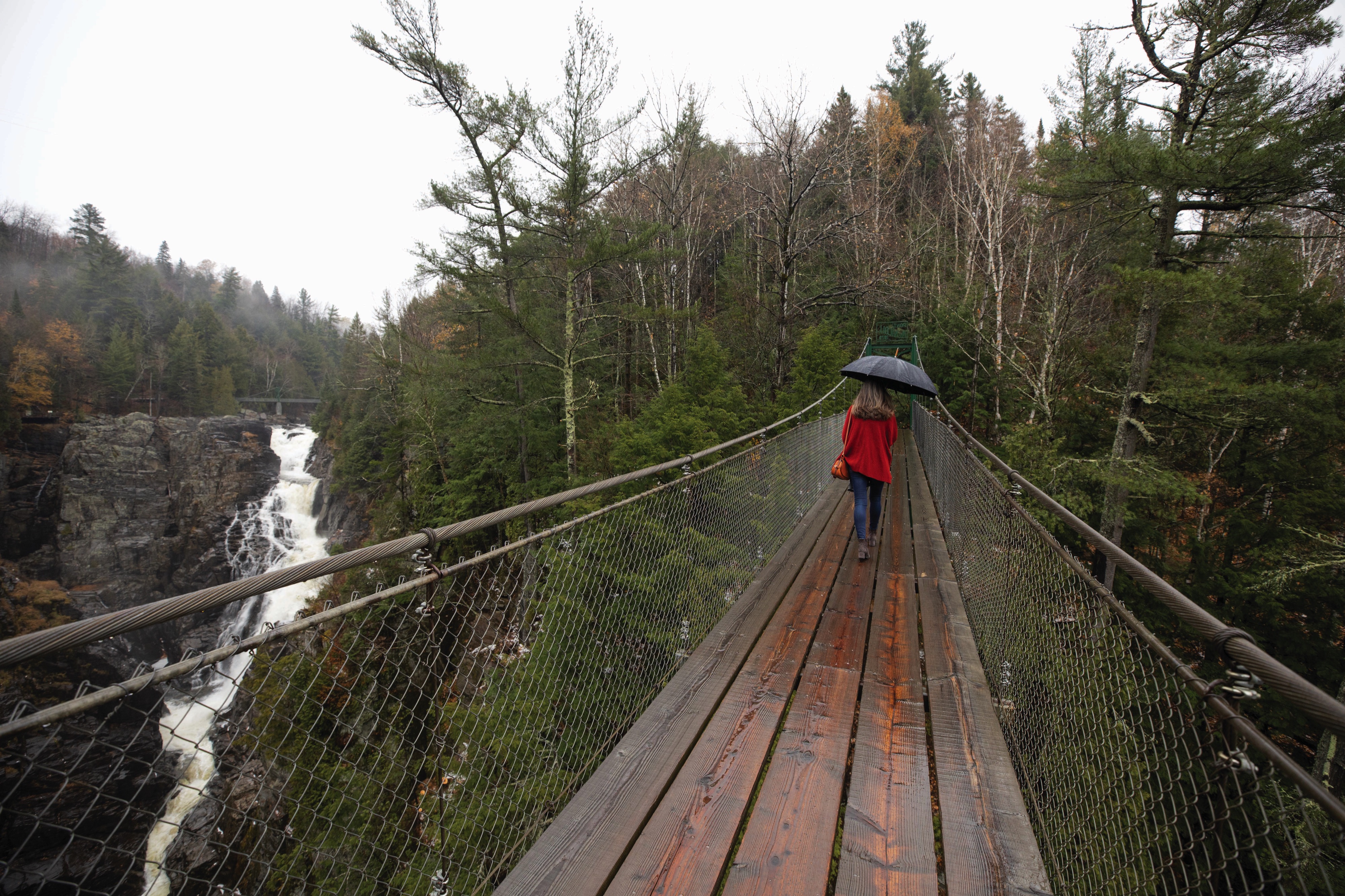
In-Port Overnights
Evenings provide a different view of a city as the streets light up and the locals unwind. Discover the fun of a destination’s nightlife and enjoy more time ashore with more overnights in ports across every region of the world.
LET THE NIGHTTIME SET YOU FREE
Celebrate sunsets and ease into moonrises as locals cut loose and skylines twinkle in the world’s great cities. You’re free to pursue your passions – from elegant dining to after-hour museum tours. It’s not just port cities that transform after dark. Regent in-port overnighters do, too. After the exhilaration of daytime excursions, sunset releases you to do as you please and sway to a city’s rhythms.
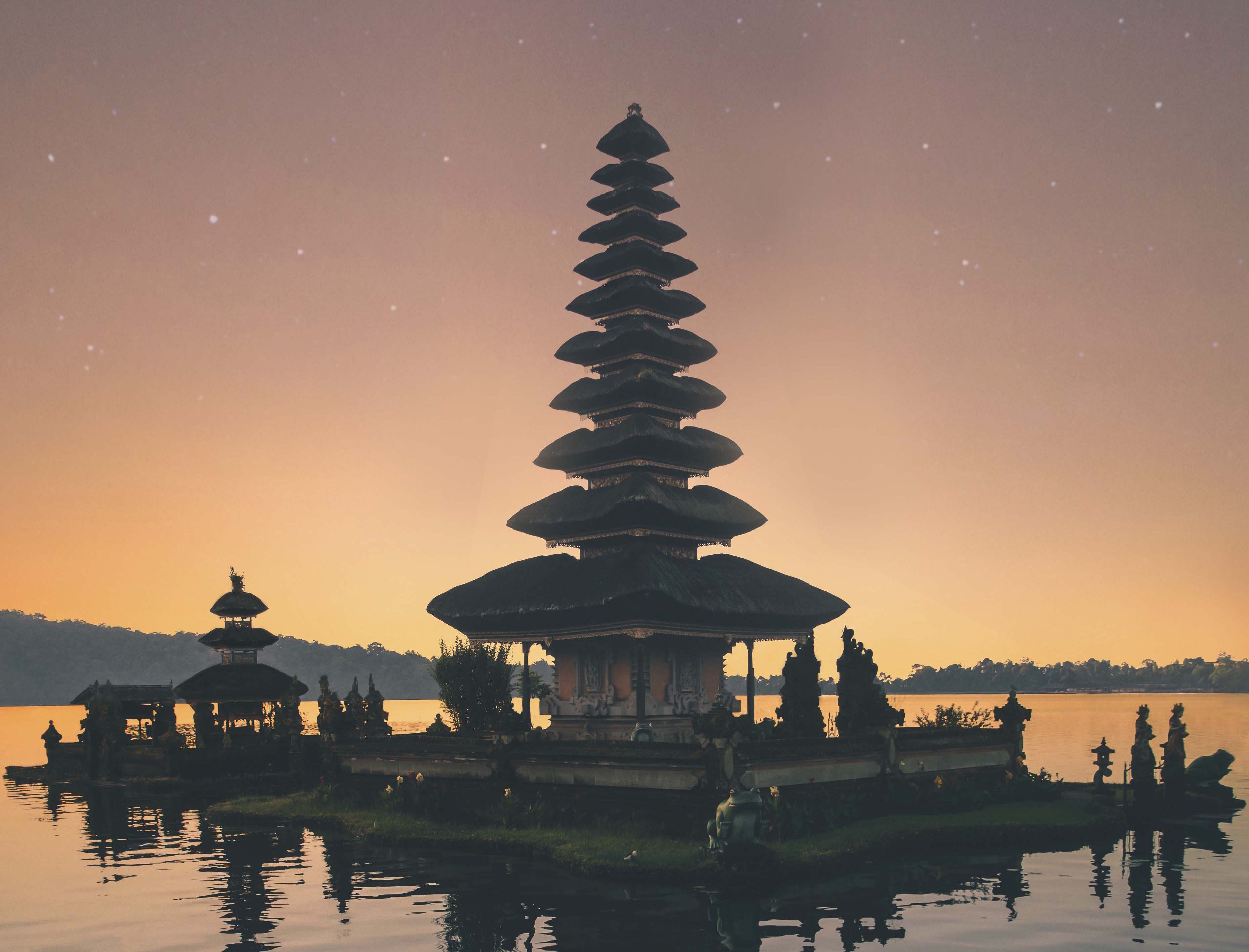
Spotlight Voyages
Explore your destination through special excursions and onboard experiences tailored to the spotlighted theme of your cruise. Hear from captivating speakers, renowned in their respective fields across multiple areas of interest, from culinary masters to renowned vintners to entertainment icons and beyond.
Embark on a journey of discovery with our Spotlight Voyages — tailored experiences designed to ignite your passions and curiosities. Whether you’re a wine enthusiast or a gourmand, these immersive cruises promise unforgettable adventures. Imagine savoring dishes made by award-winning Chefs, mastering your swing alongside a golf pro on legendary courses, or delving into the history of Fabergé eggs.
Don’t miss these one-of-a-kind onboard and shoreside opportunities. Mention promotional or offer code “SPO” when booking to unlock complimentary Spotlight Voyage programming.
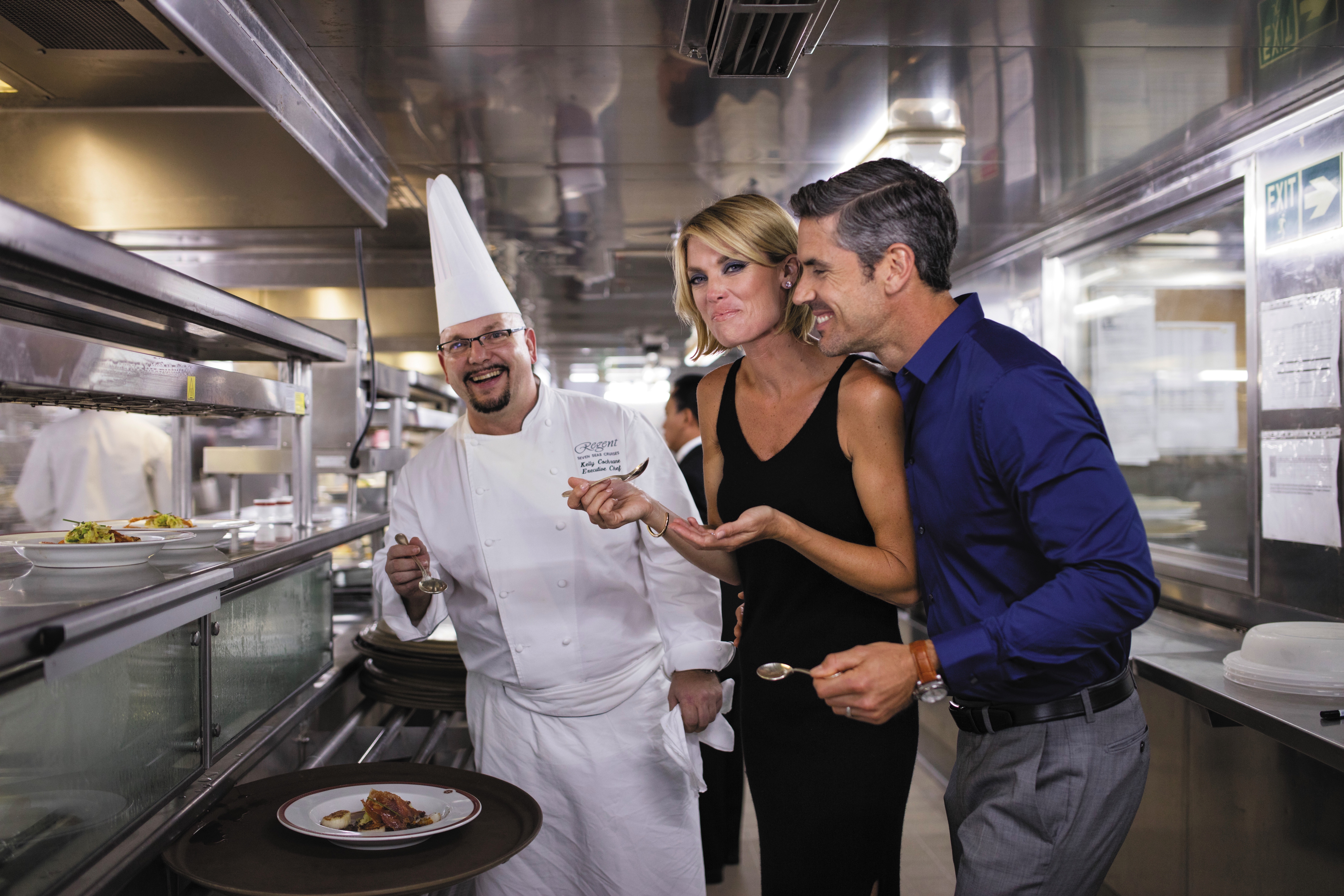
Unlimited Shore Excursions Included
Every destination we sail to harbours treasured experiences waiting to be unearthed. And there’s no better way to dig in than by taking advantage of our hallmark inclusion of thousands of wonderful, Unlimited Shore Excursions.
MAKE YOUR VACATION YOUR OWN
When your feet touch the ground, your cruise enters a new dimension. What’s your preference? Exploring the world’s great cities? Immersing yourself in local culture? Or indulging your inner beach bum? Over 4,500 Unlimited Shore Excursions across every region of the world allow you to embrace it all.
Wherever you’re traveling, opportunities to maximise memories abound. Whether it’s urban adventures brimming with history, architecture and culture or escapes to natural wonders that stagger the senses, our Unlimited Shore Excursions guarantee your vacation will be like no other. Start dreaming today.
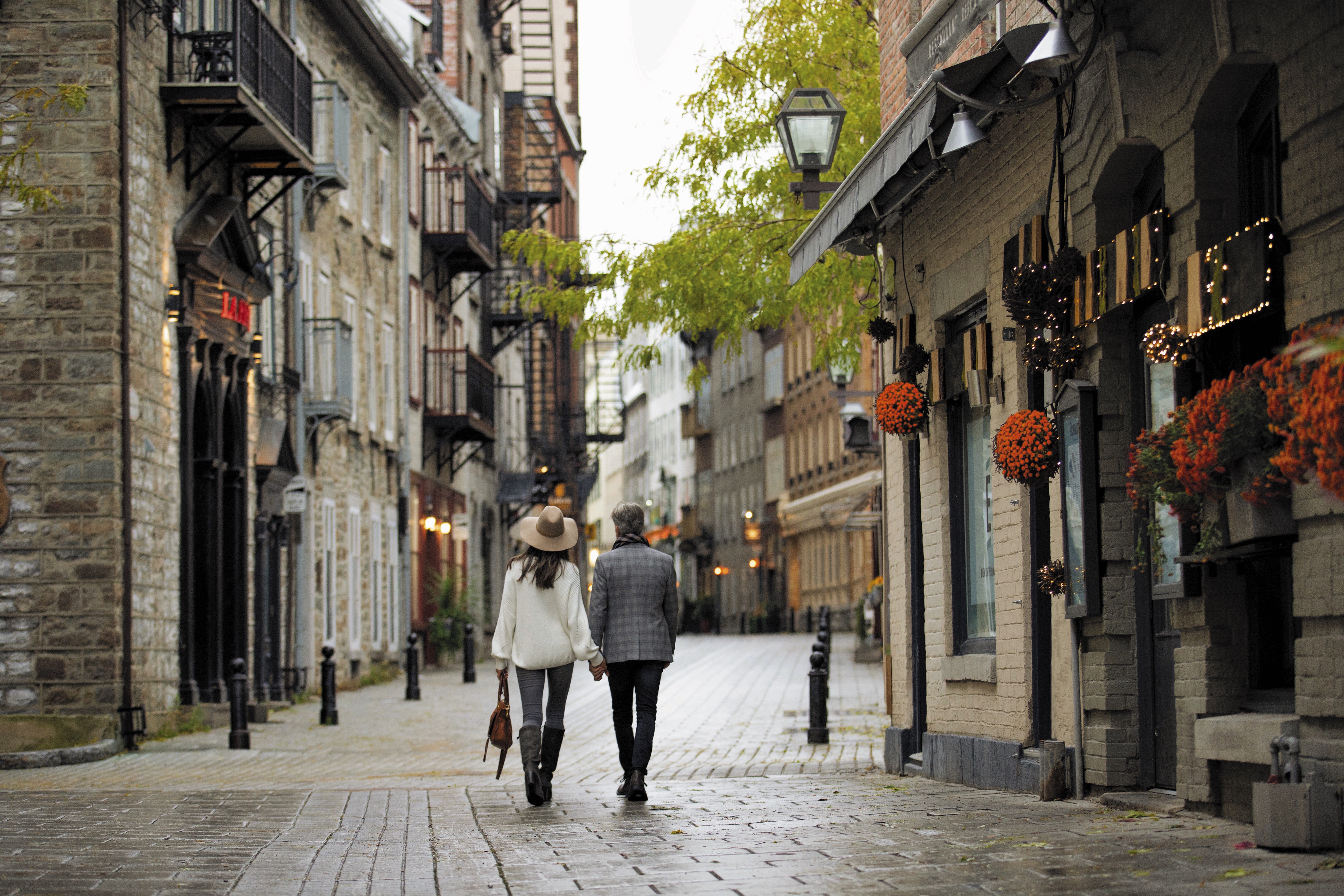
Epicurean Explorer Tours
Taste the cultures of the world with our specially curated, Master Chef-led, Epicurean Explorer Tours, unique to sailings aboard Seven Seas Splendor® and Seven Seas Explorer®. Be treated to a particularly French dining experience with Michelin-starred Master Chef René Bérard at his private estate along with a Provençal cooking demonstration in Provence or be led through the open-air, seaside market in Nice and partake in an exquisite lunch at Château Eza in Eze. Please your palate and expand your culinary knowledge with each of our delectable Epicurean Explorer Tours.
Outside of a stellar local expert, our noses may be our best guides to places beloved by foodies. Market spices drifting on a breeze, sizzling street foods, wine poured in a sun-kissed vineyard – these smells forever recall a destination as much as any photo or souvenir.
CHEF-LED SHORESIDE EXCURSIONS
Allow our chefs to be your guides on these specially crafted small-group experiences. Discover vibrant ancient markets, sample world-class restaurants, incorporate new learnings in the kitchen, and more. Exclusive aboard Seven Seas Explorer®, Seven Seas Splendor® and Seven Seas Grandeur™, these curated tours require a discounted supplementary charge.
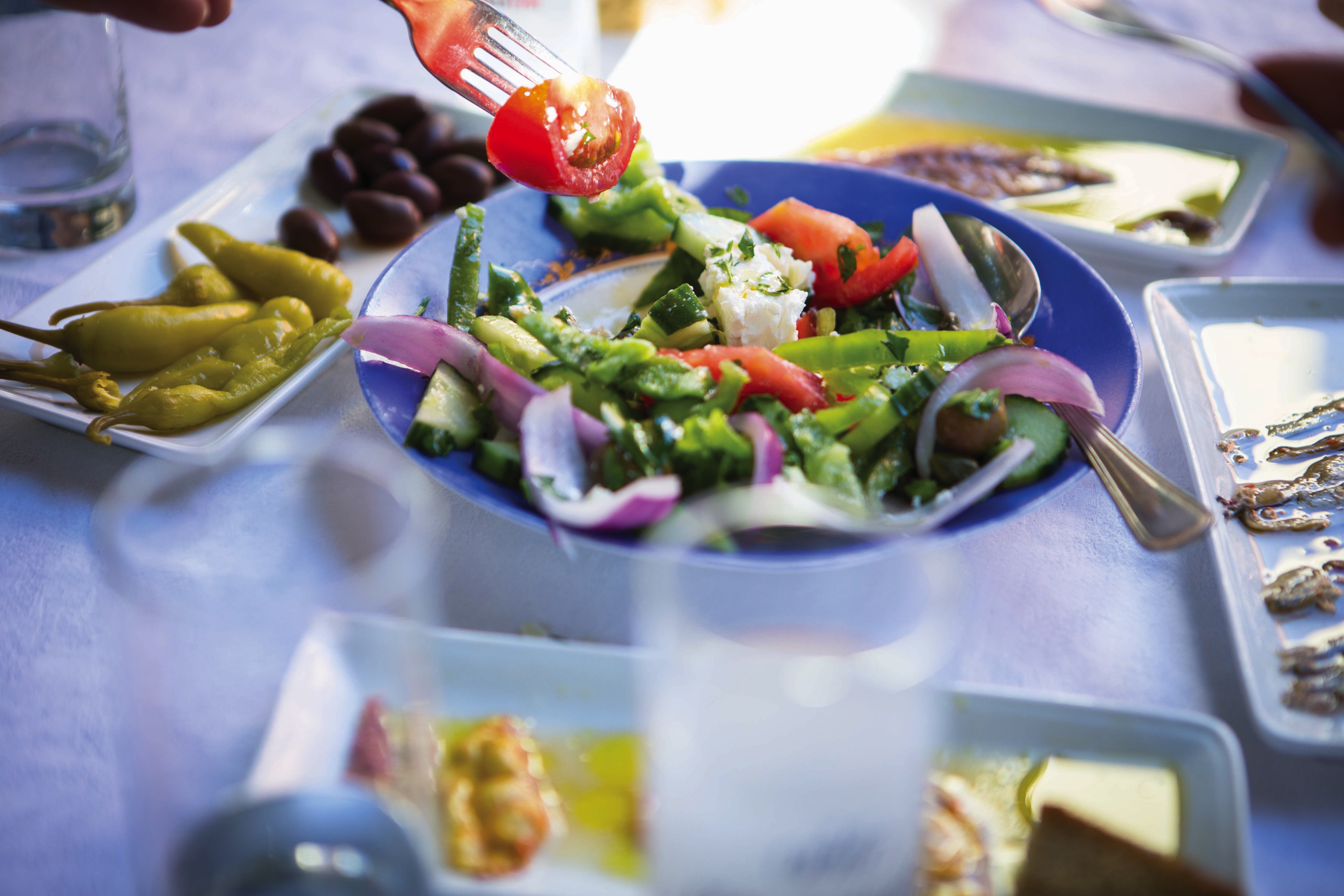
Serene Spa & Wellness™ Tours
Transcend the moment as you expand your mind and strengthen your body with a Serene Spa & Wellness Tours. Soak in a restorative, mineral-rich thermal spring in Rome or centre your chi with a taiji (tai chi) class on a beautiful and serene beach on Palma de Mallorca. Be refreshed by a Mediterranean breeze as you calm your mind and strengthen your focus through a yoga class overlooking the seaside town of Taormina. Restore and heal your mind, body and soul as you travel throughout the world with our Serene Spa & Wellness Tours.
To further enhance your vacation, our Wellness program allows you to enjoy a holistic experience from beginning to end, from complimentary fitness classes and healthy gourmet cuisine on board to Wellness Tours.
A HOLISTIC, REJUVENATING DISCOVERY
These tours allow you to discover the incredible destinations we visit while maintaining your active and healthy lifestyle. Practice yoga against a stunning backdrop in Taormina, learn about apitherapy, a school of alternative medicine based on bee products, or practice meditation on the idyllic island of Palma de Mallorca. Many Wellness Tours are part of our FREE Unlimited Shore Excursions, while some require a discounted, supplementary charge.
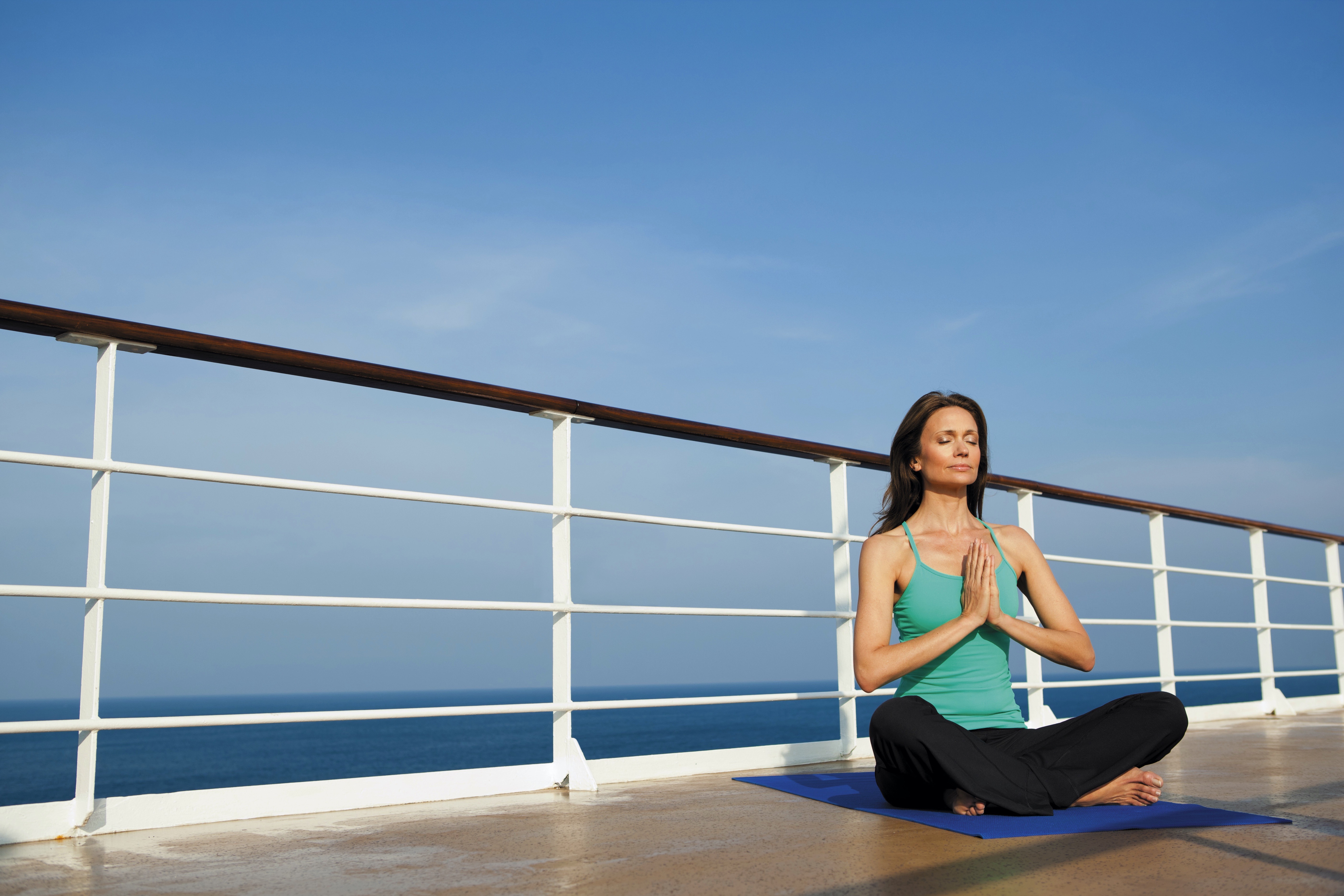
Executive Collection & Bespoke Travel Arrangements
Envision your perfect day of sightseeing and exploring your destination exactly as you’d like… Creating your own, customised excursions is possible. Whether you’re looking to engage a private vehicle from our Executive Collection with a personal driver and/or English-speaking guide or hoping to develop a truly bespoke experience with our elite concierge team, we welcome the opportunity to help you create your perfect journey.
You choose the locales – we’ll provide the private transport. Our Executive Collection frees you to explore ports of call with a driver and/or English-speaking guide, the ultimate way to maximise your time onshore. Whether heading out to a city’s outskirts or taking off along spectacular coastlines, you’ll accrue lifelong memories by the mile (or kilometre).
MAKE YOUR VACATION YOUR OWN
Excitement builds each time a Regent Seven Seas’ cruise ship approaches a port city. Let your excitement skyrocket with a car, driver and/or English-speaking guide awaiting you onshore. Where do you go? Across the Charles River to explore Cambridge, Boston’s academic neighbour? Along Monaco’s famed Formula 1 route? Across Sydney’s iconic Harbour Bridge? Only you know for sure.
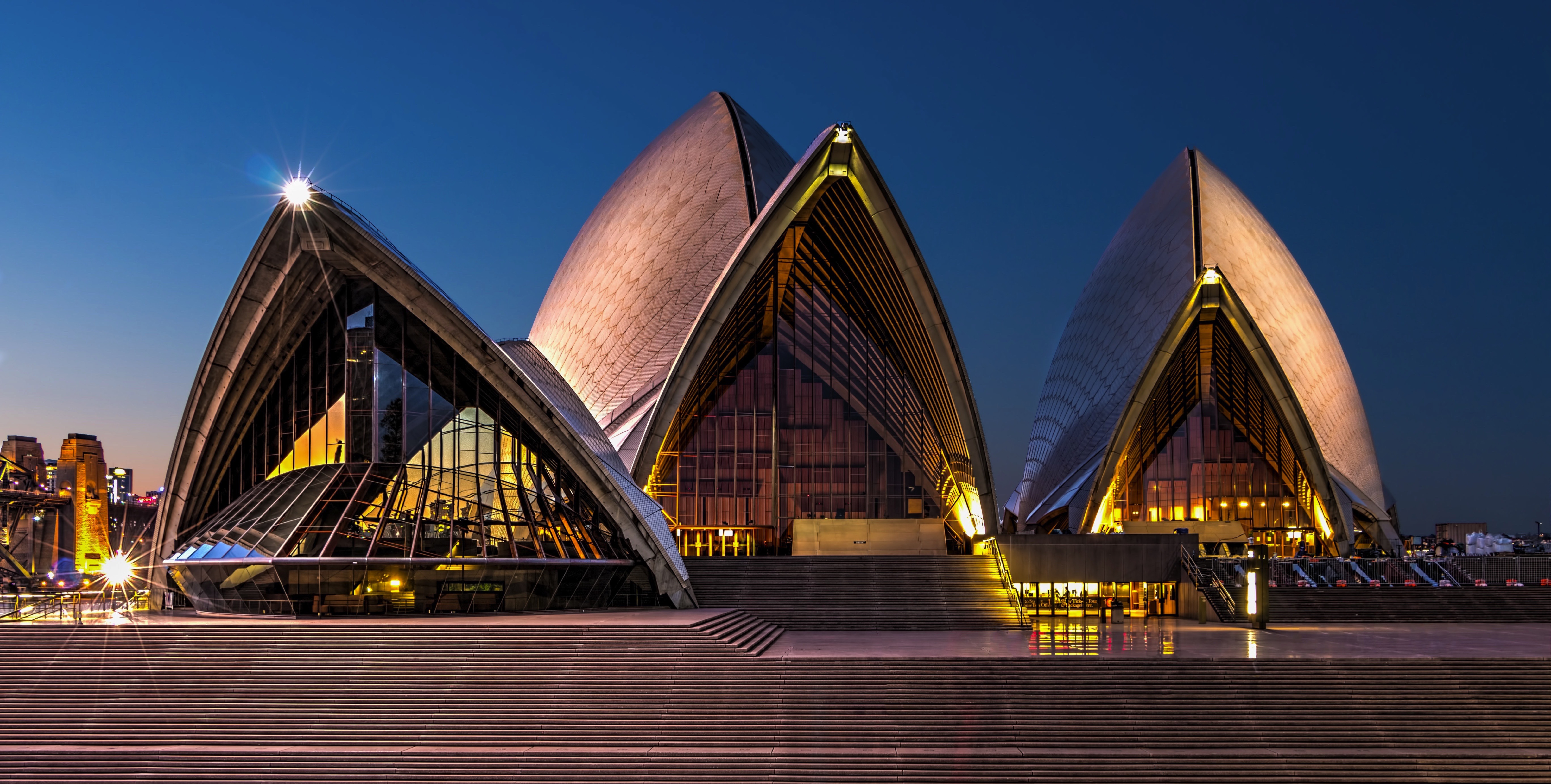
Customise Your Journey
Enhance your cruise by adding another layer of luxury to your travel with any of the multiple options we offer. Select from a variety of enhancements like immersive Land and Overland Programs, Pre- and Post-Cruise Hotel Programs and air upgrades.
PERSONALISED CRUISE EXPERIENCE
Take your all-inclusive luxury travel to the next level by personalising it. Select from a variety of enhancements like our Regent Choice Shore Excursions, Pre- and Post-Cruise Hotel Programmes and air upgrades. Embark on a specially-designed, luxury vacation that offers an experience unlike any other as you explore the cultures, sights and cuisines of your destination. Enjoy it all with The World’s Most Inclusive Luxury Experience® across air, land and sea.
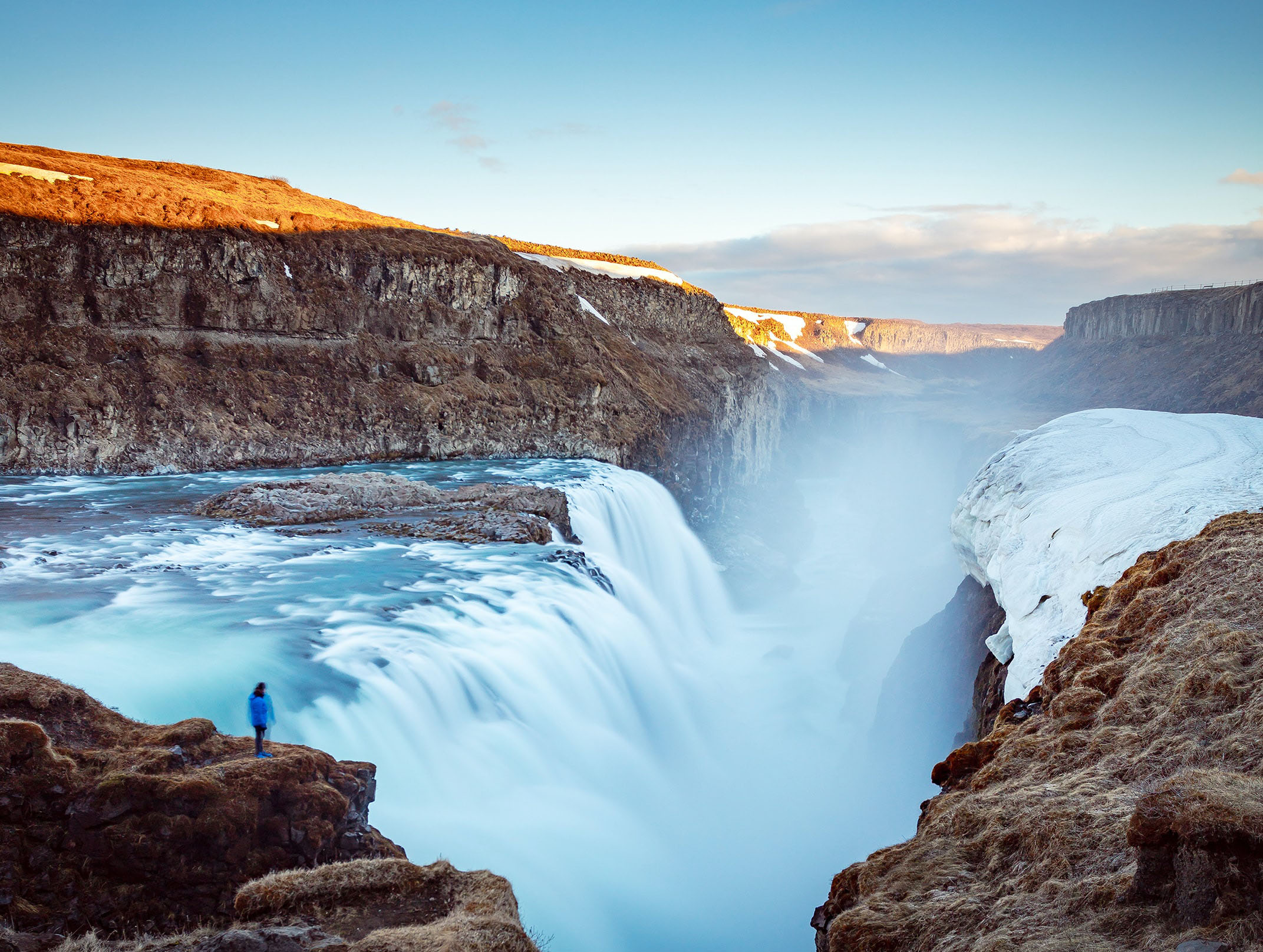
Featured Guest Entertainers & Speakers
Experience world-class entertainment and engage with esteemed experts on a journey of inspiration and discovery. This immersive experience invites you to delve into meaningful dialogue, while each performance is thoughtfully curated to captivate and uplift. Throughout your voyage, enjoy a front-row seat to brilliance.
When you travel with a distinguished guest Speaker, knowledge sets sail with you. Engage with esteemed experts, from celebrated art historians and acclaimed authors to former diplomats and cultural icons. This immersive experience invites you to delve into meaningful dialogue and connect personally with our Speakers throughout your entire journey.
Featured Guest Entertainers and Speakers are scheduled in advance and are subject to change without notice due to unforeseen circumstances beyond our control.
Bridge at Sea
Enjoy social and competitive Bridge play on select voyages. ACBL Certified Bridge Masters sail with guests to provide professional instruction and host games for all levels.
luxury is in the cards
Enjoy social and competitive Bridge play on more than 93 of Bridge at Sea Voyages aboard The World’s Most Luxurious Fleet®. Sail to breathtaking destinations alongside Bridge Masters, who provide professional instruction and host games for all levels — in addition to being knowledgeable and entertaining professionals. Our ships are ACBL Certified, which means you can accumulate master points while cruising to the places you’ve always dreamed of exploring.
Explorer Lounge
The perfect spot to begin or end an evening, our Explorer Lounge inspires intimate conversations over perfectly mixed cocktails at an elegant, black marble bar while resident musicians play soothing live music.
With rich mahogany wood columns, heavy leather chairs and deep blue fabrics, the atmosphere here is conducive to intimate conversations and bonhomie. Relax to familiar tunes and special requests performed by our resident musicians from an intimate stage arched with a golden proscenium. A perfect spot to meet new friends for a pre- or post-dinner cocktail at the elegant, black marble bar.
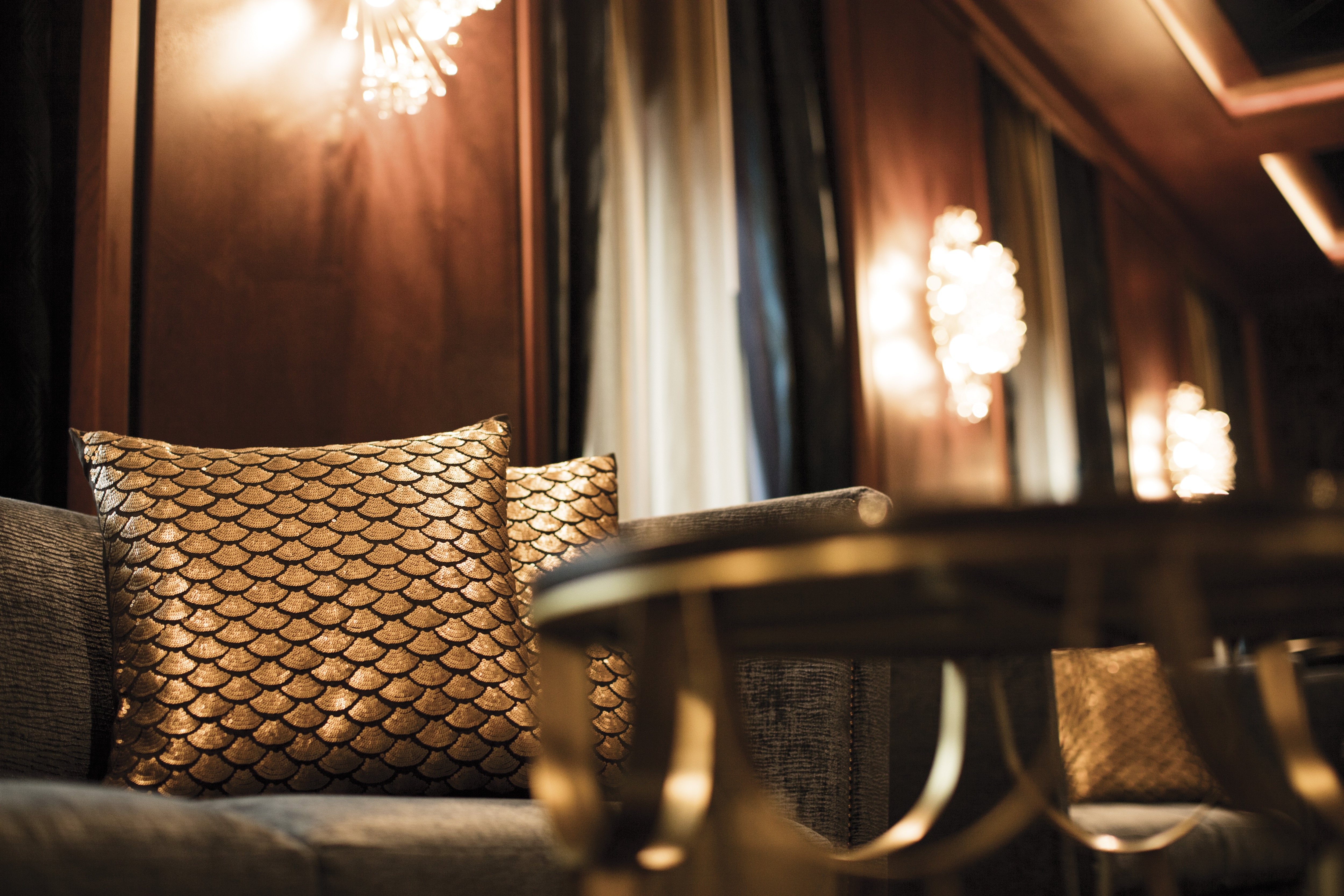
Observation Lounge
With musicians performing throughout the day and night, captivating décor and floor-to-ceiling windows, you’ll be instantly drawn to this chic yet comfortable lounge as you unwind with a cocktail and jovial conversation.
Walk through a black and gold-lit tunnel and be instantly captivated. This chic yet comfortable lounge features an impressive bar, dazzling geometric ceiling, ample seating and floor-to-ceiling windows that create a magical atmosphere. Musicians perform throughout the day, creating an alluring vibe that sets just the right mood as you unwind with a pre-dinner cocktail or satisfying nightcap.
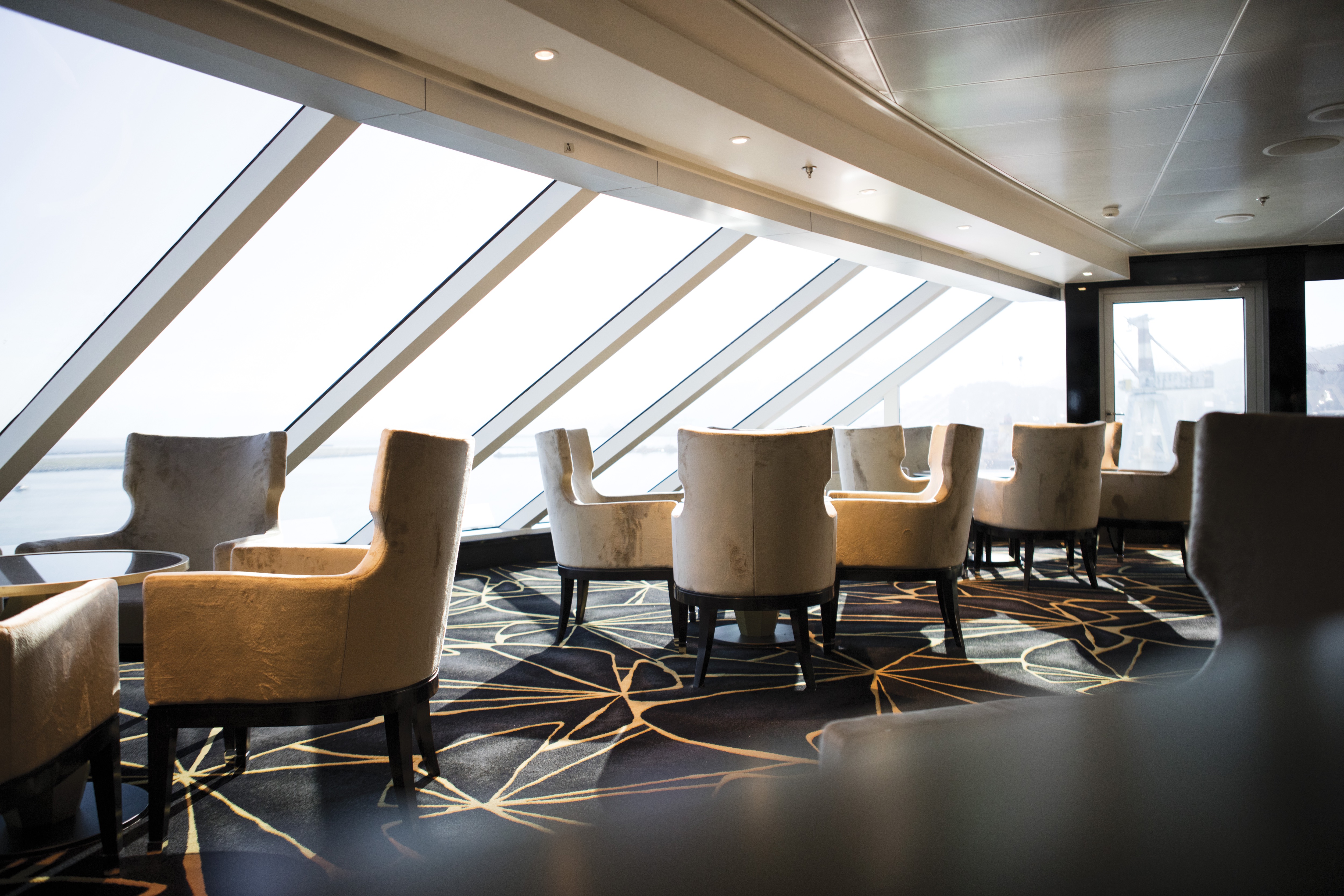
Constellation Theater
Even before the lights drop and a lavishly staged, high-energy show begins, you’re greeted by a Gatsby-esque atmosphere of glamor and sophistication as you enter our Constellation Theatre.
A dazzling staircase mosaic creates a Gatsby-esque atmosphere as you enter our Constellation Theater, a space so grand it takes up two decks. Perfectly tiered for pleasing sightlines and furnished with plush seating, the main show lounge is an intimate venue without a bad seat in the house. Performances vary from full-scale musical revues to rousing singalongs, all backed by our incredible, five-piece Regent Signature Orchestra.
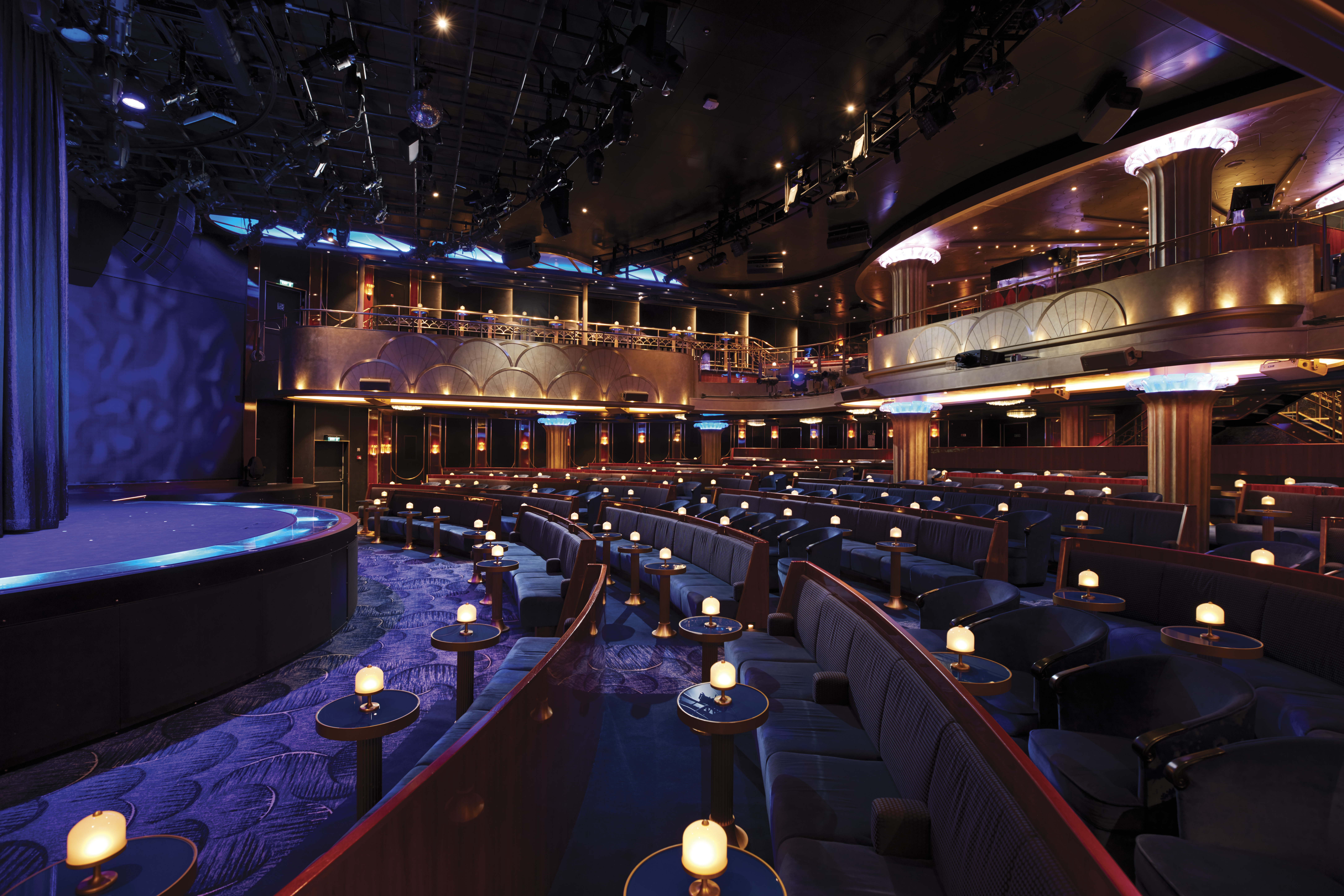
Connoisseur Club
Engage in spirited conversation with new friends in an elegant hideaway that calls to mind gentleman’s clubs of old. An elegant throwback where cigars are savored, you’ll take to like a favorite cardigan.
Maybe it’s the deep blue walls that give the Connoisseur Club such a gentile, old-fashioned feel. Or maybe it’s the collection of impossible comfortable leather armchairs. Whatever it is, this is a relaxing spot for you and new friends to enjoy a fine cigar and sip cognac (both are available for purchase) in classic gentleman’s club environs. Smoking is permitted in the club.
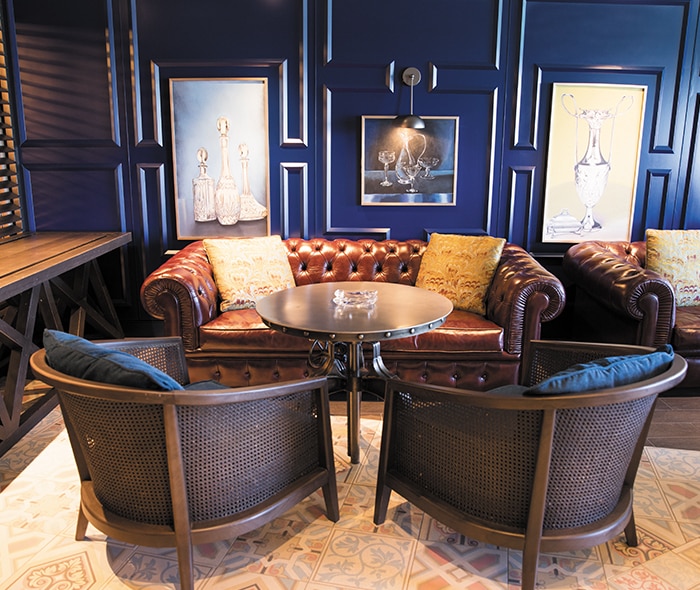
Atrium
Simply put, the Atrium is the very heart of Seven Seas Explorer®. Natural light cascades from above but it’s a magnificent chandelier shining like a glowing star that steals the show.
Often described as the crossroads of the ship, our Atrium is an inspiring testament to the grandeur of luxury ocean travel. Cascading stairwells make it a natural gathering place for guests, but convenience alone doesn’t begin to describe its magnetic appeal. On Seven Seas Explorer® a spectacular chandelier hovers like a glowing star, enhancing the natural light shining down from far above.
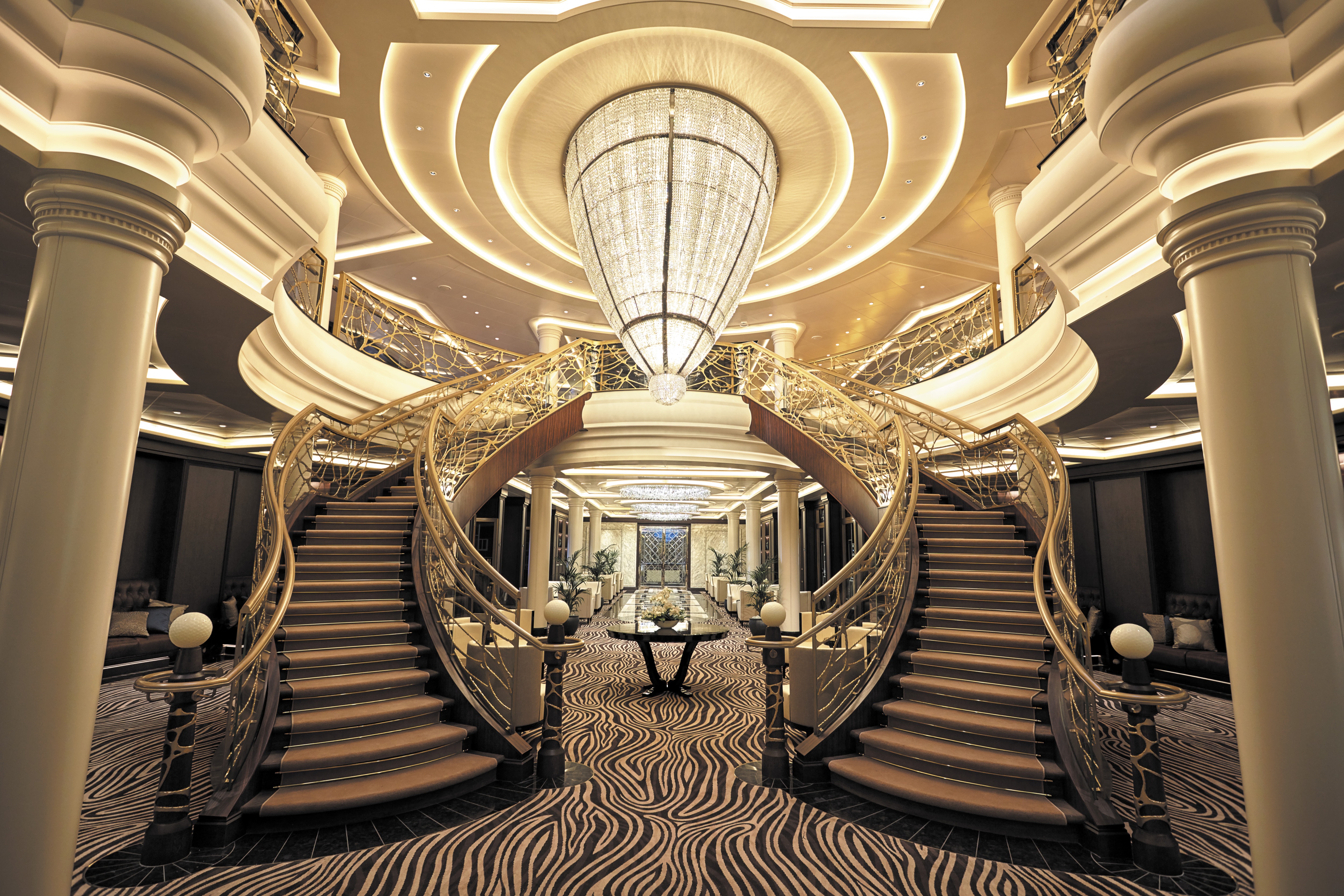
The Casino
Enjoy the elegance and excitement of a Monte Carlo-style casino. Stride through the Casino’s glass doors to an elegant setting abuzz with Blackjack, roulette, poker, as well as slot machines.
Get a taste of Monte Carlo excitement at our Casino directly across from the equally inspiring Explorer Lounge. Walk through glass doors into an elegant setting bustling with games of chance that include Blackjack, roulette, poker, as well as slot machines. The Casino is open every day at sea when not restricted by territorial border limits.
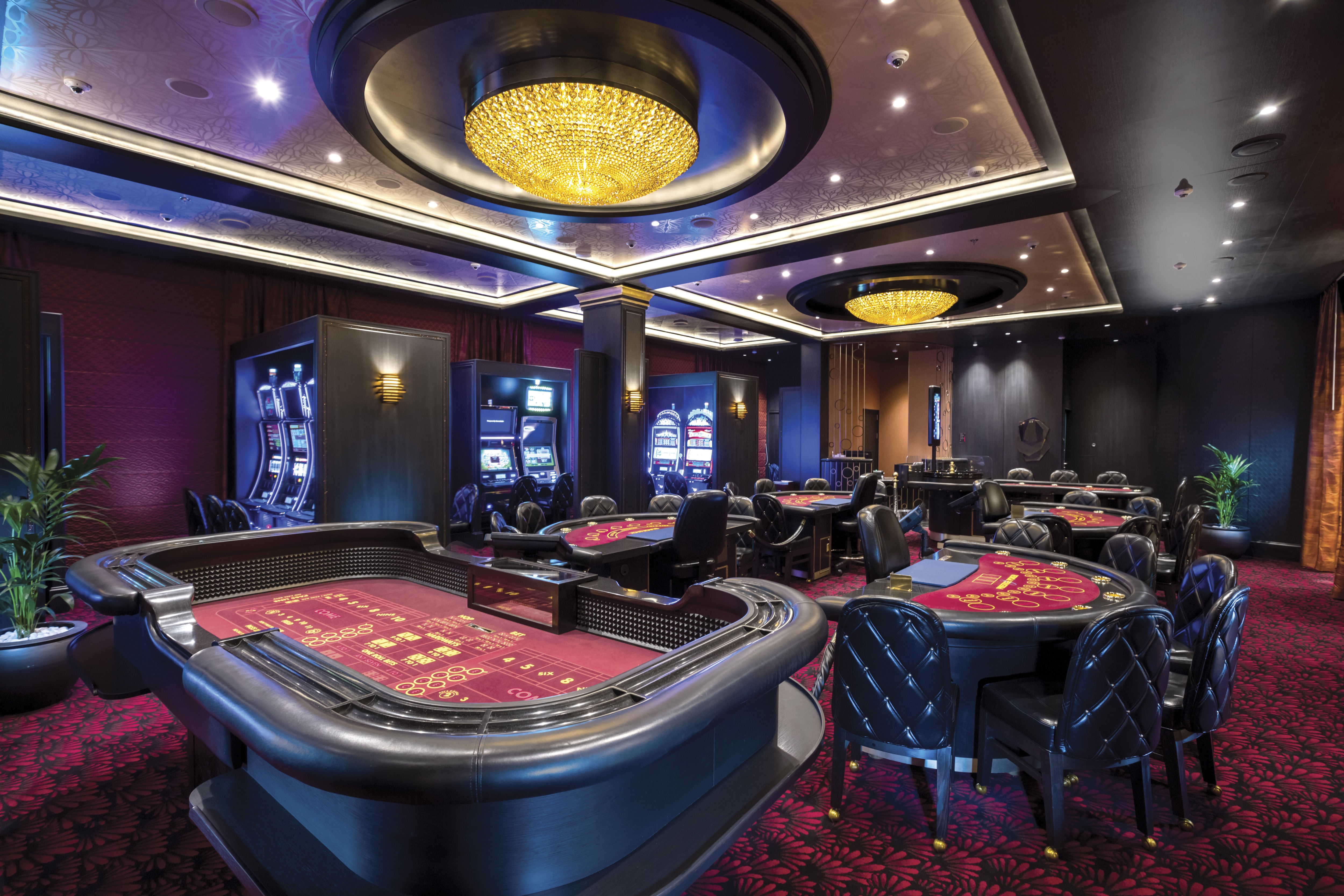
Meridian Lounge
A popular spot for informal gatherings over impromptu cocktails, you may find yourself here after a thrilling theater experience. Meridian Lounge is a spacious, friendly space with an expansive bar and live music at night.
Situated along a lively hallway, Meridian Lounge is a natural place to gather with others for an afternoon or early evening cocktail. Elegantly appointed and comfortably furnished, it boasts an expansive bar and relaxed armchairs that beckon conversation. A popular spot to catch your breath after a dazzling Constellation Theatre show, this lively spot invites you to extend your evening with virtuoso performances by resident musicians.
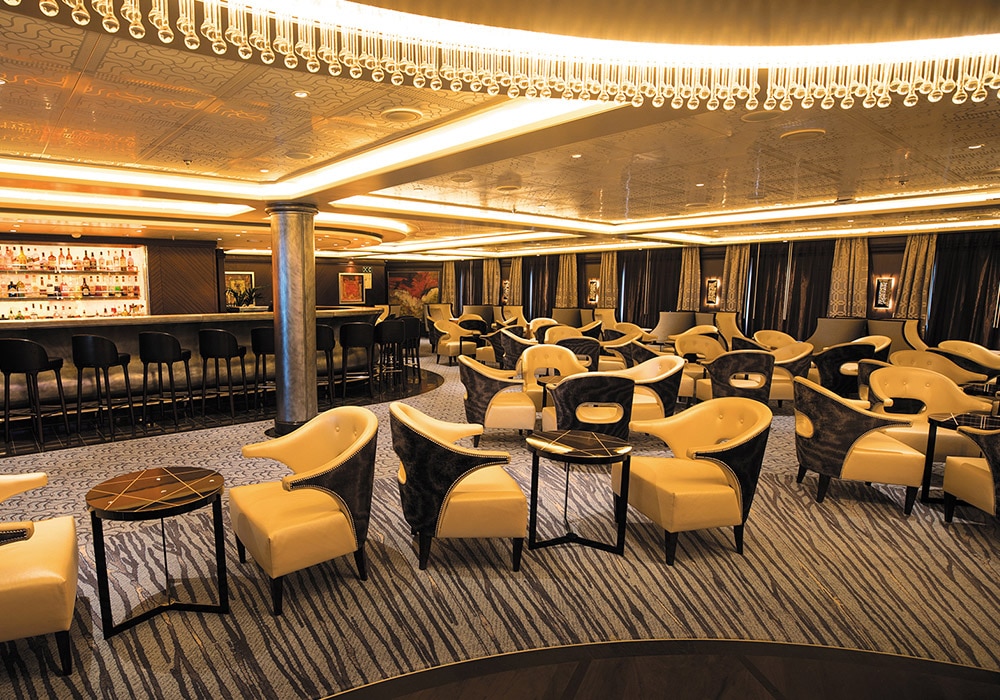
Card Room
Clubby and comfortable, our Card Room is a charming spot for you and new friends to gather for friendly competition in elegant surroundings.
An inviting and tranquil oasis dedicated to the pure pleasure of playing games. Our beautifully decorated Card Room sits across from Observation Lounge, and it’s not unusual for guests to go from one fun space to the other. Gather your favourite teammates in the Card Room for a lively afternoon or evening of board games, a social game of Bridge or to participate in an ACBL Tournament on select voyages.
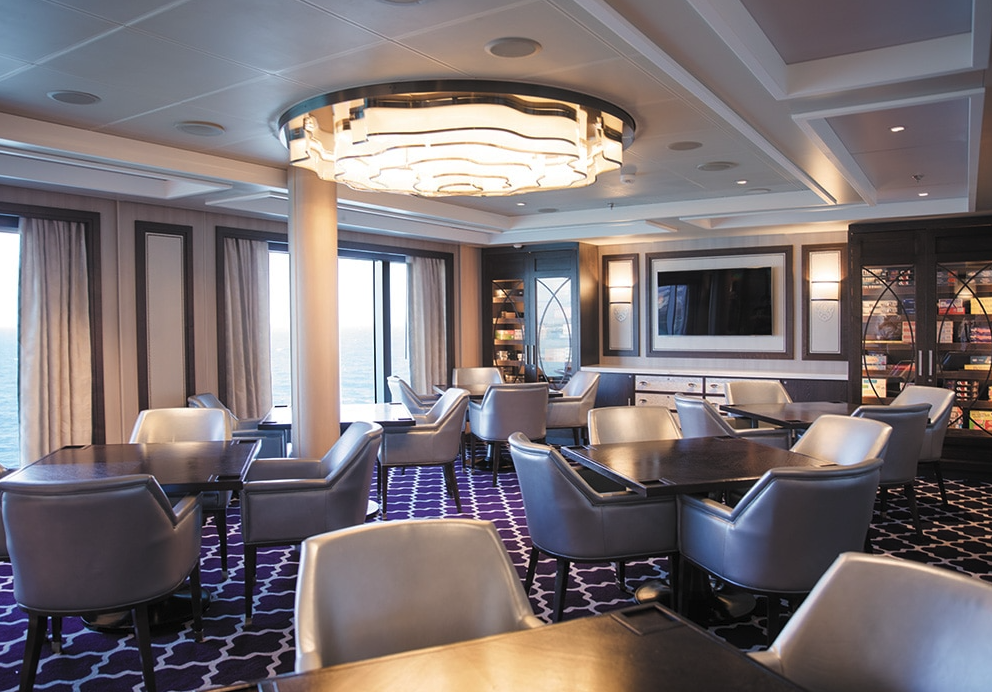
Library
Choose from a large selection of reading material in our Library, a relaxing retreat dedicated to calming the senses as well as stimulating the brain.
Well-stocked and exceedingly comfortable, you’ll immediately feel at ease within the Library’s calm setting. Browse a vast collection of volumes, from destination-specific guide books to best-selling mysteries to classics of literature, on a variety of comfortable chairs. Conveniently located across from the Card Room, our library is a welcoming, low-key treasure you just may find hard to leave.
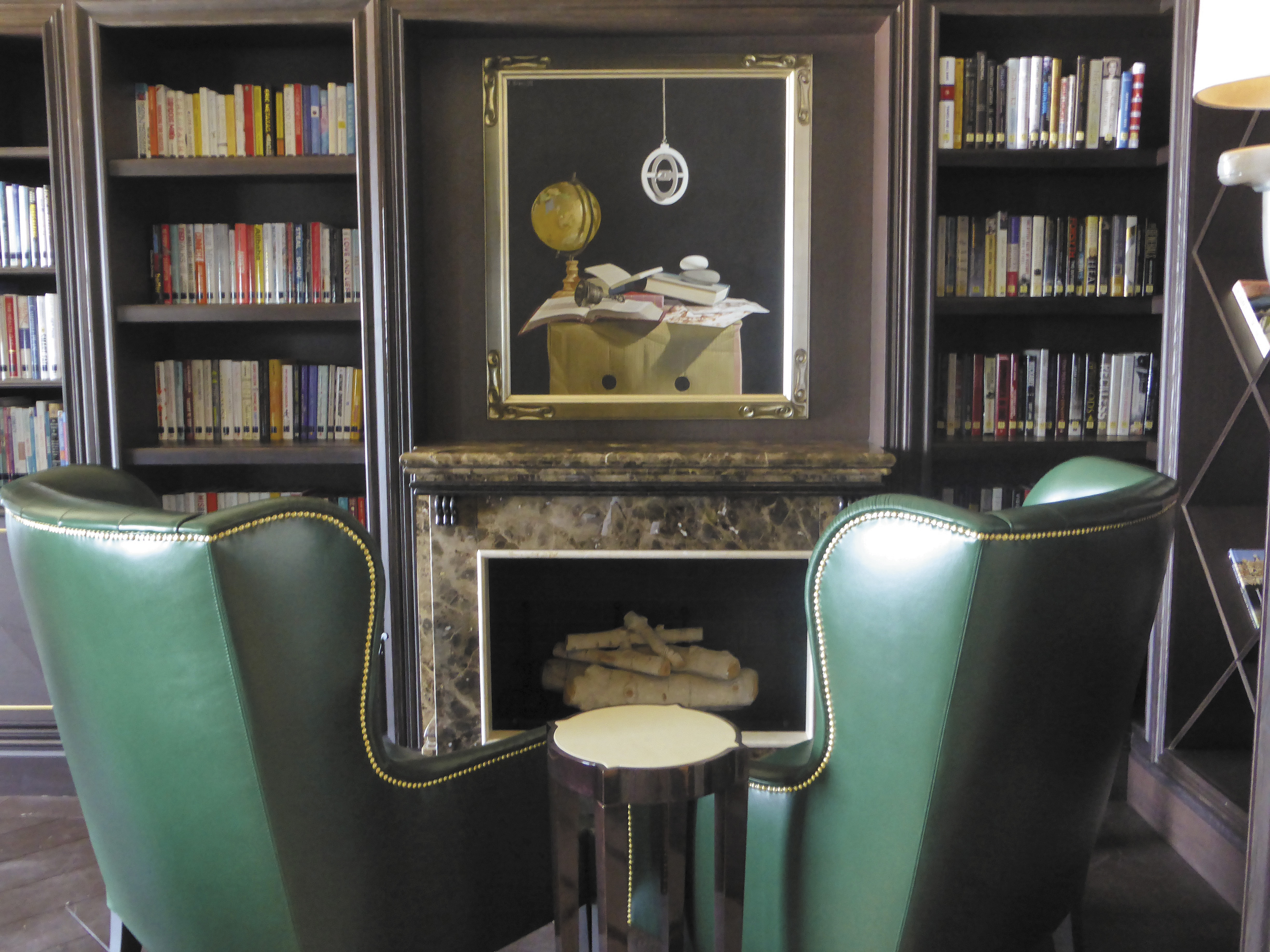
Boutique
Perhaps it’s a dress to wear for dinner or a piece of jewellery that calls your name. Our boutique items are carefully selected, providing you with quality handbags, fragrances and clothes to give as gifts… or give yourself.
Whether looking for something special to wear for dinner or a memento for friends and family back home, you’re bound to be tempted by the designer garments and fashionable accessories in our shops. Relax as you browse a wide range of items – upscale handbags to exclusive fragrances to fine jewellery and more – in an intimate and unhurried setting.
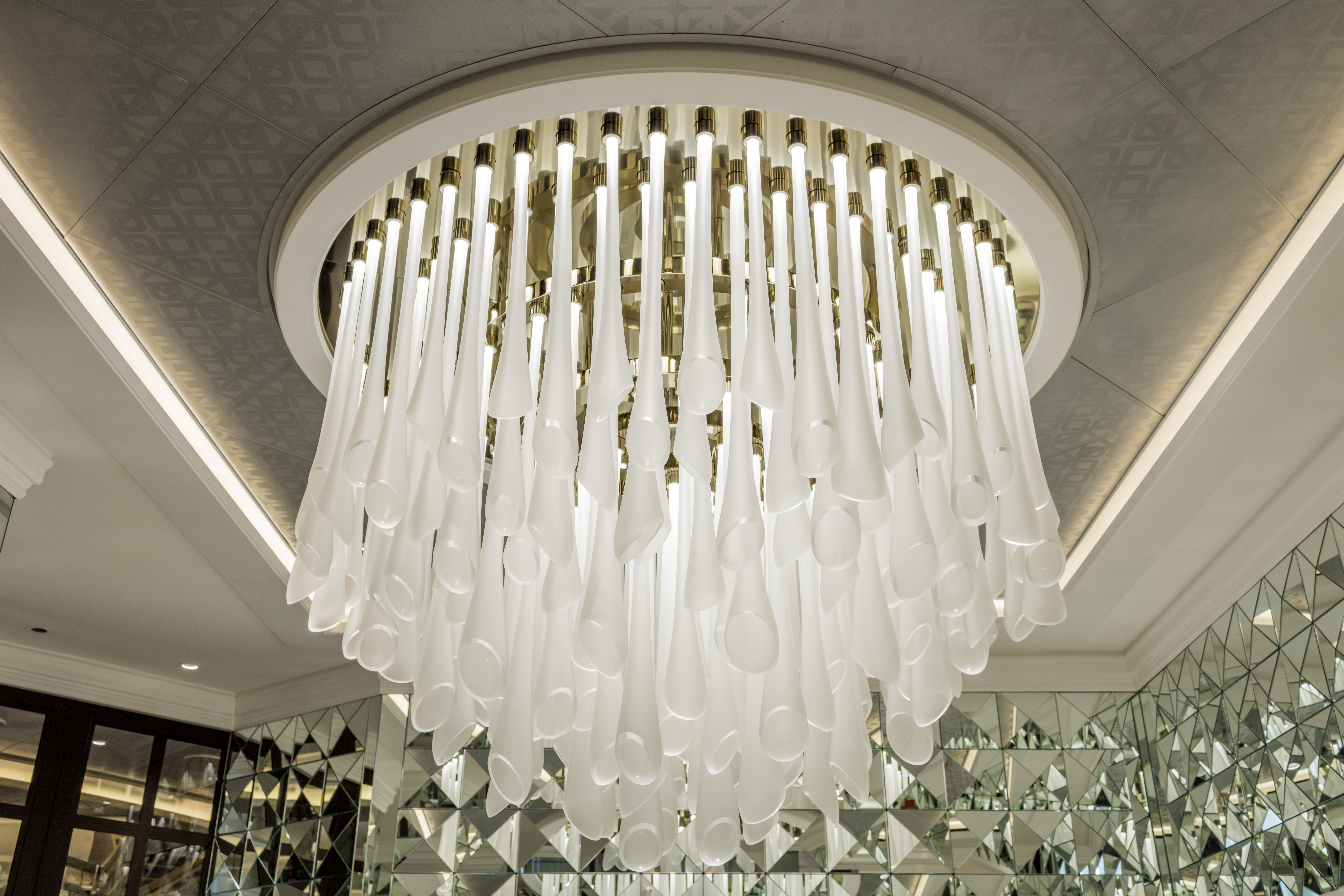
Pool Bar
Very few things equate to a pure vacation activity more than sitting at our Pool Bar. Make new friends while sipping a cocktail or frozen drink in the most laid-back atmosphere imaginable.
When you envision an activity you’re only likely to do while on vacation, sipping a frozen drink at a pool bar onboard a glorious cruise ship is probably near the top of the list. You can tick that box at our Pool Bar, where you and new friends can enjoy leisurely conversation over cocktails and frozen drinks in a delightfully relaxed atmosphere.
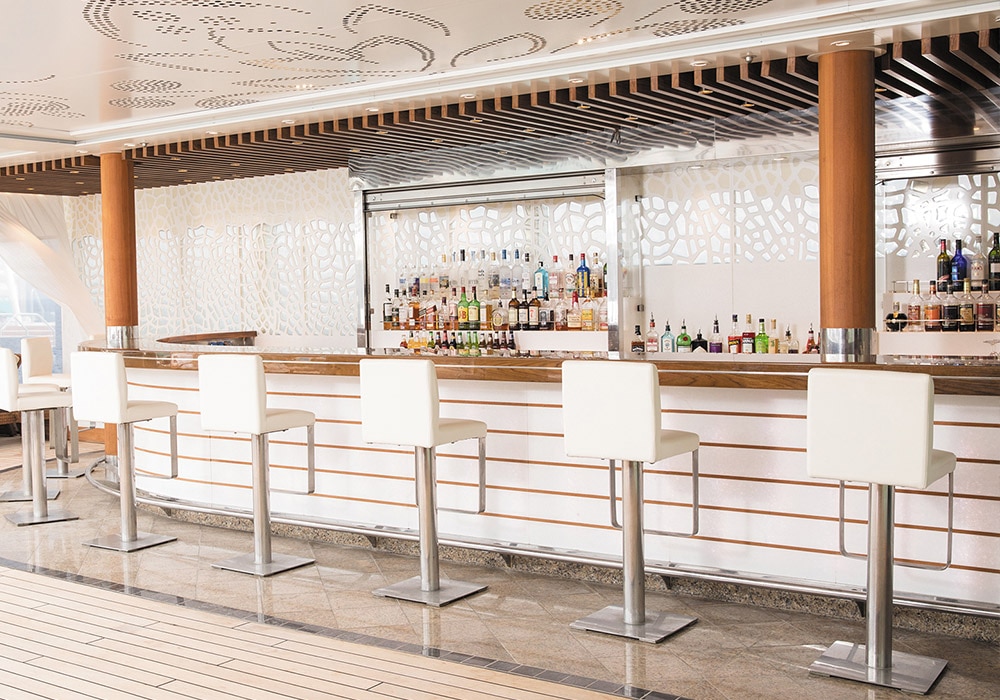
Business Centre
For those who’ve chosen to leave their laptops at home, desktop computers are available at our staffed Business Centre. Of course, you may access WiFi without charge throughout the entirety of the ship.
If you prefer to travel without a laptop, our staffed Business Center offers desktop computers that allow you to access your emails and browse the Internet. Printer access is available for a nominal fee. Seven Seas Explorer® provides WiFi access throughout the ship, allowing you to connect to the Internet with whatever device you’ve brought on board.

Reception & Concierge/General Manager
Turn to the Reception Desk for answers to questions about your Seven Seas Explorer® experience. Our knowledgeable staff is available day and night. You may also contact the ship’s Concierge here.
Our Reception Desk is the place to turn to have your every wish, whim and want fulfilled any time of day or night. Our knowledgeable, personable staff will welcome your questions and work to ensure your Seven Seas Explorer® experience is everything you want it to be. The ship’s Concierge may also be contacted at the Reception Desk.
While cruise-related issues are first submitted to Reception/Concierge, you can be assured that a General Manager is on hand to resolve issues to your satisfaction.
Accountability is a critical aspect of providing you with an unrivalled experience on Regent Seven Seas Cruises®. As a guest you’ll always know where to find our General Manager, whose sole responsibility is making sure things are running as they should — and that includes providing you with superior customer service.
Destination Services
A great resource if you’re keen on making the most of your time in port cities. Visit Destination Services to book a FREE Unlimited Shore Excursion or unique, small-group Regent Choice Shore Excursion.
Whether you’re interested in a tour from our FREE Unlimited Shore Excursion menu or a customisable Regent Choice Shore Excursion, our staff at Destination Services is ready to help you make the most of your time in port cities. Head here for assistance with tailor-made pre-and post-cruise programs, from a simple stay in a luxurious hotel to a 3-night extension that includes private tours of coveted destinations.
Serene Spa & Wellness™
A globally inspired, tranquil haven of health, beauty and wellness, our spa offers restorative treatments and activities that incorporate globally sourced, natural ingredients to soothe both the body and mind.
Serene Spa & Wellness™ is a globally inspired, tranquil haven of health, beauty and wellness, offering restorative treatments and activities to soothe both the body and mind. Strengthen and elevate as you engage with a variety of treatments and services designed to enhance your whole being, from massages, and body wraps to facials, manicures and pedicures and exclusive treatments curated especially for Regent Seven Seas Cruises®.
Pool Deck
On days you wish to lounge by a pool, head here. You’ll be greeted by a Pool Deck with an unforgettable vista, elegant teak accents and an amiable crew offering cold drinks and lounge chairs with plush towels.
When the call of a glistening pool with an unforgettable vista beckons, head to our Pool Deck. Outfitted in teak accents which make it one of the most elegant at sea, the Pool Deck features a lavish pool and two whirlpools. You’ll also find an amiable and dedicated crew standing by to provide refreshing beverages and lounge chairs with plush towels.
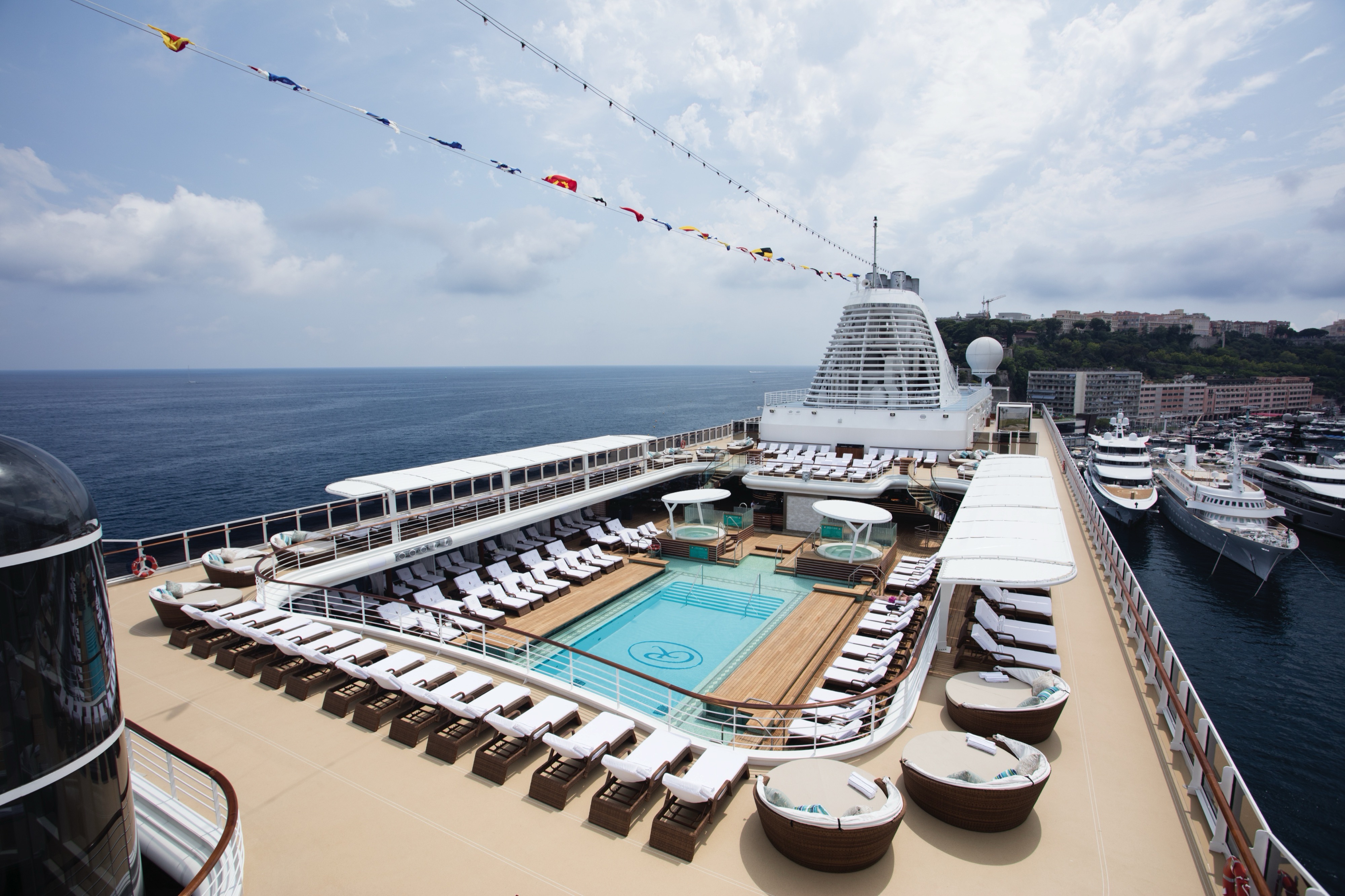
Sports Deck
Practice your golf swing, go for a jog around the track, or gather some new friends for a spirited (but fun) game of bocce ball, all while taking in stunning views and fresh, ocean air.
You may visit our Sports Deck after a relaxing visit to Serene Spa & Wellness™ to jog a few laps around our track or practice your fairway golf swing. Then again, you could head up to Deck 12 after an afternoon cocktail to take on new friends in games of bocce ball or paddle tennis. Whatever you do, you’ll enjoy the freshest ocean air and vistas you’ll never forget.
Infinity Pool
What better way to relax your body and mind than in a refreshing pool with dramatic views every way you turn? Discover this and an inviting teak-deck terrace for yourself, just outside Serene Spa and Wellness™.
Fitness Centre
Look after yourself at sea. Take part in Pilates, yoga and aerobics classes or help yourself to spinning bikes, dumbbells, treadmills, Technogym Strength Machines, workout mats and step benches. For guests 16 and over.
Serene Spa & Wellness™ fitness experts lead popular exercise classes, such as Pilates, yoga and meditation and are on hand to offer advice and demonstrate the use of fitness equipment. Equipment includes spinning bikes, dumbbells, treadmills, Technogym Strength Machines, workout mats and step benches. One-on-one training can be arranged with a fitness instructor. Guests under the age of 16 are not permitted in the Fitness Center.
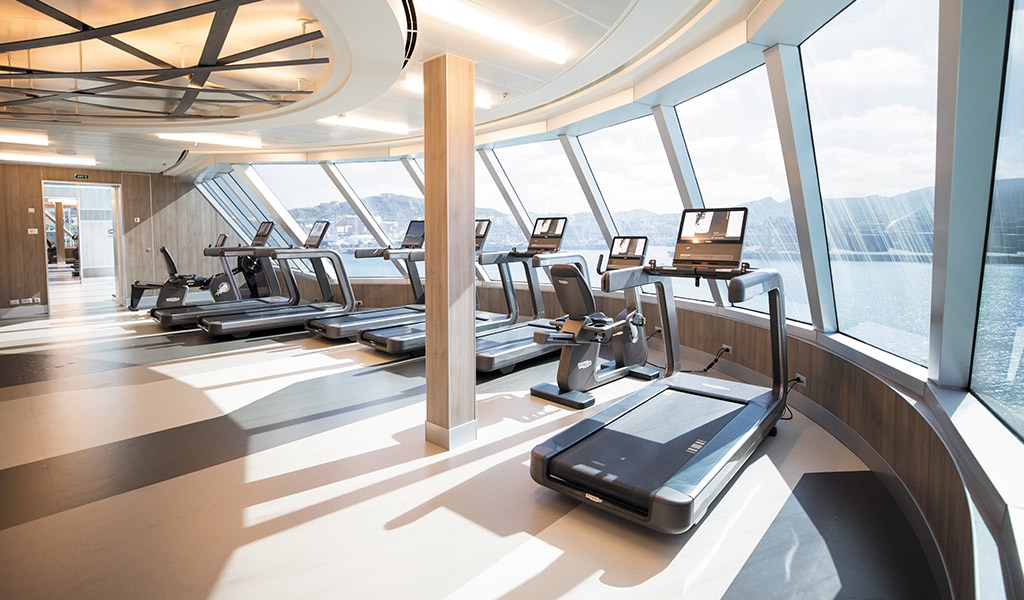
Jogging Track
If you have a regular walking or running routine, fear not – your healthy habit can be maintained while cruising the high seas. Regardless of the speed you traverse our track, dramatic views and fresh air await.
Whether you prefer to start your day with a brisk jog or wait until later and get in an afternoon walk, our Track is a popular destination for those who’ve developed active lifestyles back on dry land. Onboard Seven Seas Explorer® it’s an outstanding place to get your heart pumping while enjoying unforgettable ocean vistas.
Golf Net
If the mood strikes to work on your fairway swing, head to our Golf Net. All equipment is provided for you to practice your swing while soaking up the most glorious views imaginable.
The glorious ocean vistas you’ll admire every day won’t necessarily have you thinking of golf course fairways, but if you find yourself wishing you could be practicing your fairway swing, head to our Golf Net. All the clubs and golf balls you need are available. Who knows? Maybe you’ll return home from your voyage with a few kinks worked out of your golf swing.

Bocce Court
Gather some friends and engage in a game originated in 5,000 BC. Our Bocce Court has the requisite equipment – a pallina and 8 larger balls – for you to engage in a spirited contest as the sun sets.
The originators of bocce ball 7,000 years ago couldn’t have imagined their simple game being played high atop a glorious ocean liner… but you’ll be able to do more than imagine while playing it onboard Seven Seas Explorer®. Bocce ball – also known as Italian lawn bowling – is played with a pallina and 8 larger balls, all of course provided.
Shuffleboard
Probably the game most associated with cruise ships, shuffleboard onboard Seven Seas Explorer® is a more dramatic affair. High atop your ship, you won’t mind awaiting your turn as you take in glorious horizon views.
This isn’t the sleepy version of shuffleboard. From high atop Seven Seas Explorer®, you’ll be enchanted by ocean vistas stretching horizon to horizon as you engage in a game that dates back to 15th-century England. All equipment is well-maintained and available for use — all you have to do is bring a team, or perhaps join one in need of a player.
Paddle Tennis Court
Our completely screened and well-maintained paddle tennis court will beckon you and your teammates to win at all costs – or simply enjoy a fun game of paddle tennis or two.
One look at our Paddle Tennis Court and you’ll know it’s a place of serious competition. All the equipment you need is nearby, the court is completely screened and the surface is immaculate. Whether you find yourself in a tense match or something more leisurely, you and your fellow players will be enjoying fresh ocean air and fantastic views from high atop your ship.

Putting Green
Not nearly as serious as the Golf Net, our Putting Greens invite you to gather friends – perhaps after an afternoon cocktail – for a spirited round of putt-putt golf or two.
While the Golf Net is meant to help you improve your fairway swing, our Putting Greens are less about self-improvement than group fun as your ship travels from one destination to another. A popular pastime is gathering friends after an afternoon cocktail and heading to the top deck of Seven Seas Explorer® for a spirited competition as twilight approaches and a delicious dinner in one of our stellar restaurants looms.
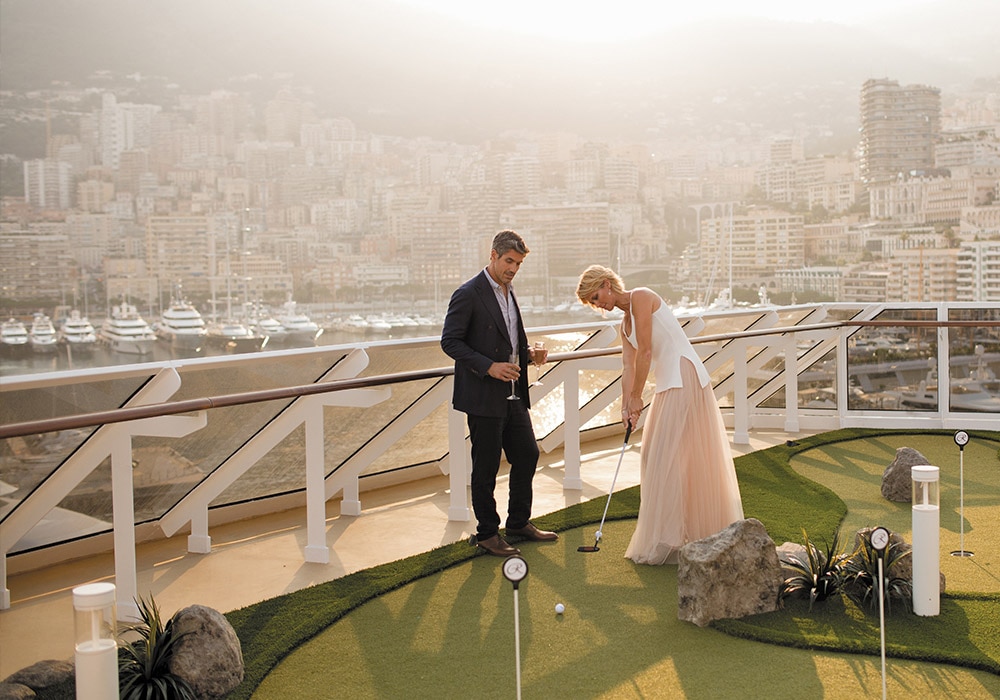
Club Mariner
Families with young travellers will enjoy our Club Mariner Youth Program on select voyages. Children ages 5 to 17 can participate in a range of specialised activities, from mini-putt tournaments to dance parties to movie nights. Each program is designed and supervised by friendly and professional youth counsellors.
Club Mariner is available on select sailings only. Please ask your travel professional for details.
Pacific Rim
Walk past the Tibetan Prayer wheel at the Pacific Rim entrance and be prepared for an evening of culinary perfection with an array of Pan-Asian flavors and dishes. An elegantly exotic eatery.
Maximise your sense of the exotic as you pass a large Tibetan Prayer wheel on your way into Pacific Rim, our dining masterpiece that celebrates the culinary traditions of Asia. Taking a seat beneath huge lanterns and a hand-painted mural covering the entire back wall, you’ll receive a signature cocktail and the promise of an extraordinary culinary journey. Be sure to check out the ocean views through Pacific Rim’s lotus-shaped windows.
Compass Rose
The wondrous colors outside Seven Seas Explorer® are no match for the vivid cobalt-blue glass installation on the ceiling of our elegant Compass Rose, a perfect setting for breakfast and dinner.
We are pleased to re-introduce the elegantly enhanced Compass Rose, the largest specialty restaurant across our fleet. Ensuring a tantalizing mix of new and familiar items on every visit, the new lunch and dinner menus offer a vast selection to meet your discerning tastes. Exclusively aboard Seven Seas Mariner®, Seven Seas Voyager®, and Seven Seas Navigator® for lunch, you may choose from a robust list of appetizers and main courses from our specialty restaurants. And across our fleet for dinner, you have the unique ability to design your very own entrée from preferred sides, sauces, pastas and main features of beef, poultry and fish. This is in addition to sinfully indulgent desserts made by talented bakers and pastry chefs. With daily changing menus, the refreshed Compass Rose offers more choices than ever before.
Pool Grill
When you desire a quick bite after sunbathing or swimming in the pool, our Pool Grill is the place for grilled-to-order burgers, seafood, sandwiches, even hand-dipped ice cream sprinkled with tasty toppings.
The Pool Grill is truly a come-as-you-are venue. Enjoy this casual dining experience whether you’re getting a bite after sunbathing or swimming in the pool. The Pool Grill is open-air, yet abundantly shaded for comfortable dining at lunch or dinner. Enjoy grilled-to-order burgers, grilled seafood, sandwiches, and fresh salads. Treat yourself to milkshakes and malts or an old-fashioned hand-dipped ice cream dessert with toppings.
La Veranda
Located on Deck 11 aft, guests take in stunning ocean views while enjoying elegant breakfast and lunch buffets in the chic indoor dining room or al fresco on the shaded, open-air deck.
Take in stunning ocean views while enjoying elegant breakfast and lunch buffets in the chic indoor dining room or al fresco on the shaded, open-air deck. Breakfasts include traditional favorites, as well as a made-to-order omelet station, a variety of fresh fruits and pastries, along with daily specials, like fluffy Belgian waffles with fresh blueberry compote. For lunch indulge in an array of choices from a bountiful salad bar, gourmet sandwiches, hot carving stations and delicious desserts.
Prime 7
From perfectly aged New York strip, porterhouse and succulent filet mignon to smoked salmon with a phenomenal tamarind-whiskey sauce, Prime 7 elevates classic American fare to lofty heights.
A true classic in every sense, Prime 7 sets a new standard in steakhouse fare with its contemporary interpretation of an American classic. Handsomely decorated with supple leather wing-back chairs, burnished woods and rich earth-toned fabrics, Prime 7 exudes a distinct, intimate elegance. This is sophistication redefined, a luxurious setting to enjoy classic steakhouse cuisine with a modern flair.
All the traditional starters are here, including Jumbo Lump Crab Cakes, Classic Steak Tartare, and Clam Chowder. Of course, beef is the undisputed star, and it is aged for a minimum of 40 days to ensure the ultimate tenderness and juiciness. New York Strip, Porterhouse Steak and succulent Filet Mignon only touch upon the selections. Mouthwatering alternatives include Applewood Smoked Salmon and Dover Sole.
Reservations Required
Sette Mari at La Veranda
Enjoy an extensive menu of authentic antipasti and Italian specialties served á la carte and paired with fine Italian wines. All dishes are prepared with the freshest gourmet ingredients and served by our attentive waiters.
Each evening, La Veranda transforms into Sette Mari at La Veranda, a casual, intimate dining experience. Choose from authentic Italian specialties inspired by family recipes that span generations, or opt for something with a modern twist like a spice-crusted tuna steak with braised endive, polenta and salmoriglio. Savour it all with a perfectly paired Tuscan wine. Sette Mari at La Veranda is open for dinner only.
Chartreuse
A restaurant with a modern French menu and attention to detail you’ll notice in its Parisian décor, expertly prepared dishes and wait staff. About the closest thing to a Parisian culinary gem on the high seas.
Chartreuse evokes memories of a chic Parisian fine dining restaurant discovered during an evening stroll. Wherever you are seated in this regal restaurant, you will be treated to a succulent dinner while enjoying incredible ocean views. The restaurant ambiance is complemented by a menu that features modern French dishes. Available on Seven Seas Grandeur™, Seven Seas Splendor®, Seven Seas Explorer®, Seven Seas Mariner® and Seven Seas Voyager® with reservations each evening for dinner, and open for lunch on Seven Seas Explorer on alternate port days. French bistro style food is offered.
Reservations Required
Coffee Connection
Grab a barista-made coffee, check the headlines of international newspapers or choose from a variety of handmade pastries in our cozy café which is open throughout the day.
Enjoy complimentary coffee drinks prepared by our baristas, as well as delicious pastries, gourmet sandwiches and homemade cookies. Whether perusing international newspapers or simply taking in an always spectacular view, our café is the perfect place to relax, converse and enjoy coffee and snacks throughout the day.
Room Service
Knowing that guests sometimes prefer to simply dine in the comfort of their suites, we offer room service around the clock. Select from an extensive room service menu and the wait staff will promptly serve your order in the comfort of your suite. During normal dining hours, guests may also order from the Compass Rose menu, which changes daily and features Continental, vegetarian, and kosher cuisines. Dinners will be graciously served course-by-course.
The Study
Guests of the most luxurious suite on the high seas — the Regent Suite on Seven Seas Explorer® — have exclusive access to The Study, a private, ornately decorated dining room that seats up to 12 guests.
In an atmosphere that’s reminiscent of a personal library in an elegant, stately home, Regent Suite guests may gather in The Study to privately dine on meals from the adjacent Chartreuse and Prime 7 restaurants. Such an exclusive opportunity further establishes the Regent Suite on Seven Seas Explorer® as the pre-eminent luxury accommodation on the high seas.
Gourmet Explorer Tours
Our distinctive Gourmet Explorer Tours, offered exclusively aboard Seven Seas Explorer, allows guests the unique opportunity to experience the culinary culture of the world’s most delicious destinations. From savouring the authentic flavours of a region to learning new techniques in local cooking classes, guests can choose from a variety of optional tours that take them to local markets to find exotic spices, sample delicious wines at breathtaking estates and savour gourmet meals expertly prepared by renowned chefs. Due to their unique itineraries, Gourmet Explorer tours require a discounted, supplementary charge.
Regent Choice Shore Excursions
Take your experience to another level with the select itineraries and smaller group tours offered by our Regent Choice Shore Excursions. These unique opportunities require a discounted, supplementary charge and invite you to discover the heights of travel, from our Gourmet Explorer Tours to special experiences that take you off the beaten path.
As the name suggests, these excursions work a little harder to engage your explorer spirit. Unique itineraries and smaller groups create more personal experiences… and memories of a lifetime.
UNIQUE, UNPARALLELED EXPERIENCES
Soaring over Alaskan forests and mountains via helicopter en route to feeling the majesty of Mendenhall Glacier beneath your feet. Discover the best our world has to offer through the unparalleled experiences you’ll enjoy with Regent Choice Shore Excursions.
Enhance your shoreside experience with a Regent Choice Small Group tour. Hosting up to 16 guests, these tours provide a more intimate experience and allow for more personal engagement with your knowledgeable guide.
Culinary Arts Kitchen
Step into a welcoming environment, reminiscent of the world’s distinguished culinary institutions in both layout and design, with workstations fully equipped with top-of-the-line induction cooktops, stainless steel sinks and a comprehensive collection of cooking essentials. Guests attending classes in the Culinary Arts Kitchen will receive highly individualised, hands-on instruction. The curriculum will appeal to a wide range of tastes and cater to all levels of aptitude, from beginner to experienced chefs.
Taste, learn and share with the Culinary Arts Kitchen and Regent Seven Seas Cruises®.
Please note: Classes vary by destination and voyage to view voyages and availability click here.
Join expert chefs in a state-of-the-art teaching kitchen on board Seven Seas GrandeurTM, Seven Seas Splendor® or Seven Seas Explorer®. Learn to prepare authentic local recipes, and savour the flavours of the regions you are visiting.
From Our Kitchen, To Yours
Executive Chef and Director of Culinary Enrichment, Kathryn Kelly, has travelled throughout the world, tasting and exploring the many different cuisines and the cultures that create them. Her experience and expertise make her a natural fit to develop the curriculum for the Culinary Arts Kitchen. Exclusively aboard Seven Seas Grandeur®, Seven Seas Splendor®, Seven Seas Explorer® and Seven Seas Prestige™.
The Culinary Arts Kitchen provides everything you need to elevate your culinary skills in a welcoming environment inspired by France’s finest cooking schools. Designed with both style and functionality, the space features fully equipped workstations complete with top-of-the-line induction cooktops, stainless steel sinks, and a comprehensive collection of cooking essentials. Whether you’re a novice in the kitchen or a seasoned chef, you’ll enjoy highly personalised, hands-on instruction from expert instructors.
Culinary Classes Details
ARABESQUE
Based on the travels of Executive Chef Kelly in Morocco and Turkey, this cruise ship cooking class explores the trending culinary traditions and recipes of two ancient and revered cuisines. Learn the basics of tagine cookery and gain an appreciation for how the foods of these two great countries have influenced modern world gastronomy. Learn how to make nut milks and preserved lemons – prized in the Arabesque region and around the world. These cuisines are a favourite amongst our chefs, and the recipes are beyond delicious.
ANYTIME BRUNCH FAVOURITES
Whether celebrating the weekend with a group of friends, spending Sunday watching your favourite sports team or gathering the family for the holidays, brunch is always a great meal for casual, comforting and delicious dishes. Brunch is also a meal we want to host effortlessly, so our chefs have assembled their favorite crowd-pleasing recipes that make brunch a breeze to host. Not a meal to be served without spectacular drinks, this culinary class also features favourite mid-day libations.
BEYOND PATAGONIAN DELICIOUSNESS
The culinary world has its eyes on the cuisine of the Patagonia region. Regarded as the hot new cuisine, chefs have travelled to these remote parts to learn the secrets of Argentine grilling, as well as Chilean roasting and baking. Attend this cook-out class that features delicious and hearty dishes that you will definitely want to make at home to impress your friends. No meal in Patagonia is complete without wine, so a special focus will be made on sampling and pairing the region’s varietals.
BOUNTY OF THE SEA
Fish is something we often order when dining out, but rarely feel comfortable making at home. In this class technique-driven class, master the basics of fish cookery: sauté and grill, deep poach, shallow poach, curing, baking, and healthy pan fry. Your Chef Instructor shares personal tips for purchasing fish from your local fish monger and adding more variety to your favourite fish choices.
EPICURIAN SAFARI
Embark on a culinary safari around the diverse countries of Africa. Enjoy mastering dishes from Morocco, such as tagine and b’stilla. Then head south and learn the secrets of mouth-watering grilled meats from South Africa and Namibia. Like all great safaris, this adventure begins with a delicious and artisan-created gin and tonic.
FIESTA ON THE HIGH SEAS
If you love Mexican food, but are reluctant to cook it at home, then this class is for you! Taking inspiration from Spanish tapas, this class provides a robust menu for a tasty Mexican snacking party, including a lesson on how to make the perfect Mexican cocktails.
FRESH HEALTHY COMFORT KITCHEN
This class was designed in collaboration with Canyon Ranch® with a focus on healthy eating. Discover the secrets and methods for preparing foods that are flavourful, comforting, plentiful…and good for you. From ingredients to cooking methods, learn the many ways you can maintain a healthy kitchen — while serving fabulous food — at home.
LA TECHNIQUE FRANCAISE
As the cuisine against which all others are compared, this class is designed around the pillars of classic French culinary technique. Learn the difference between French bistro and haute cuisine as you explore the various regional cuisines of France. Steeped in the fundamentals this class focuses on classic techniques designed to elevate your kitchen skills at home. Sample two French wines and learn the art of pairing French food and wine.
MASTER OF FIRE, HEAT & GRILL
Mastering the skill of cooking with high heat — whether on a grill or in a sauté pan — is at the core of this popular cruise ship cooking class. From achieving the perfect sear marks on a rib eye to bringing forth the flavour-enhancing char of a grilled flatbread, your Chef Instructor teaches techniques for perfect high heat cooking every time. Also learn how to use a digital thermometer, achieving internal cooking temperatures and the pillars of perfect protein cookery.
MASTERING KNIFE SKILLS
Regent Seven Seas Cruises® partnered with Zwilling Company, the makers of the chef-favorite J.A. Henckels knives, to develop one of our top guest-requested classes: Mastering Knife Skills. You’ll get a chef’s look at a complete pantry of knives and enjoy the chance to try out a few chef knives to discover the best option for you. You’ll also learn how to sharpen and maintain this essential kitchen tool, practice various knife cuts and discover how to safely use the mandolin slicer. At the conclusion of your class, you’ll receive a special Knife Skills certificate along with a savings voucher for your favourite Zwilling Company knives.
MEDITERRANEAN MELODY
The Mediterranean is revered for its cuisine and this culinary class allows you to take a virtual trip around region, celebrating signature dishes of Greece, Israel, France, Spain, Italy, Turkey, and Morocco. Each class is a reflection of your Chef Instructor’s personal favourites from their years of tasting and travelling across the Mediterranean. Expand your food and wine repertoire as part of this enrichment programme.
NORTHERN LIGHTS
Our chefs have collected their favourite recipes from Finland, Iceland and Norway to create this class that matches culinary delights to the extraordinary sight of the Northern Lights. In recent years, the culinary world has followed these trending cuisines as many of the world’s most revered chefs fuse traditional recipes with innovative ingredients and cooking methods. A highlight of the class is our signature sparkling cocktail celebrating the auroras.
PASTA PASTA PASTA
This class is a celebration of the mouthwatering mainstay dish of Italian cuisine — pasta. Pasta is traditionally served for lunch or at dinner as the second course, or secondi, in most Italian homes. Learn the fundamentals of making this dish in a traditional way, from dry and fresh pasta to pasta cookery and favourite sauces, and impress your friends and family with this new skill when you return home.
PERFECTLY SAUCED & TOSSED
Most chefs will confess that the secret to finishing most dishes is the sauce — sometimes taking years to achieve. A perfectly executed sauce is as elemental to French cuisine as a great dressing is to a composed salad. This class focuses on the nuisances of sauces and emulsions, all while mastering some delicious dishes. If you have ever wanted to learn the secrets of the classic French pan sauce or understanding the magic of vinegars and extra virgin olive oil, then this is the class for you.
A TASTE OF SPAIN
For centuries, beginning with the migration of the Moors followed by the explorers returning to Spain from the New World, Spain has held court as the epicenter of the culinary universe. Modern Spanish chefs have transformed traditional dishes through molecular gastronomy while maintaining a reverence for traditional tapas and dishes like Valencian paella. Learn to enlighten your home kitchen with some of Spain’s signature dishes, wines and of course — the festive Sangria.
SIMPLE & ELEGANT DINNER PARTY
Our Chef Instructors are frequently asked about their personal favourite dishes that they enjoy making at home. In response, they assembled some of those simple yet elegant recipes to transform the Culinary Arts Kitchen into an elegant dinner party. Take what you learn to your home kitchen and impress your friends when you return by hosting your own dinner party, complete with exquisite wine pairings.
THE CONTENTED VIKING
Culinary historians have seen a renewed interested in the Viking diet in recent years with the emergence in popularity of lower carbohydrate diets, such as the Paleo Diet. The diet of modern Nordic countries continues to feature clean, sustainable and seasonal food. In this class learn about recipes that are famously celebrated at the top restaurants across Denmark, Norway and Sweden. Indulging in the Swedish Glogg is reason enough to join the class!
THE PERFECT PAIR
As luxury travellers, we indulge in fine wines paired with delicious food, which is the main focus of this class. Whether you are interested in learning how to properly select the right wine for your preferred dish or are searching for the right meal to pair with your absolute favourite wine, this class will expand your horizons. Your curriculum includes cooking several recipes and then pairing them with wines to explore how different varietals complement the dishes.
YAYA’S GREEK FEAST
Greeks are famous for their home-cooked, savory and generously portioned meals with family gathered — singing, dancing and eating! Greek recipes are passed down from Yaya (grandmother) by showing rather than writing down recipes. So, we recreated those hands-on recipes from our favorite yayas from Santorini, Crete, Rhodes, Corfu, and Athens for this popular cooking class. Learn to make healthy, comforting Greek-inspired dishes, imbibe in our favorite Cretan Rose cocktail and plan your next party around the recipes you master.
1493: THE FOODIES’S NEW WORLD
Delight in learning about the evolution of the Mediterranean cuisine when new ingredients were introduced after the Portuguese and Spanish returned from exploring “The New World.” Discover the way tomatoes, potatoes, corn, peppers, chocolate, blueberries, and zucchini (to name a few) found their way into the Mediterranean diet and changed their traditional dishes for the better.
Eco-Connect Tours
Eco-Connect Tours invite you to discover and experience how local communities and groups are endeavouring to conserve, sustain and improve the environments they live in.
Engage with local groups and businesses to learn about how they are transforming the world around them while experiencing the impact of their efforts first-hand.
CONNECT & GROW
Our Eco-Connect Tours provide enriching opportunities to interact with and learn from local communities around the world as they work to conserve and sustain their surrounding environments.
Discover the valuable and beautiful flora and fauna of places like Costa Rica, Vietnam and Australia. Sample the products of sustainable farming practices in regions like France, New Zealand and Argentina. Absorb the inspiring innovations in energy production at facilities in Portugal, Iceland and Japan. This is only a sampling of the more than 150 unique Eco-Connect Tours we offer.
Reinvigorate your love for the world around you with these insightful experiences — many of which are available as part of our FREE Unlimited Shore Excursions.
Behind The Design Tours
Every captivating design has a story to tell. Join us as we go Behind the Design to explore how and why some of the world’s great architectural designs came to be.
Glimpse behind the scenes of some of the most captivating and brilliant designs around the world.
BRILLIANT ARCHITECTURAL ACHIEVEMENTS
Our Behind the Design Tours invite guests to go beyond the surface and into the beauty of the design processes and inspirations that made some of the world’s most fascinating architectural structures.
Explore a myriad of architectural marvels across Europe and the Mediterranean, including buildings like the Munchmuseet in Oslo, Norway, the MuCEM in Marseille, France, Toree Glòries in Barcelona, and many more. This is only a sampling of the Behind the Design Tours available, with many more to come.
Expand your appreciation for architecture and design with these intriguing explorations — many of which are available as part of our FREE Unlimited Shore Excursions.
Go Local Tours
Uncover off-the-beaten-path experiences with our Go Local Tours providing a more direct way for you to learn the culture of a destination through the communities within. Spend a day at a family-owned goat farm in the countryside of Andalusia to learn the generations-old way of making cheese or observe skilled, local artists in their personal studios on Palma de Mallorca. Experience the world through the eyes of those who actually live there and discover the best of what you didn’t know about your favourite destinations with Go Local Tours.
Sometimes the best solution for the well-traveled guest and anyone looking to uncover off-the-beaten-path places and experiences is to start thinking like a local.
CULTURAL DISCOVERY
Go Local Tours provide a more direct way for you to experience the culture of a destination through the communities within. Spend a day at a family-owned goat farm in the countryside of Andalusia to learn the generations-old way of making cheese, discover the joy of fishing with the residents of Portofino or observe skilled local artists in their personal studios on Palma de Mallorca. Many Go Local tours are part of our Unlimited Shore Excursions, while some require a discounted, supplementary charge. Experience the world through the eyes of those who actually live there and discover the best of what you didn’t know about your favourite destination with Go Local Tours.
In-Port Overnights
Evenings provide a different view of a city as the streets light up and the locals unwind. Discover the fun of a destination’s nightlife and enjoy more time ashore with more overnights in ports across every region of the world.
LET THE NIGHTTIME SET YOU FREE
Celebrate sunsets and ease into moonrises as locals cut loose and skylines twinkle in the world’s great cities. You’re free to pursue your passions – from elegant dining to after-hour museum tours. It’s not just port cities that transform after dark. Regent in-port overnighters do, too. After the exhilaration of daytime excursions, sunset releases you to do as you please and sway to a city’s rhythms.
Spotlight Voyages
Explore your destination through special excursions and onboard experiences tailored to the spotlighted theme of your cruise. Hear from captivating speakers, renowned in their respective fields across multiple areas of interest, from culinary masters to renowned vintners to entertainment icons and beyond.
Embark on a journey of discovery with our Spotlight Voyages — tailored experiences designed to ignite your passions and curiosities. Whether you’re a wine enthusiast or a gourmand, these immersive cruises promise unforgettable adventures. Imagine savoring dishes made by award-winning Chefs, mastering your swing alongside a golf pro on legendary courses, or delving into the history of Fabergé eggs.
Don’t miss these one-of-a-kind onboard and shoreside opportunities. Mention promotional or offer code “SPO” when booking to unlock complimentary Spotlight Voyage programming.
Unlimited Shore Excursions Included
Every destination we sail to harbours treasured experiences waiting to be unearthed. And there’s no better way to dig in than by taking advantage of our hallmark inclusion of thousands of wonderful, Unlimited Shore Excursions.
MAKE YOUR VACATION YOUR OWN
When your feet touch the ground, your cruise enters a new dimension. What’s your preference? Exploring the world’s great cities? Immersing yourself in local culture? Or indulging your inner beach bum? Over 4,500 Unlimited Shore Excursions across every region of the world allow you to embrace it all.
Wherever you’re traveling, opportunities to maximise memories abound. Whether it’s urban adventures brimming with history, architecture and culture or escapes to natural wonders that stagger the senses, our Unlimited Shore Excursions guarantee your vacation will be like no other. Start dreaming today.
Epicurean Explorer Tours
Taste the cultures of the world with our specially curated, Master Chef-led, Epicurean Explorer Tours, unique to sailings aboard Seven Seas Splendor® and Seven Seas Explorer®. Be treated to a particularly French dining experience with Michelin-starred Master Chef René Bérard at his private estate along with a Provençal cooking demonstration in Provence or be led through the open-air, seaside market in Nice and partake in an exquisite lunch at Château Eza in Eze. Please your palate and expand your culinary knowledge with each of our delectable Epicurean Explorer Tours.
Outside of a stellar local expert, our noses may be our best guides to places beloved by foodies. Market spices drifting on a breeze, sizzling street foods, wine poured in a sun-kissed vineyard – these smells forever recall a destination as much as any photo or souvenir.
CHEF-LED SHORESIDE EXCURSIONS
Allow our chefs to be your guides on these specially crafted small-group experiences. Discover vibrant ancient markets, sample world-class restaurants, incorporate new learnings in the kitchen, and more. Exclusive aboard Seven Seas Explorer®, Seven Seas Splendor® and Seven Seas Grandeur™, these curated tours require a discounted supplementary charge.
Serene Spa & Wellness™ Tours
Transcend the moment as you expand your mind and strengthen your body with a Serene Spa & Wellness Tours. Soak in a restorative, mineral-rich thermal spring in Rome or centre your chi with a taiji (tai chi) class on a beautiful and serene beach on Palma de Mallorca. Be refreshed by a Mediterranean breeze as you calm your mind and strengthen your focus through a yoga class overlooking the seaside town of Taormina. Restore and heal your mind, body and soul as you travel throughout the world with our Serene Spa & Wellness Tours.
To further enhance your vacation, our Wellness program allows you to enjoy a holistic experience from beginning to end, from complimentary fitness classes and healthy gourmet cuisine on board to Wellness Tours.
A HOLISTIC, REJUVENATING DISCOVERY
These tours allow you to discover the incredible destinations we visit while maintaining your active and healthy lifestyle. Practice yoga against a stunning backdrop in Taormina, learn about apitherapy, a school of alternative medicine based on bee products, or practice meditation on the idyllic island of Palma de Mallorca. Many Wellness Tours are part of our FREE Unlimited Shore Excursions, while some require a discounted, supplementary charge.
Executive Collection & Bespoke Travel Arrangements
Envision your perfect day of sightseeing and exploring your destination exactly as you’d like… Creating your own, customised excursions is possible. Whether you’re looking to engage a private vehicle from our Executive Collection with a personal driver and/or English-speaking guide or hoping to develop a truly bespoke experience with our elite concierge team, we welcome the opportunity to help you create your perfect journey.
You choose the locales – we’ll provide the private transport. Our Executive Collection frees you to explore ports of call with a driver and/or English-speaking guide, the ultimate way to maximise your time onshore. Whether heading out to a city’s outskirts or taking off along spectacular coastlines, you’ll accrue lifelong memories by the mile (or kilometre).
MAKE YOUR VACATION YOUR OWN
Excitement builds each time a Regent Seven Seas’ cruise ship approaches a port city. Let your excitement skyrocket with a car, driver and/or English-speaking guide awaiting you onshore. Where do you go? Across the Charles River to explore Cambridge, Boston’s academic neighbour? Along Monaco’s famed Formula 1 route? Across Sydney’s iconic Harbour Bridge? Only you know for sure.
Customise Your Journey
Enhance your cruise by adding another layer of luxury to your travel with any of the multiple options we offer. Select from a variety of enhancements like immersive Land and Overland Programs, Pre- and Post-Cruise Hotel Programs and air upgrades.
PERSONALISED CRUISE EXPERIENCE
Take your all-inclusive luxury travel to the next level by personalising it. Select from a variety of enhancements like our Regent Choice Shore Excursions, Pre- and Post-Cruise Hotel Programmes and air upgrades. Embark on a specially-designed, luxury vacation that offers an experience unlike any other as you explore the cultures, sights and cuisines of your destination. Enjoy it all with The World’s Most Inclusive Luxury Experience® across air, land and sea.
Featured Guest Entertainers & Speakers
Experience world-class entertainment and engage with esteemed experts on a journey of inspiration and discovery. This immersive experience invites you to delve into meaningful dialogue, while each performance is thoughtfully curated to captivate and uplift. Throughout your voyage, enjoy a front-row seat to brilliance.
When you travel with a distinguished guest Speaker, knowledge sets sail with you. Engage with esteemed experts, from celebrated art historians and acclaimed authors to former diplomats and cultural icons. This immersive experience invites you to delve into meaningful dialogue and connect personally with our Speakers throughout your entire journey.
Featured Guest Entertainers and Speakers are scheduled in advance and are subject to change without notice due to unforeseen circumstances beyond our control.
Bridge at Sea
Enjoy social and competitive Bridge play on select voyages. ACBL Certified Bridge Masters sail with guests to provide professional instruction and host games for all levels.
luxury is in the cards
Enjoy social and competitive Bridge play on more than 93 of Bridge at Sea Voyages aboard The World’s Most Luxurious Fleet®. Sail to breathtaking destinations alongside Bridge Masters, who provide professional instruction and host games for all levels — in addition to being knowledgeable and entertaining professionals. Our ships are ACBL Certified, which means you can accumulate master points while cruising to the places you’ve always dreamed of exploring.
Explorer Lounge
The perfect spot to begin or end an evening, our Explorer Lounge inspires intimate conversations over perfectly mixed cocktails at an elegant, black marble bar while resident musicians play soothing live music.
With rich mahogany wood columns, heavy leather chairs and deep blue fabrics, the atmosphere here is conducive to intimate conversations and bonhomie. Relax to familiar tunes and special requests performed by our resident musicians from an intimate stage arched with a golden proscenium. A perfect spot to meet new friends for a pre- or post-dinner cocktail at the elegant, black marble bar.
Observation Lounge
With musicians performing throughout the day and night, captivating décor and floor-to-ceiling windows, you’ll be instantly drawn to this chic yet comfortable lounge as you unwind with a cocktail and jovial conversation.
Walk through a black and gold-lit tunnel and be instantly captivated. This chic yet comfortable lounge features an impressive bar, dazzling geometric ceiling, ample seating and floor-to-ceiling windows that create a magical atmosphere. Musicians perform throughout the day, creating an alluring vibe that sets just the right mood as you unwind with a pre-dinner cocktail or satisfying nightcap.
Constellation Theater
Even before the lights drop and a lavishly staged, high-energy show begins, you’re greeted by a Gatsby-esque atmosphere of glamor and sophistication as you enter our Constellation Theatre.
A dazzling staircase mosaic creates a Gatsby-esque atmosphere as you enter our Constellation Theater, a space so grand it takes up two decks. Perfectly tiered for pleasing sightlines and furnished with plush seating, the main show lounge is an intimate venue without a bad seat in the house. Performances vary from full-scale musical revues to rousing singalongs, all backed by our incredible, five-piece Regent Signature Orchestra.
Connoisseur Club
Engage in spirited conversation with new friends in an elegant hideaway that calls to mind gentleman’s clubs of old. An elegant throwback where cigars are savored, you’ll take to like a favorite cardigan.
Maybe it’s the deep blue walls that give the Connoisseur Club such a gentile, old-fashioned feel. Or maybe it’s the collection of impossible comfortable leather armchairs. Whatever it is, this is a relaxing spot for you and new friends to enjoy a fine cigar and sip cognac (both are available for purchase) in classic gentleman’s club environs. Smoking is permitted in the club.
Atrium
Simply put, the Atrium is the very heart of Seven Seas Explorer®. Natural light cascades from above but it’s a magnificent chandelier shining like a glowing star that steals the show.
Often described as the crossroads of the ship, our Atrium is an inspiring testament to the grandeur of luxury ocean travel. Cascading stairwells make it a natural gathering place for guests, but convenience alone doesn’t begin to describe its magnetic appeal. On Seven Seas Explorer® a spectacular chandelier hovers like a glowing star, enhancing the natural light shining down from far above.
The Casino
Enjoy the elegance and excitement of a Monte Carlo-style casino. Stride through the Casino’s glass doors to an elegant setting abuzz with Blackjack, roulette, poker, as well as slot machines.
Get a taste of Monte Carlo excitement at our Casino directly across from the equally inspiring Explorer Lounge. Walk through glass doors into an elegant setting bustling with games of chance that include Blackjack, roulette, poker, as well as slot machines. The Casino is open every day at sea when not restricted by territorial border limits.
Meridian Lounge
A popular spot for informal gatherings over impromptu cocktails, you may find yourself here after a thrilling theater experience. Meridian Lounge is a spacious, friendly space with an expansive bar and live music at night.
Situated along a lively hallway, Meridian Lounge is a natural place to gather with others for an afternoon or early evening cocktail. Elegantly appointed and comfortably furnished, it boasts an expansive bar and relaxed armchairs that beckon conversation. A popular spot to catch your breath after a dazzling Constellation Theatre show, this lively spot invites you to extend your evening with virtuoso performances by resident musicians.
Card Room
Clubby and comfortable, our Card Room is a charming spot for you and new friends to gather for friendly competition in elegant surroundings.
An inviting and tranquil oasis dedicated to the pure pleasure of playing games. Our beautifully decorated Card Room sits across from Observation Lounge, and it’s not unusual for guests to go from one fun space to the other. Gather your favourite teammates in the Card Room for a lively afternoon or evening of board games, a social game of Bridge or to participate in an ACBL Tournament on select voyages.
Library
Choose from a large selection of reading material in our Library, a relaxing retreat dedicated to calming the senses as well as stimulating the brain.
Well-stocked and exceedingly comfortable, you’ll immediately feel at ease within the Library’s calm setting. Browse a vast collection of volumes, from destination-specific guide books to best-selling mysteries to classics of literature, on a variety of comfortable chairs. Conveniently located across from the Card Room, our library is a welcoming, low-key treasure you just may find hard to leave.
Boutique
Perhaps it’s a dress to wear for dinner or a piece of jewellery that calls your name. Our boutique items are carefully selected, providing you with quality handbags, fragrances and clothes to give as gifts… or give yourself.
Whether looking for something special to wear for dinner or a memento for friends and family back home, you’re bound to be tempted by the designer garments and fashionable accessories in our shops. Relax as you browse a wide range of items – upscale handbags to exclusive fragrances to fine jewellery and more – in an intimate and unhurried setting.
Pool Bar
Very few things equate to a pure vacation activity more than sitting at our Pool Bar. Make new friends while sipping a cocktail or frozen drink in the most laid-back atmosphere imaginable.
When you envision an activity you’re only likely to do while on vacation, sipping a frozen drink at a pool bar onboard a glorious cruise ship is probably near the top of the list. You can tick that box at our Pool Bar, where you and new friends can enjoy leisurely conversation over cocktails and frozen drinks in a delightfully relaxed atmosphere.
Business Centre
For those who’ve chosen to leave their laptops at home, desktop computers are available at our staffed Business Centre. Of course, you may access WiFi without charge throughout the entirety of the ship.
If you prefer to travel without a laptop, our staffed Business Center offers desktop computers that allow you to access your emails and browse the Internet. Printer access is available for a nominal fee. Seven Seas Explorer® provides WiFi access throughout the ship, allowing you to connect to the Internet with whatever device you’ve brought on board.
Reception & Concierge/General Manager
Turn to the Reception Desk for answers to questions about your Seven Seas Explorer® experience. Our knowledgeable staff is available day and night. You may also contact the ship’s Concierge here.
Our Reception Desk is the place to turn to have your every wish, whim and want fulfilled any time of day or night. Our knowledgeable, personable staff will welcome your questions and work to ensure your Seven Seas Explorer® experience is everything you want it to be. The ship’s Concierge may also be contacted at the Reception Desk.
While cruise-related issues are first submitted to Reception/Concierge, you can be assured that a General Manager is on hand to resolve issues to your satisfaction.
Accountability is a critical aspect of providing you with an unrivalled experience on Regent Seven Seas Cruises®. As a guest you’ll always know where to find our General Manager, whose sole responsibility is making sure things are running as they should — and that includes providing you with superior customer service.
Destination Services
A great resource if you’re keen on making the most of your time in port cities. Visit Destination Services to book a FREE Unlimited Shore Excursion or unique, small-group Regent Choice Shore Excursion.
Whether you’re interested in a tour from our FREE Unlimited Shore Excursion menu or a customisable Regent Choice Shore Excursion, our staff at Destination Services is ready to help you make the most of your time in port cities. Head here for assistance with tailor-made pre-and post-cruise programs, from a simple stay in a luxurious hotel to a 3-night extension that includes private tours of coveted destinations.
Serene Spa & Wellness™
A globally inspired, tranquil haven of health, beauty and wellness, our spa offers restorative treatments and activities that incorporate globally sourced, natural ingredients to soothe both the body and mind.
Serene Spa & Wellness™ is a globally inspired, tranquil haven of health, beauty and wellness, offering restorative treatments and activities to soothe both the body and mind. Strengthen and elevate as you engage with a variety of treatments and services designed to enhance your whole being, from massages, and body wraps to facials, manicures and pedicures and exclusive treatments curated especially for Regent Seven Seas Cruises®.
Pool Deck
On days you wish to lounge by a pool, head here. You’ll be greeted by a Pool Deck with an unforgettable vista, elegant teak accents and an amiable crew offering cold drinks and lounge chairs with plush towels.
When the call of a glistening pool with an unforgettable vista beckons, head to our Pool Deck. Outfitted in teak accents which make it one of the most elegant at sea, the Pool Deck features a lavish pool and two whirlpools. You’ll also find an amiable and dedicated crew standing by to provide refreshing beverages and lounge chairs with plush towels.
Sports Deck
Practice your golf swing, go for a jog around the track, or gather some new friends for a spirited (but fun) game of bocce ball, all while taking in stunning views and fresh, ocean air.
You may visit our Sports Deck after a relaxing visit to Serene Spa & Wellness™ to jog a few laps around our track or practice your fairway golf swing. Then again, you could head up to Deck 12 after an afternoon cocktail to take on new friends in games of bocce ball or paddle tennis. Whatever you do, you’ll enjoy the freshest ocean air and vistas you’ll never forget.
Infinity Pool
What better way to relax your body and mind than in a refreshing pool with dramatic views every way you turn? Discover this and an inviting teak-deck terrace for yourself, just outside Serene Spa and Wellness™.
Fitness Centre
Look after yourself at sea. Take part in Pilates, yoga and aerobics classes or help yourself to spinning bikes, dumbbells, treadmills, Technogym Strength Machines, workout mats and step benches. For guests 16 and over.
Serene Spa & Wellness™ fitness experts lead popular exercise classes, such as Pilates, yoga and meditation and are on hand to offer advice and demonstrate the use of fitness equipment. Equipment includes spinning bikes, dumbbells, treadmills, Technogym Strength Machines, workout mats and step benches. One-on-one training can be arranged with a fitness instructor. Guests under the age of 16 are not permitted in the Fitness Center.
Jogging Track
If you have a regular walking or running routine, fear not – your healthy habit can be maintained while cruising the high seas. Regardless of the speed you traverse our track, dramatic views and fresh air await.
Whether you prefer to start your day with a brisk jog or wait until later and get in an afternoon walk, our Track is a popular destination for those who’ve developed active lifestyles back on dry land. Onboard Seven Seas Explorer® it’s an outstanding place to get your heart pumping while enjoying unforgettable ocean vistas.
Golf Net
If the mood strikes to work on your fairway swing, head to our Golf Net. All equipment is provided for you to practice your swing while soaking up the most glorious views imaginable.
The glorious ocean vistas you’ll admire every day won’t necessarily have you thinking of golf course fairways, but if you find yourself wishing you could be practicing your fairway swing, head to our Golf Net. All the clubs and golf balls you need are available. Who knows? Maybe you’ll return home from your voyage with a few kinks worked out of your golf swing.
Bocce Court
Gather some friends and engage in a game originated in 5,000 BC. Our Bocce Court has the requisite equipment – a pallina and 8 larger balls – for you to engage in a spirited contest as the sun sets.
The originators of bocce ball 7,000 years ago couldn’t have imagined their simple game being played high atop a glorious ocean liner… but you’ll be able to do more than imagine while playing it onboard Seven Seas Explorer®. Bocce ball – also known as Italian lawn bowling – is played with a pallina and 8 larger balls, all of course provided.
Shuffleboard
Probably the game most associated with cruise ships, shuffleboard onboard Seven Seas Explorer® is a more dramatic affair. High atop your ship, you won’t mind awaiting your turn as you take in glorious horizon views.
This isn’t the sleepy version of shuffleboard. From high atop Seven Seas Explorer®, you’ll be enchanted by ocean vistas stretching horizon to horizon as you engage in a game that dates back to 15th-century England. All equipment is well-maintained and available for use — all you have to do is bring a team, or perhaps join one in need of a player.
Paddle Tennis Court
Our completely screened and well-maintained paddle tennis court will beckon you and your teammates to win at all costs – or simply enjoy a fun game of paddle tennis or two.
One look at our Paddle Tennis Court and you’ll know it’s a place of serious competition. All the equipment you need is nearby, the court is completely screened and the surface is immaculate. Whether you find yourself in a tense match or something more leisurely, you and your fellow players will be enjoying fresh ocean air and fantastic views from high atop your ship.
Putting Green
Not nearly as serious as the Golf Net, our Putting Greens invite you to gather friends – perhaps after an afternoon cocktail – for a spirited round of putt-putt golf or two.
While the Golf Net is meant to help you improve your fairway swing, our Putting Greens are less about self-improvement than group fun as your ship travels from one destination to another. A popular pastime is gathering friends after an afternoon cocktail and heading to the top deck of Seven Seas Explorer® for a spirited competition as twilight approaches and a delicious dinner in one of our stellar restaurants looms.
Club Mariner
Families with young travellers will enjoy our Club Mariner Youth Program on select voyages. Children ages 5 to 17 can participate in a range of specialised activities, from mini-putt tournaments to dance parties to movie nights. Each program is designed and supervised by friendly and professional youth counsellors.
Club Mariner is available on select sailings only. Please ask your travel professional for details.
About the Ship
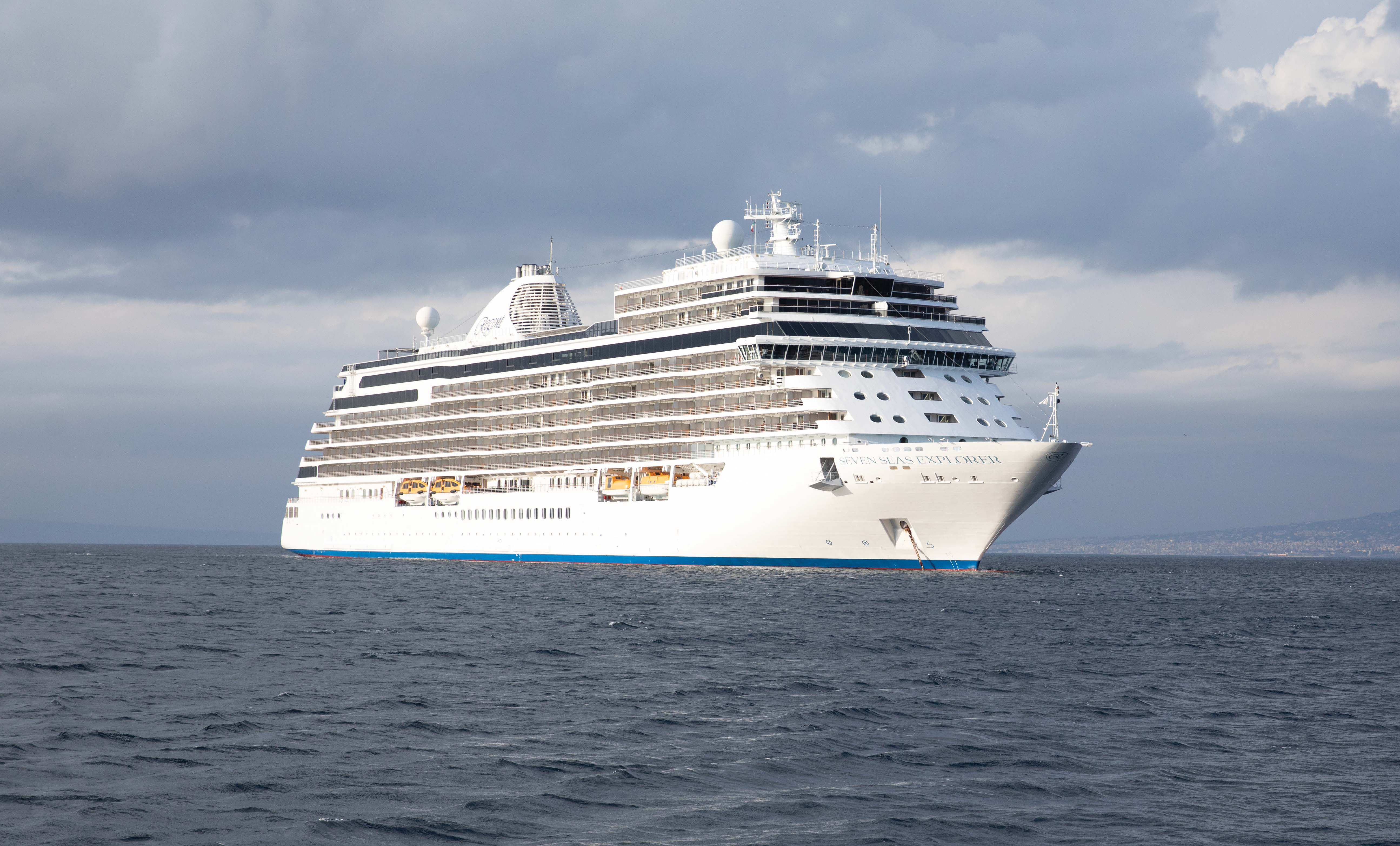
Deck Plans

- Constellation Theatre
- Boutiques
- Explorer Lounge
- Atrium
- The Casino
- Compass Rose

- Constellation Theatre
- General Manager
- Business Centre
- Destination Services
- Atrium
- Reception & Concierge
- Meridian Lounge
- Coffee Connection
- Pacific Rim
- Serene Spa & Wellness
- Infinity Pool

- Fitness Centre
- Penthouse Suites
- Concierge Suites
- Deluxe Veranda Suites
- Veranda Suites
- Launderette

- Penthouse Suites
- Seven Seas Suites
- Serenity Suites
- Concierge Suites
- Veranda Suites
- Deluxe Veranda Suites
- Grand Suites (Aft)

- Penthouse Suites
- Seven Seas Suites
- Signature Suites
- Concierge Suites
- Serenity Suites
- Deluxe Veranda Suites

- Grand Suites
- Penthouse Suites
- Serenity Suites
- Explorer Suites
- Concierge Suites
- Deluxe Veranda Suites

- Concierge Suites
- Explorer Suites
- Penthouse Suites
- Grand Suites (Forward)
- Serenity Suites
- Chartreuse
- Prime 7
- The Study

- Observation Lounge
- Card Room
- Connoisseur Club
- Library
- Culinary Arts Kitchen
- Pool Bar
- Smoking Area
- Pool Deck
- Pool Grill
- La Veranda/Sett Mari
- La Veranda

- Grand Suites
- Penthouse Suites
- Explorer Suites
- Concierge Suites
- Jogging Track
- Golf Nets
- Sports Deck
- Shuffle Board
- Bocce Court
- Paddle Tennis Court
- Putting Green

- Regent Suite
- Penthouse Suites
- Concierge Suites
- Constellation Theatre
- Boutiques
- Explorer Lounge
- Atrium
- The Casino
- Compass Rose
- Constellation Theatre
- General Manager
- Business Centre
- Destination Services
- Atrium
- Reception & Concierge
- Meridian Lounge
- Coffee Connection
- Pacific Rim
- Serene Spa & Wellness
- Infinity Pool
- Fitness Centre
- Penthouse Suites
- Concierge Suites
- Deluxe Veranda Suites
- Veranda Suites
- Launderette
- Penthouse Suites
- Seven Seas Suites
- Serenity Suites
- Concierge Suites
- Veranda Suites
- Deluxe Veranda Suites
- Grand Suites (Aft)
- Penthouse Suites
- Seven Seas Suites
- Signature Suites
- Concierge Suites
- Serenity Suites
- Deluxe Veranda Suites
- Grand Suites
- Penthouse Suites
- Serenity Suites
- Explorer Suites
- Concierge Suites
- Deluxe Veranda Suites
- Concierge Suites
- Explorer Suites
- Penthouse Suites
- Grand Suites (Forward)
- Serenity Suites
- Chartreuse
- Prime 7
- The Study
- Observation Lounge
- Card Room
- Connoisseur Club
- Library
- Culinary Arts Kitchen
- Pool Bar
- Smoking Area
- Pool Deck
- Pool Grill
- La Veranda/Sett Mari
- La Veranda
- Grand Suites
- Penthouse Suites
- Explorer Suites
- Concierge Suites
- Jogging Track
- Golf Nets
- Sports Deck
- Shuffle Board
- Bocce Court
- Paddle Tennis Court
- Putting Green
- Regent Suite
- Penthouse Suites
- Concierge Suites